Audio myths put to the test: 9 questions from your comments
To Episode 1 of our podcast You filled the comments section with praise, disagreement, and some pretty good technical questions. In episode 2, Dennis Kreutzberg and I take a closer look at these comments and examine nine common audio myths and points of contention – from low-cut on every track to EQ sweeps and -14 LUFS.
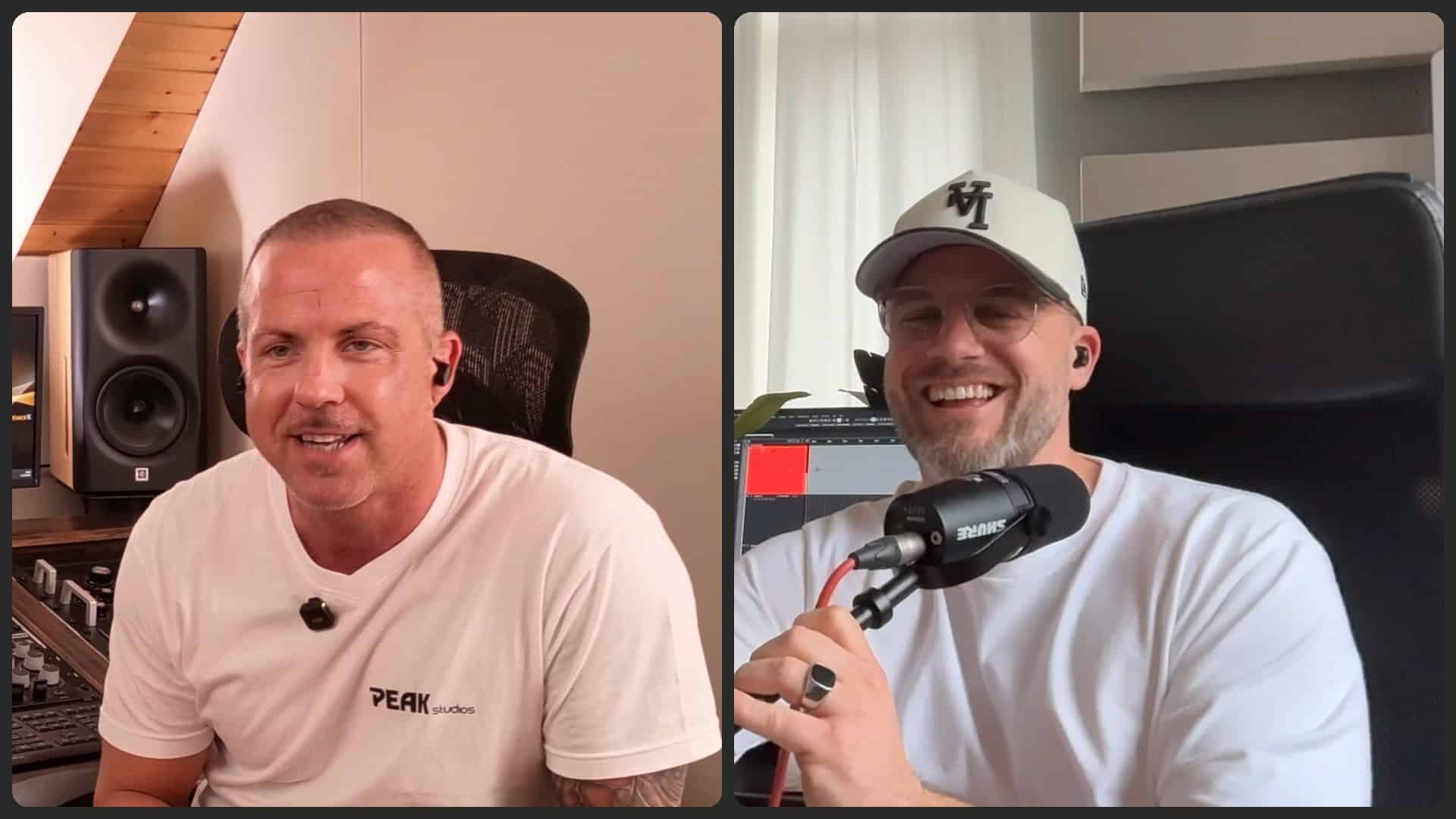
Dennis leads our Recording studio in Berlin, I'm sitting in the Studio in WürzburgMany who spend their time with us Get the song mixedWe ask exactly these questions. Below the video you'll find each question with a short answer and what we said about it in the conversation.
Chapter of the episode
- 0:00 Hilti or brush? (Preview)
- 0:16 Today we prepared
- 5:52 Breaths and smacks: You were right.
- 7:18 Does every track need a low cut?
- 14:49 EQ sweep: When to intervene?
- 21:26 Room correction: Do professionals need it?
- 27:08 Halftime: Your comments
- 28:10 Mono or stereo in the club.
- 36:48 Myth: 44,1, 48 or 96 kHz?
- 47:00 Myth: 3 or 6 dB headroom?
- 50:35 Myth: Master's degree at -14 LUFS?
- 56:25 Bonus: Listen quietly
- 59:29 One tip to take away from each
- 1:02:13 My Mono breakdown
- 1:04:23 Your question to us
Content
- What episode 2 is about
- How the episode came about
- Low Cut and EQ Sweep
- Room correction and mono or stereo in the club
- Sample rate, headroom and -14 LUFS
- Quiet listening and mono switch
- Further learning and conclusion
- Frequently asked questions
The quotes are taken from the conversation and have been slightly smoothed for readability.
Which audio myths do Dennis and I debunk in episode 2?
Nine questions from your comments: Does every track need a low-cut filter? Is an EQ sweep a mistake? Do professional studios use room correction? Do clubs run in mono? Also, sample rate, headroom, -14 LUFS, quiet monitoring, and the mono switch. Our answer is almost always the same: There's no hard and fast rule. Listen first, then intervene as little as possible.
How the episode about audio myths came about
I hadn't expected so much feedback after the first episode. In the first week alone, we racked up over 8.000 views, along with comments on YouTube and Instagram, some of which really made me think. Two points of criticism came up repeatedly. @MichaelMatzerath wrote, in essence, that we take too long to get to the point. And several of you complained about the sound of breathing and smacking noises in the audio.
Both are true. That's why I held the printed script up to the camera at the beginning of the episode, and that's why we adopted a clear approach this time: simply jump in, then delve deeper. @dertrion found episode 1 a bit too technical for absolute beginners in places – we wanted to strike a better balance in that area.
The tone requires an honest explanation. The voices in the first episode were processed through an equalizer. Compressor and De-EsserWhat was missing was the step that reduces breaths and mouth sounds. The compressor actually amplified them. Two sound engineers making a podcast overlooked that – embarrassing, but that's how it happened. In episode 2, we reduced the breaths first and only then compressed the audio. Dennis explained it like this in the episode:
"This is about information and exchange, not about sounding particularly great. You shouldn't be annoyed by any smacking or ASMR noises."
Dennis Kreutzberg
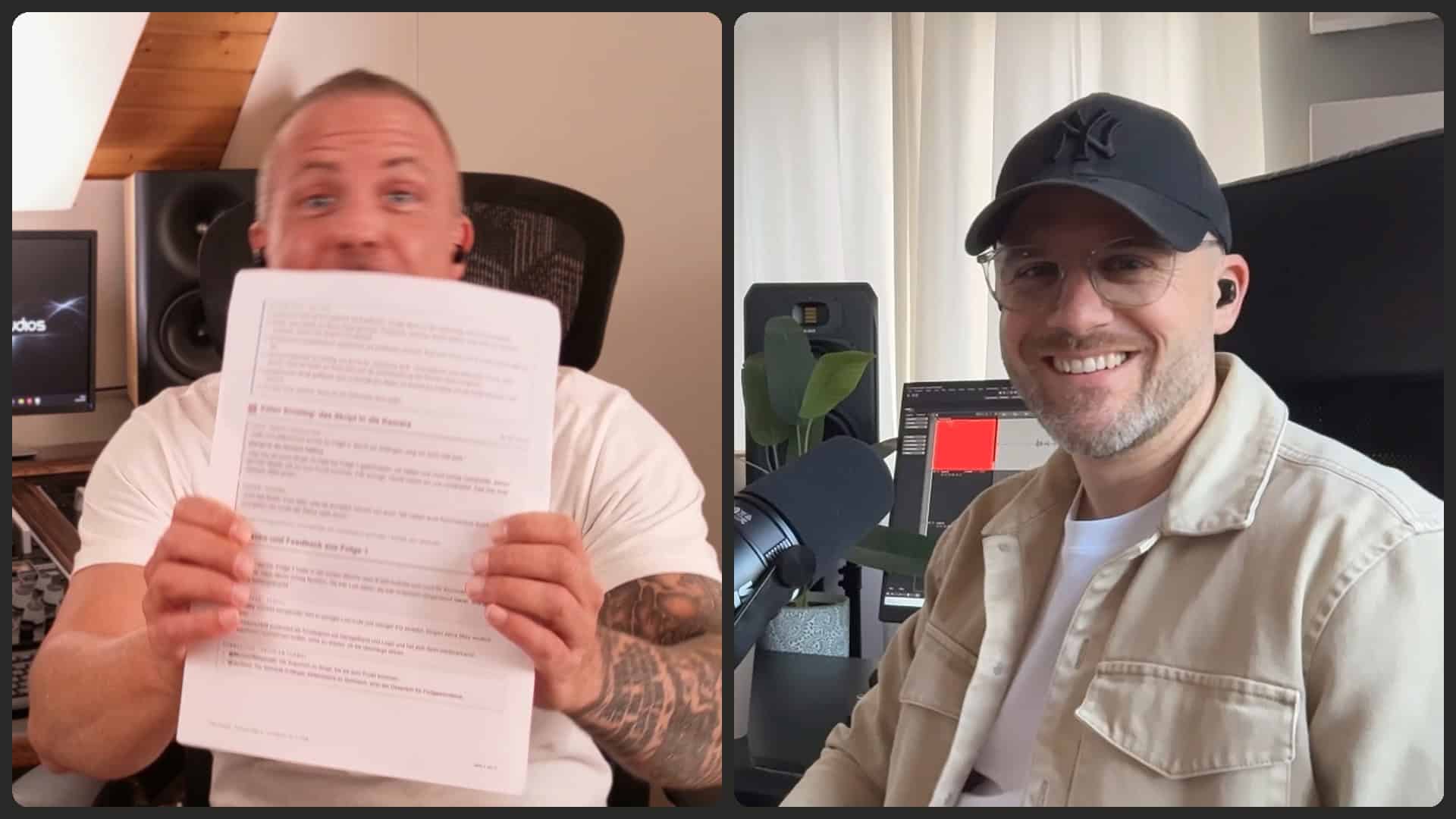
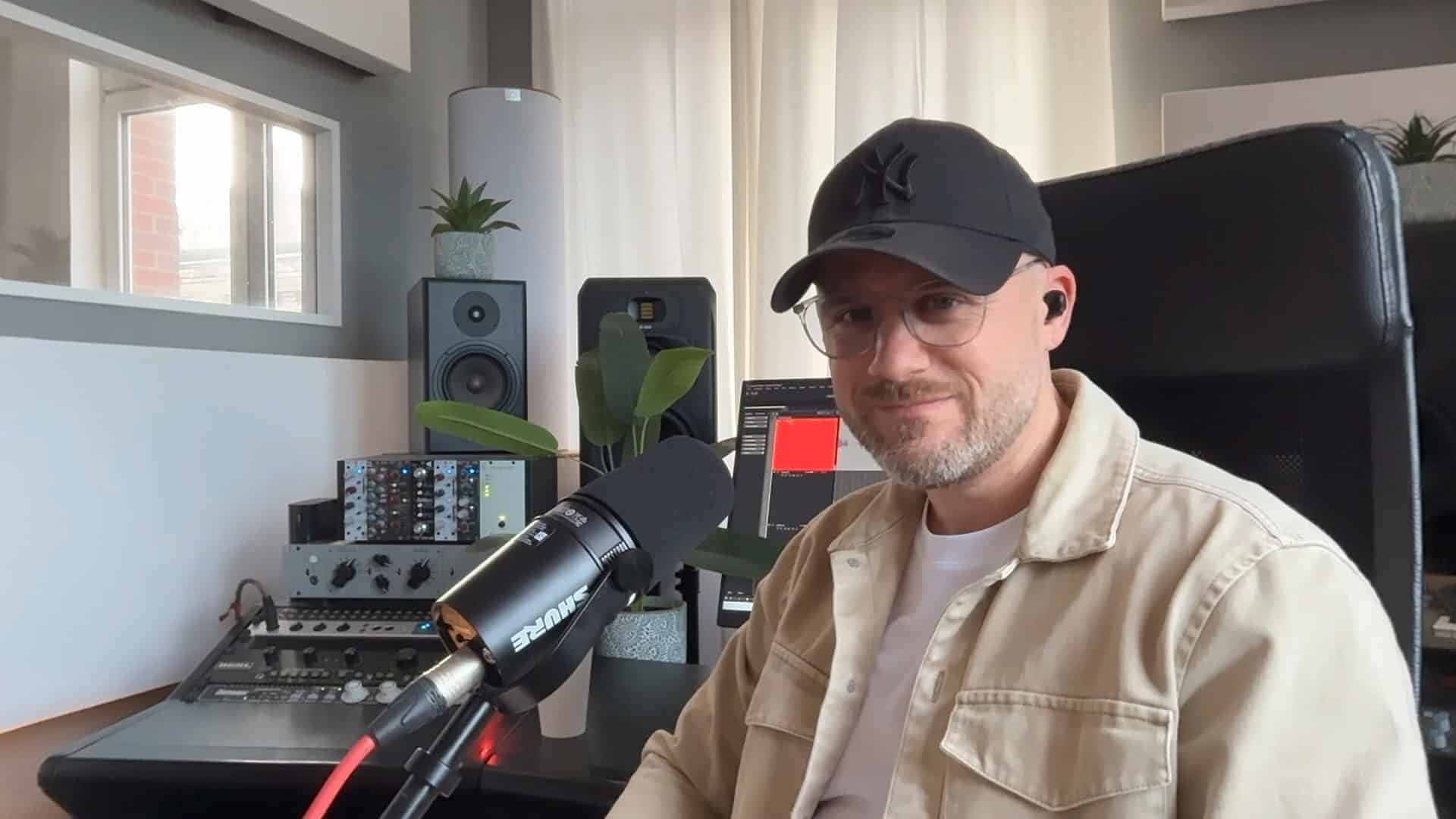

We recorded again in two studios, each with its own camera and microphone. Who I am and what else I do is explained on... my profile page.
Low cut and EQ sweep: two audio myths from your comments
Most of the comments focused on two audio myths that almost everyone knows from tutorials: using low-cut filters everywhere and chasing resonances. Neither of these habits is inherently wrong. It only becomes wrong when applied indiscriminately.
Does every track need a low cut?
No. A low-cut filter is a filter, and every filter changes the phase of the signal. Use it where low frequencies are actually bothersome, not on every track out of habit.
@Breymien compared different low-cuts on vocals using a null test, and @MrVinylistic wrote that the low cut is not a black-and-white decision – there is also low-shelf, automation, and dynamic EQ. EqualizerDennis admits that he used to place a bet almost everywhere:
"You're often told that you have to put low cuts on everything. I've even used some where there was no rumble in the low end at all. That makes absolutely no sense."
Dennis Kreutzberg
I then clarified the term. A low cut doesn't cut off the shadows, it softens them – how much is determined by the Slope in dB per octave.
"The steeper the slope, the more the phase shifts. This can lead to signals canceling each other out or a shift in the stereo panorama. It doesn't necessarily have to have negative effects; what matters is always what you hear. But you have to be aware of it."
Chris Jones
Dennis prefers to solve this with multiple similar tracks by grouping them together. If he has five percussion tracks, each containing some low end, he combines them and applies a single low-cut to the group instead of five individual ones. I explain what happens to the phase in the glossary. Phase Shift, and when a linear phase EQ at low cut It's worth it, as explained in a separate article. The topic begins in the video. at 7:18.
Is the EQ sweep a mistake?
No. An EQ sweep involves significantly boosting a narrow band and sweeping it across the frequency range to find a problem. This is legitimate if you've previously heard that something sounds off. The EQ sweep becomes problematic when it's the first thing you do and then you cut everything that sounds unpleasant when boosted.
In episode 1, I talked about "Batman ears" in the equalizer, meaning lots of narrow, deep notches. @markusi_wagner thought that was too simplistic: a filter sweep is perfectly legitimate, and we'd be responding to every myth with a counter-myth. He has a point there. @dariocnofficial wrote on Instagram that with the extreme boost, you're only making the resonance audible to yourself. And @blackhole_showband countered that many people use too little EQ, and professional mixes are often heavily processed.
"The basis of everything is: there are no rules. If you draw circles in the EQ and it sounds good in the end, then that's how it is. The crucial point is knowing when a resonance is truly bothersome. It always depends on the context."
Dennis Kreutzberg
This ties in with what I added in the conversation: Everything resonates somewhere. Every instrument and every sound has resonant frequencies, and if you have a narrow band with a high Q Factor many Decibel If you pick up on something, you'll always find something that hurts. That doesn't necessarily mean it's bad in the mix.
For me, this results in the following order for the EQ sweep:
- Listen to the track in context first. Is anything bothering you at all?
- Identify what bothers you and roughly where it lies.
- Consider even the smallest intervention. Sometimes, simply making the track quieter is enough.
- Use the EQ sweep now to find the part you heard before.
- Lower only as much as is necessary in the context, and compare with and without intervention.
Hilti or paintbrush: when it's better to do nothing
The real problem, for me, lies in the approach. I often see it in class: a signal is there, and without thinking, the first thing people do is apply an EQ. As a result, I found an image that even made it into the thumbnail.
"First, I listen to the signal. Is anything bothering me at all, and if so, what and where? Then I consider the smallest possible intervention. And only then do I decide on the right tool. I wouldn't come into your apartment just because you don't like your walls anymore and tear them down with a Hilti when a brush and some white paint would have done the trick."
Chris Jones
Dennis then said something that I consider the most important sentence of the episode:
"That sounds so simple, but it's quite difficult. If you want to know what you're doing, you also have to know where you don't have to do anything. That's based on years of experience."
Dennis Kreutzberg
For me, good engineers aren't defined by how much they do. They know when to stop doing something. As one commenter put it: Every intervention is, theoretically, initially a step backward. The section begins in the video. at 14:49.
Can't you hear if your mix needs tweaking?
Room correction and club facilities under review
Two comments directly attacked statements from episode 1, thus bringing two further audio myths to light. Regarding the first, Dennis and I disagree with the viewer. Regarding the second, I had to correct myself.
Do professional studios use room correction software?
Yes, professional studios also use room correction software – we do too. But it doesn't replace room acoustics. Only the room itself resolves cancellations, room modes, and long bass reverberation times. The software then extracts the last few percent of performance.
@Byron101_ wrote that professional studios generally don't use room correction software; only acoustic design and calibration are relevant. Dennis sees it differently:
"Conversely, that would mean: anyone who uses room correction software doesn't have a professional studio. I know professional studios that use it. They have the most expensive equipment, acousticians have been there, and yet they still use it."
Dennis Kreutzberg
I think there's still some truth in the comment, and I said so in the episode:
"The foundation is good room acoustics. Software like this can't solve room modes and fundamental cancellations, nor can it control bass reverberation time. It all depends on the acoustics. Everything else is just the icing on the cake."
Chris Jones
In Würzburg, an acoustician designed the room, and the reverberation times are correct. We also use the Acourate correction software. This roughly halved the deviations in the frequency response, from about 4 dB to about 2 dB. This made a big difference for us – but only after the room was properly calibrated.
For your own studio, this means: first setup and absorbers, then measurements, then adjustments. I'll show you how much you can achieve in small spaces in this article. Small space, great acoustics. Help against booming bass Bass traps, and you need a for measuring. Measurement MicrophoneThe topic begins in the video. at 21:26.
Do club sound systems operate in mono or stereo?
Both scenarios occur; there's no hard and fast rule. There are mono systems, dual-mono systems, stereo tops with shared subwoofers, and multi-zone systems. Therefore, your mix must work in mono, regardless of where it's played.
In episode 1, I said that club sound systems generally ran in mono. A viewer who's been doing club nights for 20 years disagreed. I did some research, and he's right.
"There is no fixed rule. And position is not the same as channel: Four speakers can receive four identical mono signals, two stereo pairs, cross-stereo, or four separate channels. Ultimately, the routing determines this."
Chris Jones
Side areas like the lounge or bar often run in mono, while the main floor in the same venue plays in stereo. There's no hard and fast rule regarding subwoofers either. Dennis, after a brief exchange with a club he knows well, reported the same thing: their sound system doesn't run in mono. His conclusion:
"Ultimately, it's about creating a phase-free low end in the mix so that it works well everywhere. This is independent of whether the system is stereo or mono."
Dennis Kreutzberg
I'm grateful for the counter-argument. Without the comment, I wouldn't have looked into it so closely. The article explains in detail why a kick in a club can suddenly sound weak. Kick in the club without bass, the basics in the glossary to Mono CompatibilityThe topic begins in the video. at 28:10.
Practical test for a stable low end
For this episode, I've written down three points that you can check before and during mixing:
- When checking tracks with multiple microphones or layers, first look for polarity and time offset. With drums, for example, the microphones are often positioned at different distances, which can quickly make the kit sound muddy. Correcting the offset will clear things up.
- Listen regularly in mono, at both high and low volumes. Important elements should not be lost in the listening experience.
- Don't artificially widen the kick and bass. The bass remains stable in the center; you don't need a fixed frequency cutoff for that. More information can be found in the article on... Stereo distribution in the mixdown.
Dennis works a lot with house and EDM, where the kick and bass carry the song. If the kick, the drive, is missing, in his experience it's often because there are too many elements getting in the way, and small details are canceling each other out. You can read how to bring both together in the article. Mix kick and bass.
Three audio myths about sample rate, headroom, and LUFS
These three audio myths are constantly encountered in our teaching and in the studio. There's a lot of misinformation about them online, both positive and negative.
Myth sample rate: 44,1, 48 or 96 kHz?
For a release, 44,1 or 48 kHz is sufficient. Your mix won't sound better just because you change the sample rate. Higher rates are more helpful for editing and digitizing tape or vinyl records, but they do require more processing power.
Dennis and I both work at 48 kHz, for different reasons. For Dennis, it's primarily the computing power:
"I do a lot of work on my laptop. With 100 or 200 tracks, you'd probably reach the limit relatively quickly at 96 kHz. For pop, house, EDM and hip-hop, 48 kHz is perfectly sufficient for me."
Dennis Kreutzberg
Two things come together for me. Most releases are now streamed, and 48 kHz isn't a problem there – what the individual services support is listed in our overview. Uploading to streaming servicesFurthermore, I like working with saturation and Clippers in the high frequencies. These generate overtones, and the frequency is at 48 kHz. Nyquist Frequency a little higher. That gives me more breathing room before Aliasing This is how it comes about. To my ears, it sounds cleaner this way, even when used with my analog equipment. This is my personal workflow and not proof.
"44,1 or 48 inches isn't a big game changer. There are more important things, like acoustics or decent monitors. This discussion is just pretty nerdy."
Chris Jones
Dennis therefore advises: Work at the rate at which your samples are available and don't convert them unnecessarily. The basics are explained in the glossary. Sample Rate, the longer explanation in the article about 48 kHz as the new standardThe topic begins in the video. at 36:48.
Headroom Myth: 3 or 6 dB?
As a guideline, 3 to 6 dB of headroom on the master bus is appropriate. The exact figure isn't crucial. What's important is that nothing is clipping and there's no limiter on the master bus.
"If a file only has 3 dB of headroom, I'll reduce it by another 3 dB myself, then I have my 6 dB, which I like to start with. The only important thing is that nothing clips."
Dennis Kreutzberg
I see it the same way and have made it a bit clearer in the following: I don't really care how much headroom someone leaves, as long as no Clipping in the game and the Limiter The total amount remains the same. I find the recording level more important.
"If you record too quietly, you're closer to the background noise. And if you increase the volume later, you also increase the noise. Something between -6 and -12 dB is perfectly sufficient for recording."
Chris Jones
The article about why the recording is so crucial explains this. recording qualityYou can find everything else on this topic in the glossary. headroomThe topic begins in the video. at 47:00.
Myth -14 LUFS: Does your master's degree have to be so loud?
No. -14 LUFS is the value Spotify uses to adjust playback in normal mode. It's not a guideline for mastering. Master at a volume that sounds good while preserving the dynamic range.
The background is easily explained. Since then loudness war Songs vary greatly in volume. Someone listening on the go would have to adjust the volume for every track. That's why streaming services automatically adjust the volume during playback – that's the key. Loudness normalizationThis has led to the misconception that every song must be at -14. LUFS Nations.
"I prefer to make sure a song sounds good. If it ends up at -10, then so be it. Unless the client specifically requests -14 LUFS, then we'll do that."
Dennis Kreutzberg
"Make it as loud as sounds good. If the song works, then upload it, regardless of whether it's at -14, -12, -10 or -9. I'm just not a fan of extreme loudness. A song with dynamics moves me much more."
Chris Jones
In some genres, loudness is part of the style, for example in metal or hard techno. Dennis personally enjoys listening to soul and funk from the 60s and 70s, precisely because these mixes still have so much... Dynamic Range Which loudness level is suitable for which genre is explained in the article. How loud should you master?And if you prefer your song mastering If you'd like, we can take care of it. The topic begins in the video. at 50:35.
WHAT QUESTION SHOULD WE CLARIFY NEXT?
Write to me – about the episode, your mix, or a topic for the next issue. We usually get back to you within 3 hours (on weekdays).
- Personal point of contact
- Over 20 years of experience
- Highest quality standards
You can reach us by phone from Monday to Friday from 9 a.m. to 8 p.m.
Quiet listening and mono switching: our takeaway tips
Finally, we wanted to share two things you can try in your own mix tomorrow. Both are free.
Why would you listen quietly?
Listening at a low volume allows you to hear volume levels more accurately. Turn the volume down until only individual elements remain. Anything that stands out on its own will be too loud in the mix.
@baumgart_olaf wrote that he deliberately listens very quietly to notice an overly dominant voice early on. I found that interesting because it's one of the Fletcher-Munson Curves It fits with what we talked about in episode 1. At first, you're overwhelmed by the sound and think everything is fine. At a low volume, you start to listen closely. Dennis makes this a regular part of his work:
"I turn the volume down so low that I can barely hear anything. If you only hear the voice and hardly anything else, it's too loud. If you can hardly understand what's being sung, it's probably too quiet."
Dennis Kreutzberg
His tip for beginners: Start your next mix very quietly and see how far you can get. During the course of a mix, you should still go through all the levels: quiet, normal, and loud. I explain how to find your ideal monitoring volume in the article. Volume set correctlyThe topic begins in the video. at 56:25.
What does the mono switch do?
The mono switch shows you which elements are lost when the left and right channels are combined. Press it occasionally. Mixing exclusively in mono isn't necessary.
"Look what's missing. How many of the elements that are supposed to carry your mix can still be heard in mono? I think mixing only in mono is nonsense, but I can't stress enough the importance of switching back and forth between mono and mono."
Chris Jones
Dennis goes a step further and mixes in mono at times, because one Frequency superposition He hears it particularly well then. When he switches back to stereo afterwards, it's "like a revelation".
My Mono breakdown
The switch has a quirk, though, and I experienced it myself. Several years ago, I created a master, checked the metering for mono at the end, exported it, and sent it out. Weeks later, a major comparison of mixing and mastering services was published. The gist of it was: "Sound great, but the file came out in mono." I had simply forgotten to turn the switch off before exporting. It still haunts me to this day. Dennis had just the right comment for it:
"Shit happens. There are also people who forget to cut the kisses out of their podcast."
Dennis Kreutzberg
So: before every export, quickly check that Mono is really off. I tell the story in the video. from 1:02:13.
Further learning and my conclusion on audio myths
If I had to sum it up in one sentence: Almost none of these audio myths are completely wrong, but none of them are suitable as a rule. Low cut, EQ sweep, room correction, 48 kHz, 6 dB headroom, -14 LUFS – everything has its place. The crucial thing is that you listen beforehand to what your song needs.
If you want to delve deeper:
- Im Teaching and coaching We work one-to-one on your own songs and on exactly these kinds of decisions.
- In the 1:1 Masterclass You'll be there live when your song is mixed.
- The ten most common mistakes in mixing We have compiled this information in a separate tutorial.
- Our Free tools for musicians They help you with measuring and testing, for example with loudness.
I enjoyed the second episode even more than the first because it was created based on your comments. I learned something new myself, and that's exactly how it should be: not a competition to see who knows the most, but an exchange of ideas. Dennis ended the episode with a question for you: Where do you find yourself struggling most with mixing? Write your answers in the comments below the video. If we keep getting this many questions, we might even make it a dedicated Q&A session.
Frequently asked questions about the podcast episode on audio myths
Who is Dennis Kreutzberg?
Dennis Kreutzberg is a music producer and mixing and mastering engineer. He owns Blactronic Studios and manages the Peak-Studios location in Berlin. You can find out more about him at Dennis' profile page.
Where can I watch the whole episode?
The episode is embedded above in the post and is running on the Peak-Studios' YouTube channelIt lasts approximately 67 minutes and is divided into 15 chapters.
Do I need to have seen episode 1?
No. While we do address comments from episode 1, we explain each topic from the beginning. If you like, you can then watch the first episode about beginner mixing mistakes.
What do I do if I can't hear whether my mix needs adjustment?
Have someone else listen to it. The mix analysis provides you with a written report that tells you which issues are really holding your mix back and where you don't need to do anything.
How can I submit a question for the next episode?
Write your questions in the comments below the video on YouTube. We read everything and address the questions in future episodes.