
Measurement microphone – use, function & tips
For the acoustic analysis of a room, a measuring microphone is used: a specially calibrated condenser microphone with the most linear frequency response possible, which objectively records sound without coloring it. Typical applications include measuring frequency responses, reverberation times, and calibrating loudspeaker systems in recording studios or home theaters.
What is a measurement microphone?
The measurement microphone is the heart of any room acoustic measurement. It serves as a reference for precisely determining the characteristics of an unknown room. Due to the high demands placed on their transmission characteristics, measurement microphones are almost always condenser pressure transducers. Their power supply requires special power supplies, which typically provide a polarization voltage of 200 volts. Less expensive models use electret condenser capsules, which operate at lower voltages.
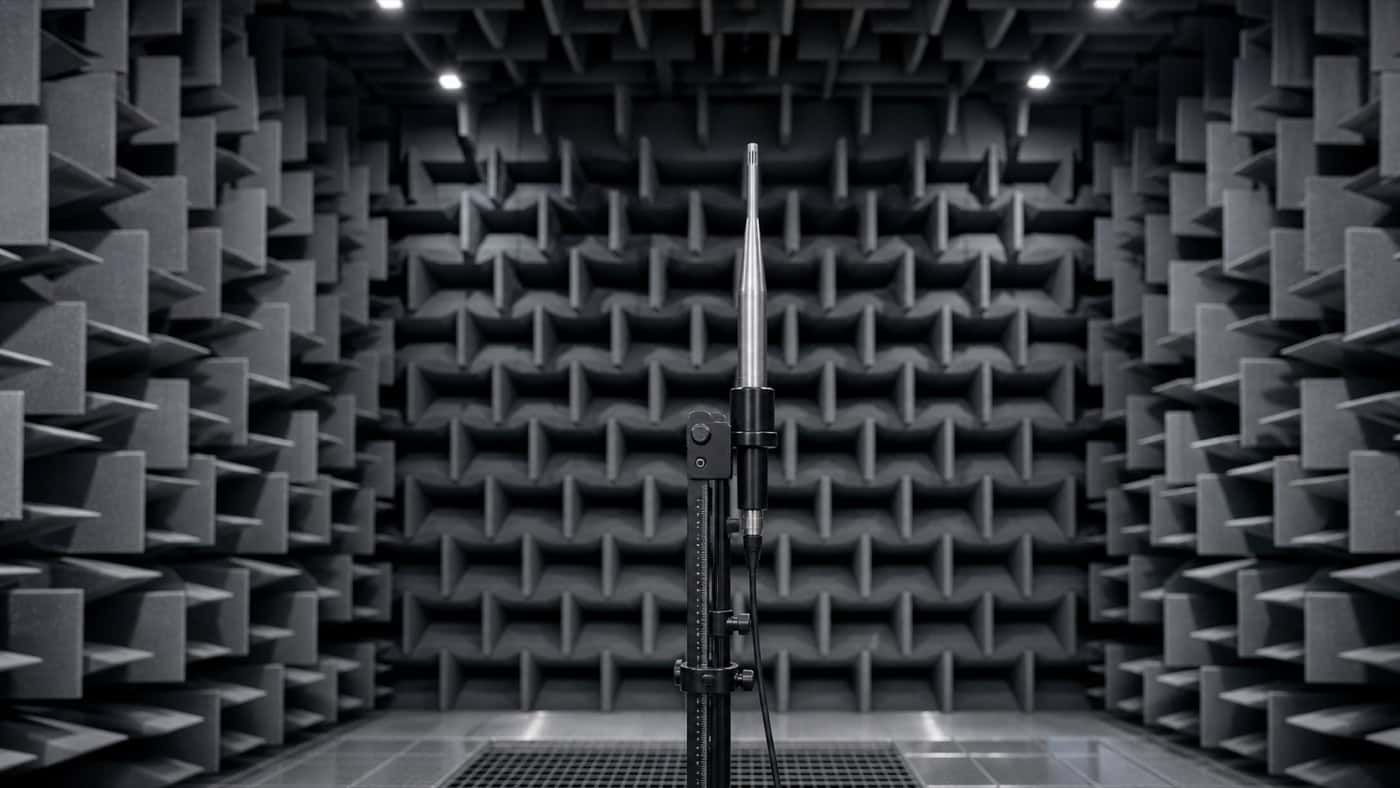
Structure and variants of measurement microphones
Measurement microphone capsules are available in four standard diameters: 1 inch, ½ inch, ¼ inch, and ⅛ inch. They are offered in free-field equalized and diffuse-equalized versions. With the appropriate impedance converter, high-quality models achieve linear transmission well into the ultrasonic range. Some models are even capable of recording infrasound.
Typical applications of measurement microphones
Measurement microphones are primarily used in room acoustics optimization, sound reinforcement technology, and research. Typical applications include measuring the frequency response of a room, determining reverberation times, and calibrating loudspeaker systems. A defined sound source such as a sine sweep is usually used for calibration.
Using monitoring correctly: Our Mixing Guide shows you how to interpret measurement results, room acoustics and frequency perception in a structured practical workflow.
Why is choosing the right measurement microphone crucial?
Choosing the right measurement microphone significantly influences the accuracy of your measurements. Professional measurement microphones impress with their extremely linear frequency response and minimal distortion. Especially when optimizing recording studios, home theaters, or concert halls, a calibrated, certified measurement microphone is recommended to obtain reliable and internationally comparable results.
Application of a measurement microphone in practice
In practice, the measuring microphone is positioned at ear level and precisely aligned. Together with acoustic measurement software such as Room EQ Wizard (REW) or ARTA, various points in the room are measured to reveal resonances, room modes, and acoustic weaknesses. Based on this data, targeted acoustic optimization measures such as... Bass traps, diffusers or absorbers are planned.
Measurement microphone as an indispensable tool
A high-quality measurement microphone is key to a thorough analysis of room acoustics. Anyone who wants to create optimal acoustic conditions - whether in a recording studio, home theater or hi-fi living room - should not skip professional room measurements.
A measurement microphone is the basis of every room acoustics calibration — why this is so critical for mastering decisions is explained by the Mastering Guide.
FAQ – Frequently asked questions about measurement microphones
Which measurement microphone is suitable for beginners?
For beginners, inexpensive models like the MiniDSP UMIK-1 or the Behringer ECM8000 are suitable. These microphones offer sufficient accuracy for basic room acoustics analysis and are also easy to connect via USB or XLR.
How do you correctly calibrate a measurement microphone?
Ideally, a measurement microphone is calibrated to a defined sound pressure level using a calibrator. Additionally, software calibration files (e.g., SPL or frequency response calibration) should be used to refine the measurement results.
What is the difference between free-field and diffuse-equalized microphones?
Free-field equalized microphones are designed for direct sound source measurements, while diffuse-equalized microphones are optimized for evenly distributed sound fields (e.g., reverberation measurements). The choice depends on the specific application.
What is a measurement microphone?
A measurement microphone is a specially calibrated microphone for the objective recording of sound. It is used for room acoustics analysis, loudspeaker measurement, and frequency response evaluation, and is characterized by a frequency response that is as linear as possible.
Which microphone should be used for measurement?
A calibrated omnidirectional measurement microphone is used for calibration. These microphones capture sound as accurately as possible from all directions and are ideal for acoustic measurements.
Where should the measurement microphone be placed?
The measurement microphone is usually placed at ear level at the listening position. For room or loudspeaker measurements, measurements can also be taken at multiple positions to obtain a more realistic overall picture.
Can you record with a measurement microphone?
Technically, this is possible, however, measurement microphones are not optimized for musical recordings. They deliver a very neutral sound without any tone-shaping characteristics and are therefore usually unsuitable for vocals or instruments.