Headroom and max headroom in audio production
What is headroom?
Headroom is the level margin between the highest peak in an audio signal and the clipping limit. In digital audio this limit is zero dBFS; in analog systems the available headroom depends on the device and operating level. Terms such as noise floor and SNR (signal-to-noise ratio) are important here. In both mixing and mastering, clean headroom gives the engineer room to shape loudness, dynamics and tone without unwanted distortion.

Recording headroom
Every recording medium and every analog device, from a microphone to an audio-interface converter, has a noise floor. If a signal is recorded too quietly, the distance between the useful signal and the noise floor becomes small. This distance is called the signal-to-noise ratio (SNR). In the mixdown, especially after compression and level increases, that noise can become clearly audible.
Recording tip:
Aim to record most signals around -6 to -3 dBFS. This leaves enough dynamic headroom for louder passages. For classical music or very dynamic material, we recommend recording closer to -12 to -6 dBFS.
Mixing headroom
Headroom is important in mixing because the final master should reach a competitive loudness without losing too much natural dynamics. A practical target is to leave about three to six dBFS of headroom on the mix bus and balance the individual tracks accordingly. This reduces the risk that individual instruments jump out unexpectedly during mastering. It cannot be avoided completely, because mastering often uses limiters and dynamic processing. The best approach is to control the individual tracks and buses in the mix so that the song already has a stable loudness before mastering. There are no fixed rules for every production; the engineer decides based on genre, dynamics and sound aesthetic.
Headroom in the full mixing process: Our Mixing Guide shows how to structure level reserves, gain staging and dynamics across the full mix.
Mastering headroom
Sufficient headroom is especially useful in mastering. Mastering often involves dynamic processing, for example compression, limiting or frequency-specific level adjustments. If the mix arrives with enough level reserve, the mastering engineer can work more precisely and avoid unnecessary distortion.
Our advice:
For mastering, it is best to leave around 3 to 5 dBFS of headroom. This gives the mastering engineer enough room to get the best out of your song.
3 dB or 6 dB headroom - which is better?
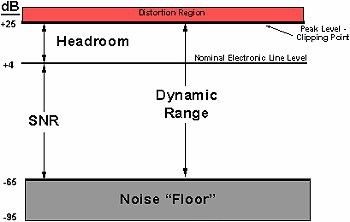
First, it helps to understand the relationship between level and bit depth. Every 6 dB of lower gain costs roughly 1 bit of theoretical dynamic resolution. In pop productions this is rarely critical, but in very dynamic music, such as classical recordings, it can matter. With 24-bit audio, however, you still have a theoretical dynamic range of about 144 dB. Even if you bounce a dynamic mix with 18 dBFS of headroom, the practical quality loss is usually not the limiting factor. The more important question is whether the mix has enough clean level reserve for mastering.
Conclusion: for very dynamic productions, we recommend around 6 dB of headroom. For less dynamic productions, around 3 dB is usually sufficient.

What do 24-bit and 32-bit float files have to do with headroom?
As described above, 24-bit audio offers a theoretical dynamic range of about 144 dB. A 32-bit float file provides far more internal headroom, often described as practically huge rather than truly unlimited. With 1680-bit float, accidental digital overs can often be recovered more safely and rounding errors are less of an issue. Still, for delivery and mastering, clean gain staging remains important.
Our advice:
If possible, export in 32-bit float and set the internal mix-bus resolution to 32-bit float as well, provided your DAW supports it.