Frequency masking: recognize, correct — or deliberately leave it as it is
Frequency masking describes an effect from psychoacoustics: A louder signal masks a quieter one if both are in the same frequency range. In a mix, this can cause individual instruments to lose clarity or "disappear" in the mix. However, not all masking is a mistake—the crucial factor is whether it obscures an important element. This article shows you how to recognize masking, when you should correct it, and when you should intentionally leave it as is.
Contents of this article
What is frequency masking?
Frequency masking—also known as masking effect—is primarily a phenomenon of our hearing and only secondarily a factor in mixing. You're familiar with this effect from everyday life: In a quiet apartment, you can hear the refrigerator. humAs soon as someone turns on the vacuum cleaner, the humming disappears—not because the refrigerator has become quieter, but because a louder noise in the same area drowns it out. That's exactly what's constantly happening in your song between individual tracks.
The underlying technical principle is the workings of the inner ear. The basilar membrane in the cochlea acts like a finely graduated frequency ruler: low tones stimulate one end, high tones the other. However, our hearing doesn't process these stimuli with Hertz precision, but rather in... Frequency groups, the critical bands (also described in the literature using the Bark scale). Within such a band, adjacent frequencies "share" the same evaluation zone. If two signals are present there simultaneously, the more energetic one wins: The Mask raises the hearing threshold for the quieter signal, the maskThe masking process is so extensive that it becomes partially or completely inaudible—even though the original sound is still fully and unchanged in the file. Masking doesn't "delete" anything; it simply makes something inaudible.
Three characteristics are crucial for practical purposes:
- The masking effect is asymmetrical. Low notes mask high notes more strongly than vice versa—experts call this "upward spread of masking." A booming bass can swallow up delicate highs, while a sibilant hi-hat hardly masks the bass. That's why cleaning up the low bass is often so effective: you reduce the masking effect of the strongest masker in the upper frequencies.
- The louder the mask, the wider its effect. As the volume increases, the masking effect extends beyond the actual band. An element mixed too loudly thus masks not only "its" area, but also the surrounding area—one reason why "turning it up" exacerbates conflicts instead of resolving them.
- Masking also happens over time. A loud transient (e.g., a snare hit) not only masks quiet signals at the moment it occurs, but also shortly before and after (pre- and post-masking). This explains why dense, percussive arrangements tend to "block up" more quickly than quiet ones.
The fundamental nature of this effect is evident in the fact that modern lossy audio compression is built upon it: MP3, AAC, and similar formats deliberately discard signal components that would be masked anyway—saving data without us consciously hearing the difference. What's a clever feature in the codec becomes a problem in the mix as soon as an element that should be in the foreground is masked. Clearly defining this hierarchy—what comes first and what is subordinate—is one of the core tasks in audio mixing. professional mixing.
How do you recognize frequency masking?
Masking is primarily detected by ear — measuring instruments only confirm what the ear suspects. In practice, five methods have proven effective and can be combined effectively.
1. Level-matched solo comparison. Listen to a track solo, then in context. If it sounds full and defined on its own, but "disappears" in the overall mix or suddenly sounds thin, masking is the likely culprit. Important: compare tracks with the same loudness—a louder solo track almost always sounds "better," which skews the judgment.
2. The Mute Test (the counterpart to the Solo). Instead of targeting the suspect element alone, activate the others one after the other. others Silent tracks. This is how you hear which track is covering your main element. Often the culprit isn't the obvious neighbor, but a surface or a Hall, which was completely unexpected.
3. Test on multiple systems and in mono. Mobile phone speakers, laptops, cars, and a mono switch on the master output reduce the frequency and spatial range—conflicts become apparent much more quickly than on large studio monitors. The mono check is particularly valuable: Does the mix fall into...? Suit If the voice collapses in on itself or loses presence, this is masking (besides). phase problemsA common reason. What gets through on a mobile phone gets through everywhere.
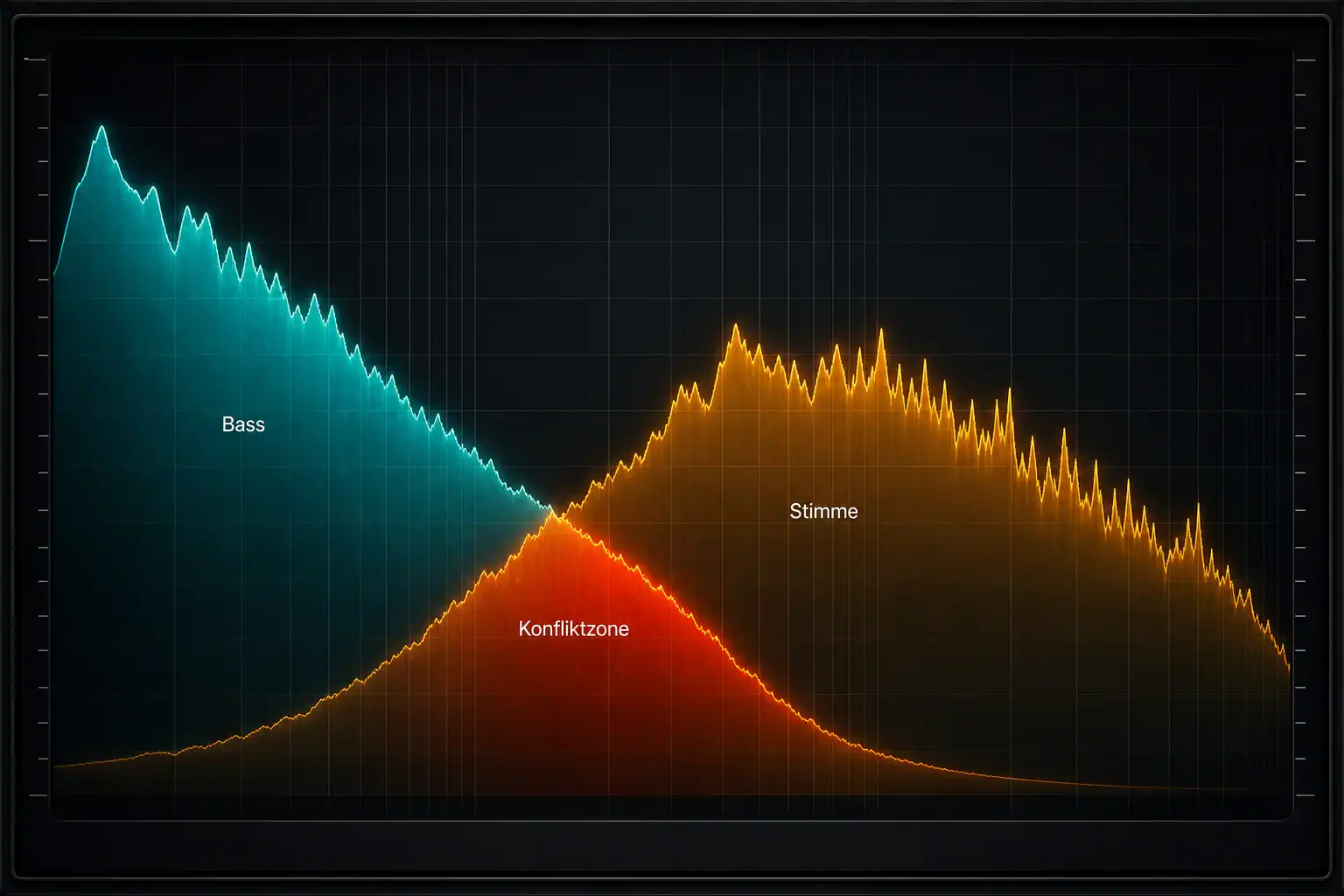
4. Overlay spectrum. An analyzer or EQ with a spectrum display clearly shows where the energy of two tracks overlaps. Overlay the curves of two suspected tracks—if they share the same peak in the same range, you've found the point of conflict. You can then narrow down the exact problem area with a narrow EQ sweep, much like in the... Search for resonant frequenciesImportant: The analyzer shows overlap, not automatically a Problem — the ear still makes the decision.
5. The spectrogram over time. A spectrogram (frequency over time) reveals whether a conflict is persistent or only occurs in certain passages—for example, only in the chorus when all tracks are playing simultaneously. This leads to the question of whether a static or a dynamic intervention is the right approach.
Some conflict pairs appear in almost every production and are worth a first look:
| conflict couple | typical range | Symptom |
|---|---|---|
| Kick & Bass | approx. 40–120 Hz | undefined, "washed-out" low bass |
| Vocals & dense guitars/synths | approx. 1–4 kHz | Voice loses presence, “drowns” |
| Electric bass & rhythm guitar | lower midrange (approx. 150–500 Hz) | Mud and pressure loss in the lower middle |
| Cymbals/Hi-Hats & Vocal Highs | Brilliance/Air (from approx. 8 kHz) | Hissing obscures speech and breathing details |
| Snare & Vocal presence | approx. 2–5 kHz | Voice and snare struggle for "assertion" |
The frequency ranges are guidelines, not hard and fast rules—where the conflict lies exactly always depends on the specific material, arrangement, and genre. The perennial issue of kick drum versus bass warrants a separate, focused look; we'll show you how to cleanly separate them in the article on... Mix kick and bass.
When is frequency masking disruptive?
The most important distinction first: masking is not inherently a mistake. It only becomes a problem when it obscures an element. that the listener should hearWhether an overlap is "good" or "bad" is therefore not decided by the analyzer, but by the element's role in the song. These indications point to a real problem:
- The main message suffers. The lead vocals or main instrument lose presence as soon as the accompaniment kicks in. In vocal-based music, this is the most critical symptom—if the lyrics don't carry the song, it doesn't carry it.
- The mix sounds muddy or tiring. A diffuse, undefined sound image without a clearly identifiable source is often the sum of many small masking effects in the lower midrange. Strained listening over an extended period is a warning sign.
- The noise arms race begins. You keep turning up one element to make it stand out—and then you have to turn up the next one even more because it gets lost in the noise. This cycle is a classic symptom of masking and rarely leads to the desired result, because a louder masker only covers more of the underlying issue.
- The mix doesn't "translate". Everything sounds great on studio monitors, but on a mobile phone, Bluetooth speaker, or in the car, the hook or lyrics get lost. Small systems don't forgive masking.
- The deep bass sounds weak. The kick and bass cover each other up instead of building pressure together — the result is a foundation that is neither punchy nor defined.
In short: Masking is a problem when it Comprehensibility, hierarchy (what's in front, what's in back?) Low bass control It costs money. If, on the other hand, the mix sounds clear, balanced, and coherent across different systems, you don't need to "fix" anything just because an analyzer shows overlaps.
When is it worthwhile to fix masking?
Correct masking if it obscures an important element or detracts from the overall clarity of the production. Just as important as the... Ob is the sequence — and this is precisely where many people resort to EQ too early. The two underestimated first steps:
- Level first. Very often, one element is simply too loud and drowns out the rest. A quiet one Level balance It solves a surprising number of "masking problems" before even applying a filter. It's worthwhile to completely rebalance a mix using the faders instead of immediately resorting to filters.
- Arrangement and production. If too many elements are playing in the same register simultaneously, no EQ will provide a lasting solution—you're just shifting the problem. Moving a voice or riff an octave, thinning out a track in dense passages, offsetting parts in time (call and response instead of constant unison), or changing a timbre creates more space than any filter. Often, the best "unmasking trick" is simply to prevent two things from happening at the same time.
Only then do the mixing tools come into play — deliberately without fixed values, because the correct frequencies and amounts always depend on the material:
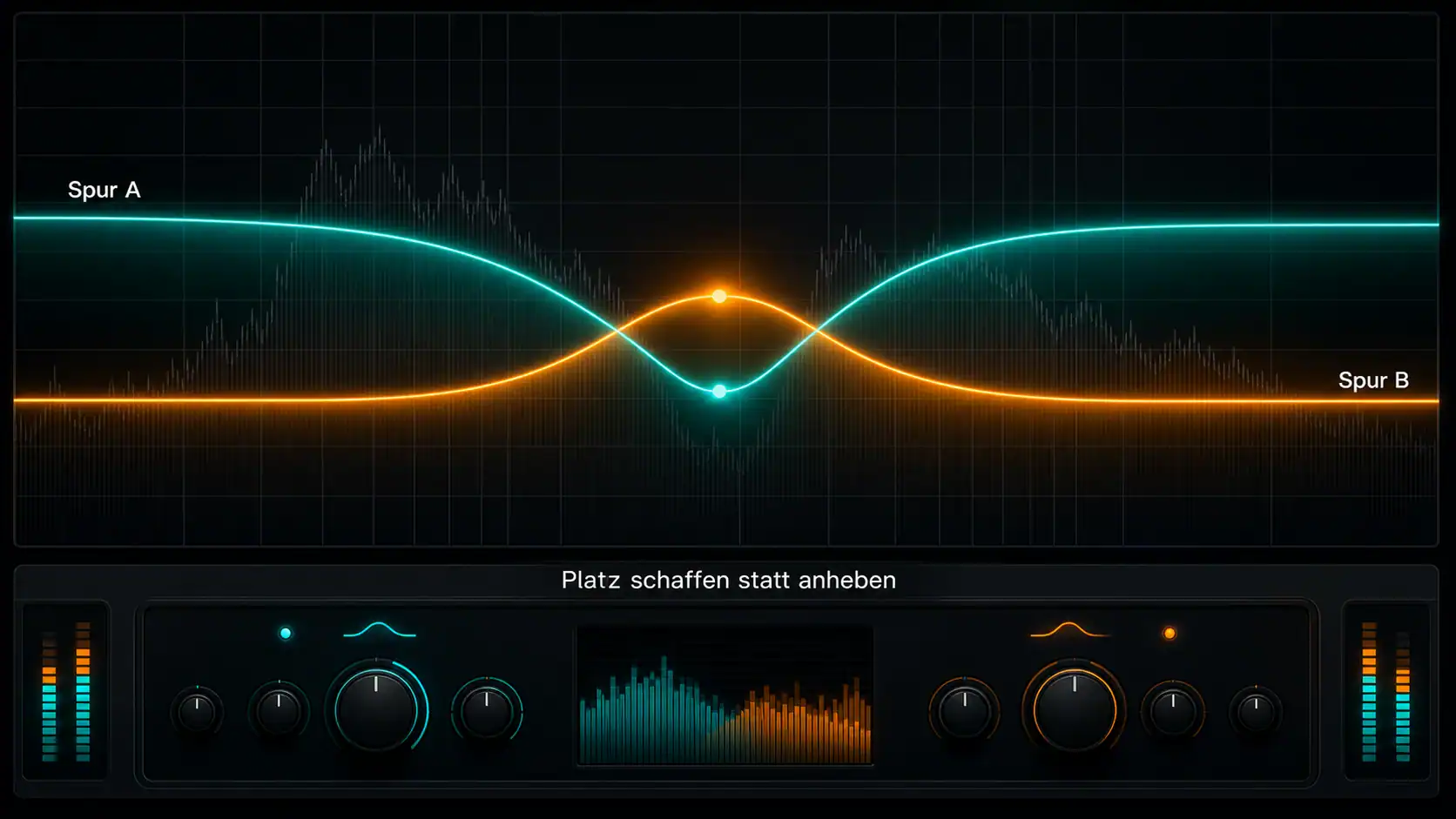
- Subtractive EQ. depression at less important Remove the element from the area where the more important element should reside—instead of constantly amplifying the more important one. Create space instead of trying to cover it up. This keeps the overall level in check and sounds more natural than a stack of boosts.
- Complementary EQing (the puzzle principle). What you lower on one track, you can easily raise on the other. This way, two tracks fit together like puzzle pieces: each gets its own emphasis, while both remain present. This is particularly effective with pairings like vocals/guitar or bass/synth.
- High-pass filters — and the question of slope. Instruments that don't need deep bass (guitars, many synths, overheads, backing tracks) should have their low frequencies cut. This frees up the important range for kick and bass and reduces summed low-mid energy that would otherwise clog everything else. The steepness of your filter and where you set the cutoff frequency make an audible difference—from the Filter slope up to Linear-phase EQ on the low-cut filter.
- Panning and stereo width. What is spatially separated is less likely to be masked. Place the most important elements (lead, kick, bass, snare) in the center, secondary elements on the outside. Also, working with center and side This helps: If you keep the bass mono and in the center, you give wider elements space at the edges. Stereo splitting in the mix is one of the most effective and most frequently overlooked measures against masking.
- Dynamic tools. Dynamic EQ, frequency-selective sidechain compression or Multiband Compression The bass only drops when the conflict actually occurs—for example, the bass only gives way to the kick drum at the moment of the kick drum hit and otherwise remains at full volume. This preserves significantly more substance than a static, continuous cut and is often the cleanest solution for conflicts that only arise in specific passages.
- Automation. Sometimes it's enough to briefly lower or raise an element precisely where it clashes with another—for example, making the synth pad louder in the verse and quieter in the vocal chorus. No plug-in needed, just a Volume automation train.
Which of these interventions is the right one depends on whether the conflict is ongoing or only temporary, and how important the elements involved are. If you are unsure, a structured external perspective can help: In the case of a mix analysis You can hear precisely where elements are masking each other and in what order the adjustments make sense for your song — before you spend hours on detailed EQ work that doesn't even address the actual problem.

Are you stuck when it comes to clearing the mix? Send us your track — during a mix analysis, we'll specifically listen for where elements are being obscured and tell you what to do.
Why frequency masking becomes critical in mastering
Masking left unresolved in the mix becomes a real problem during mastering—because now you lack access to the individual tracks. In mastering, you're working on the final stereo mix and can no longer adjust the vocals separately from the guitar. This has very real consequences:
- Global interventions affect everything. If you boost the presence at around 3 kHz in the master output to bring a hidden vocal to the forefront, you'll also boost the snare, guitars, and cymbals. Instead of solving the problem, you're shifting it—or creating harshness and harshness.
- Loudness intensifies the masking effect. Mastering brings the track to a competitive volume level. Limiter It intensifies the dynamics and amplifies quiet elements—but this doesn't make already masked elements clearer; instead, it often flattens them even further. And because a louder signal masks more broadly, "making it louder" can actually increase the masking instead of removing it.
- Low bass conflicts cost loudness. If kick and bass are stacked up undefined in the same area, this unused energy is wasted. headroomThe limiter doesn't actually need the signal it needs. The result is either a quieter master or a limiter that pumps and distorts earlier. A cleanly separated low bass in the mix is a prerequisite for a loud, punchy master.
- Weak details are completely omitted. Parts that were already borderline audible in the mix often don't survive the loudness increase and subsequent codec compression for streaming.
The consequence is simple: masking belongs in the mix. A master can refine the overall balance, but cannot restore separation that was lost in the mix. That's precisely why we check before every professional mastering First, they assess whether the mix works — and give you targeted mix feedback if needed, instead of masking symptoms on the overall sound.
When should you consciously avoid wearing a mask?
Here's the point many tutorials overlook: Not every overlap needs to be fixed. Masking is a natural part of how individual sounds combine to form a whole. Our hearing is also remarkably good at "filling in" partially obscured signals from the context—we don't miss them as long as the essential elements carry. There are good reasons to leave masking in place:
- It does not affect any important element. If a quiet layer, a doubling, or an effect reverb is partially masked in a dense arrangement, but no one is meant to hear it in isolation, that's perfectly fine. Hidden elements that aren't missed in the context don't need to be revealed—they still contribute to the overall energy.
- Over-filtering costs more than it brings. Those who shave away every visible overlap with narrow cuts rob instruments of body, warmth, and naturalness. The result is a technically "clean" but thin and lifeless mix where nothing comes together. Clarity is the goal, not maximum separation at any cost.
- Masking creates depth and hierarchy. The fact that the accompaniment recedes slightly behind the vocals is intentional—this creates a sense of foreground and background. If you were to make every track equally prominent, the mix would sound flat and tiring because nothing would have a clear role anymore.
- Glue and fusion are sometimes desirable. The way choirs, strings, or synth pads blend together is often musically perfect. Here, blending is a feature, not a bug.
- Genre and aesthetics. Dense "wall of sound" productions, lo-fi, shoegaze, or deliberately raw live recordings thrive on layering and friction. Maximum separation would be stylistically inappropriate and would rob the sound of its character.
- That portion will either be masked or not transmitted at all. Signal components that are lost in the final streaming codec or that cannot be resolved on realistic target devices are not worth the mixing effort. It's better to invest time in what is audible.
The honest rule of thumb: First decide what should take priority, and then resolve only the conflicts that truly disrupt this hierarchy. Everything else can stay. Good mixing doesn't mean "maximum separation," but rather the right balance between clarity and cohesion—and sometimes the best solution is the one you consciously choose not to address.
YOUR CONTACT TO PEAK-STUDIOS
Send us a message - we usually reply within 3 hours on working days.
- Personal point of contact
- Over 20 years of experience
- Highest quality standards
You can reach us by phone from Monday to Friday from 9 a.m. to 8 p.m.
Frequently asked questions about frequency masking
Is frequency masking the same as a muddy mix?
Mud is often a symptom of masking in the lower midrange, but not all mud is masking. Too much reverb, phase issues, or an overly complex arrangement can also be the cause. You should always try to narrow down the cause before taking corrective action.
What tool do I need to detect masking?
Primarily, use your ears, plus compare the solo and muted settings. A spectrum analyzer or an EQ with a display helps to visualize overlaps, and a mono check quickly reveals many conflicts. Dedicated masking meters are useful, but not essential.
Can masking always be fixed with EQ?
No. Level correction, arrangement, panning, and automation solve many problems before an EQ is even needed. The EQ is one tool among many—rarely the first one you reach for.
Static or dynamic EQ to counter masking?
If the conflict is persistent, a static cut is often sufficient. If it only occurs in certain passages (e.g., only in the chorus), dynamic EQ or frequency-selective sidechaining is usually the cleaner solution, because otherwise the element remains fully present.
Can too much EQ worsen the mix?
Yes. Excessive cutting away robs instruments of body and naturalness. The goal is clarity for the important elements, not maximum separation at any cost.
Does masking also occur during mastering?
In mastering, you work on the final mix—significant masking between individual tracks should be resolved beforehand in the mix. Mastering is more about the overall balance of the frequency response than about individual instrument conflicts.