Why your kick drum has no bass in the club
At home, the kick drum is great, but in the club, the bass suddenly disappears. A hardtekk producer came to our studio with exactly this problem. Mixing Masterclass to Würzburg. The cause was neither the EQ nor insufficient saturation, but the interplay between the mono system and phase.
In this post, I'll show you what happens to your kick drum in the club, why it often goes unheard at home, and how you can check it yourself before your next gig. The short video from the masterclass reached many producers and DJs on social media, so here's the detailed explanation. If you'd prefer to have your track edited by us... have it mixed If you want, we pay close attention to these points before he hears the club's sound system.
Content
Why doesn't the kick drum in the club have bass?
Many club sound systems reproduce bass in mono, meaning the left and right channels are mixed together. If kick samples are layered out of phase, or if the low bass contains stereo components, the low frequencies partially cancel each other out in this combined mix. This phase cancellation is precisely what robs you of the punch you need in a club. At home, using separate speakers, this is hardly noticeable.
The video: This is what the kick drum sounds like in a club, simulated in the studio.
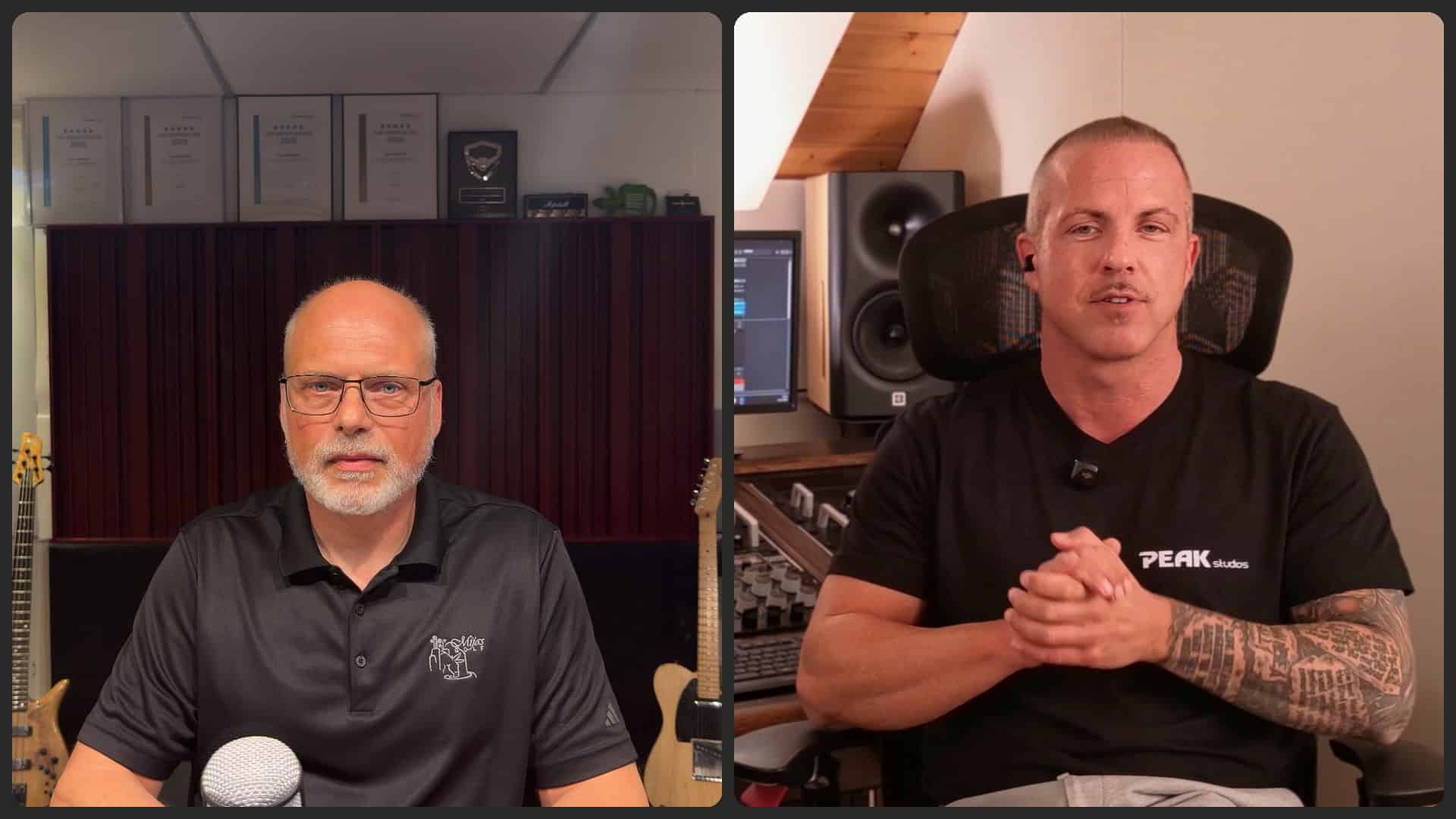
This excerpt is from a three-hour hardtekk and techno masterclass we held at [location]. recording studio in Wuerzburg The participant, a DJ himself, had built his kick drum from three samples, distributed across three keys, to gradually add them in during his set. His observation: as soon as the third sample is added, the kick drum sounds thin. His question: "Where did my bass go in the club?"
In the video, I switch the monitors entirely to mono. This is our club simulation. Then you hear the same section twice: once with the correct phase and once with a layer rotated 180 degrees. In mono, the difference is even more noticeable than in stereo. That's exactly what happens in a club.
Why do the sound systems in the club play in mono?
Many club sound systems operate in mono for the bass range, often even entirely. There are practical reasons for this. Firstly, low frequencies are difficult to localize, so a separate left and right signal for the subwoofers offers no audible advantage. Secondly, most of the audience isn't positioned directly between two speakers. Someone dancing against the left wall would primarily hear the left channel in a stereo system. In mono, however, everyone on the dance floor hears the same track.
As in the video: "They don't have the crowd set up with one speaker for the left channel and one for the right channel. So they're all in mono."
What happens when summarizing on Mono
In a mono sum, the left and right channels are added together. If both signals are the same, the sum simply becomes louder. However, if they are in opposition, meaning one wave rises while the other falls, then they cancel each other out. In physics, this is called... destructive interferenceIn the studio, we call this phase cancellation. It affects the low bass most severely because the waveforms there are long, and even small time offsets cause significant level losses.
At home, you listen through two separate speakers or headphones. The two channels only mix in the air, or not at all, and your ears then reassemble the sound. That's why the same track sounds full at home and hollow in a club. The term "mix" describes how well a mix withstands this combination. Mono Compatibility.
What stereo components cost the bass in the club
However, not every width is a problem. It becomes particularly critical below approximately 100 to 150 Hz. Typical sources of stereo components in the low bass are:
- Kick or bass tracks that already come as a stereo file with different channels
- Stereo widening, chorus, or a delay after the Haas Effect on the bassline
- Hall on the kick drum, which extends broadly into the deep bass.
- Layers that are distributed differently in the panorama, see also Panning in stereo image
A Correlation meter This shows you the status of your signal. A value of +1 means both channels are identical, i.e., mono. Values around 0 indicate a wide, independent signal. Stereo signalIf the reading in the bass range drops below 0, the channels are working against each other, and energy is lost in mono. Goniometer shows the same thing additionally as an image.
Does your kick sound thin in the club?
Three samples, one problem: layering and phase of the kick drum.
The second cause arises even before the mono mix is achieved. Layering multiple kick drums also adds waveforms. If the samples don't match, phase cancellation occurs in the low bass frequencies, and this happens in every playback. The effect is even more pronounced in mono because all stereo differences are then also present.
For the masterclass participant, that was precisely the crux of the matter. Previously, he would have reacted to the thin sound with EQ and overdrive to "create more volume." In the interview at the end, he says: "But it's actually just the phase that makes such a difference."
Reverse polarity or rotate phase?
Two tools are often confused. The phase reversal switch, labeled Ø in most DAWs, reverses the polarity: every wave crest becomes a trough. This corresponds to the 180 degrees shown in the video and is helpful when two layers are running in opposite directions.
Often, however, the phase shift lies somewhere in between. In this case, a phase rotation plugin can help, as it shifts the phase continuously without changing the time of the sample. In the masterclass, the optimal value was 58 degrees. This made the kick and bassline sound not like two separate samples, but like a single unit, significantly more powerful and without any additional effects. You can find more background information on the causes in our article on... Phase Shift.
What you should pay attention to when layering kicks
- Adjust starting points: The transients All layers should start on precisely the same sample. Even a millisecond offset can weaken the low bass.
- Check the mood: If the layers have different fundamental tones, the bass will sound weak and lack power. Tune the samples to each other and to the key of the track.
- Distribute tasks: One layer provides the subtitles, one the punchline, one the click. With a EQ You remove from each layer what another layer does better. This prevents three samples from overlapping simultaneously in the low bass. Note: A high-pass filter also inverts the phase around the cutoff frequency. linear phase EQ at low cut Avoid that.
- Only one layer in the sub: Ideally, only one sample should play below approximately 100 Hz. This provides the most reliable protection against phase cancellation.
- Less is more: Each additional layer is another opportunity for cancellations. If two samples are sufficient, the third is often detrimental.
Our article shows you how to cleanly integrate the kick and bassline in the mix. Mixing bass drum and basslineThose working with 808s can find further tips at Mixing 808 bass.
How to test your kick before the club: the club simulation in five steps
You can recreate the simulation from the video in any DAW. All you need is a mono switch, your monitors, and a few minutes of your time.
- Switch to mono: Assign a mono switch or a utility plugin to the master output. Many audio interfaces and monitor controllers have a dedicated button for this.
- Listen at a moderate volume: Don't listen too loudly, because at high volume the bass sounds fuller than it actually is, that's what they explain. Fletcher-Munson Curves.
- Compare stereo and mono: Switch back and forth several times. If the low bass remains the same volume, everything is fine. If the kick drum becomes thinner or quieter in mono, there is a phase cancellation issue.
- Check layers individually: Mute each of the kick layer tracks one after the other and reverse the polarity of each one. The layer where the bass suddenly returns is the culprit.
- Correct and listen back: Reverse the polarity, rotate the phase, shift the starting point, or relieve the low-bass layer using a high-pass filter. Then check again in mono.
Additionally, secure the bass in mono in the club.
Additionally, it helps to make the bass range mono overall. Many stereo tools offer a function that centers everything below an adjustable frequency. A value between 100 and 150 Hz is a good starting point. Afterwards, be sure to check whether the kick drum sounds different as a result. This is even more important for pressings: Vinyl Mastering The bass should be centered anyway.
HOW DOES YOUR KICK IN MONO SOUND?
Send us your question about the track, the kick drum, or the next gig. We'll listen and tell you honestly whether the bass will work in the club.
- Personal point of contact
- Over 20 years of experience
- Highest quality standards
You can reach us by phone from Monday to Friday from 9 a.m. to 8 p.m.
Typical mistakes that will cost you bass in the club
We see the following patterns in the Techno mixing and in other club tracks again and again. The table shows what happens in the mono mix and how you can counteract it.
| Error | What happens in the club | Solution |
|---|---|---|
| Three kick samples without phase matching | The deep bass is partially eliminated, the kick drum becomes thin. | Check layers individually, reverse polarity or rotate phase |
| Stereo kick sample with different channels | The subwoofer becomes quieter in the mono mix. | Set the kick drum below approximately 150 Hz to mono. |
| Bassline widening or chorus | Correlation below 0, bass partially disappears | Focus the effect only on the overtones, leave the low bass in the center. |
| Reverb on the kick drum down to the deep bass. | Muddy bass, unsteady pressure | Filter out reverberation using a high-pass filter starting at approximately 200 to 300 Hz. |
| Blow up a thin kick drum with EQ and overdrive | More loudness and distortion, but no pressure. | First check the phase, then decide on the timbre. |
The last point is particularly common, because those who don't know the cause tend to use more EQ, more saturation and more LimiterThis makes the track louder, but not the bass in the club. Our article explains how loud a club track actually needs to be. how loud you should master technoIf, on the other hand, the kick and bass overlap at the same frequencies without the phase being the cause, it's worth taking a look at the Frequency maskingOur article about further pitfalls collects more information. the most common mistakes in the mix.
Conclusion: This is how you get your kick drum back its bass in the club
If your kick drum lacks bass in a club, it's rarely due to a missing effect. Usually, two things come into play: a sound system that reproduces the bass in mono, and layers or stereo components that are canceling each other out in that mix. With a mono simulation in the studio, you'll hear the cancellation before the audience notices it. Furthermore, the solution is often surprisingly simple: reverse the polarity, rotate the phase, or remove a layer.
The participant took away exactly that from the masterclass: fewer layers and fewer effects, but properly placed, more powerful, and more consistent. If you want to learn something like that for your own track, the... Masterclass in individual lessons The direct approach. We work on your song live, and you have a say. If you just want to know where your mix is losing bass, send us the track for a... mix analysis .
Frequently asked questions about kick, bass and mono
Do all clubs really play in mono?
No. Many systems, however, reproduce at least the subwoofers in mono, some everything. Since you rarely know the wiring beforehand, your track should work just as well in mono as in stereo.
Which is better for a club, mono or stereo?
Both have their place. Kick, sub, and bassline belong centered and mono in the low bass. Hi-hats, pads, effects, and reverb can be wide. This keeps the track open yet powerful.
How do I check if my kick drum mono is working?
Switch the master to mono and compare it to stereo at moderate volume. If the bass remains the same volume, it's fine. A correlation reading below 0 in the bass range is a warning sign.
What is the difference between polarity and phase?
Polarity reversals the signal; a wave crest becomes a trough, i.e., 180 degrees. Phase rotation shifts the phase continuously, for example by 58 degrees, without shifting the sample in time.
How many kick drum samples should I layer on top of each other?
As few as possible. Two well-balanced layers are sufficient in most cases. It's important that only one sample handles the main work in the low bass, while the others provide punch and click.
At what frequency should the bass be mono?
A proven starting point lies between 100 and 150 Hz. Below this range, bass is difficult to localize, and stereo elements only waste energy. The exact limit depends on the track.
Can mastering save a kick drum without bass in a club?
Only to a limited extent. In mastering The low bass can be set to mono. However, if the kick drum layers cancel each other out in the mix, the energy is already missing there. This needs to be addressed in the mixing process.