Mixing or mastering: What does your song need?
Mixing or mastering – this question almost always comes first when someone wants to have their song professionally processed. The answer depends less on the genre than on two questions: What can you deliver, and what bothers you about your song?
In this article, I'll explain the difference in one sentence and show you five typical starting points. You'll also learn how to identify the problem yourself. If you already know what you need, you can skip ahead: Get the song mixed, Get the song mastered or to the PricingAnd if you don't know, that's... mix analysis the fastest way to a clear answer.
Content
Mixing or mastering – what do I need?
If you have the individual tracks but no finished mix, you need mixing followed by mastering. If you have a finished stereo mix that you're happy with, mastering is sufficient. If a single element bothers you, such as the vocals or bass, the problem lies within the mix. If you're unsure, a mix analysis will clarify things.
Mixing or mastering: the difference in one sentence
Mixing works on the individual tracks of your song, mastering on the finished stereo mix. That's why mixing always comes first, and mastering is the last step before release.
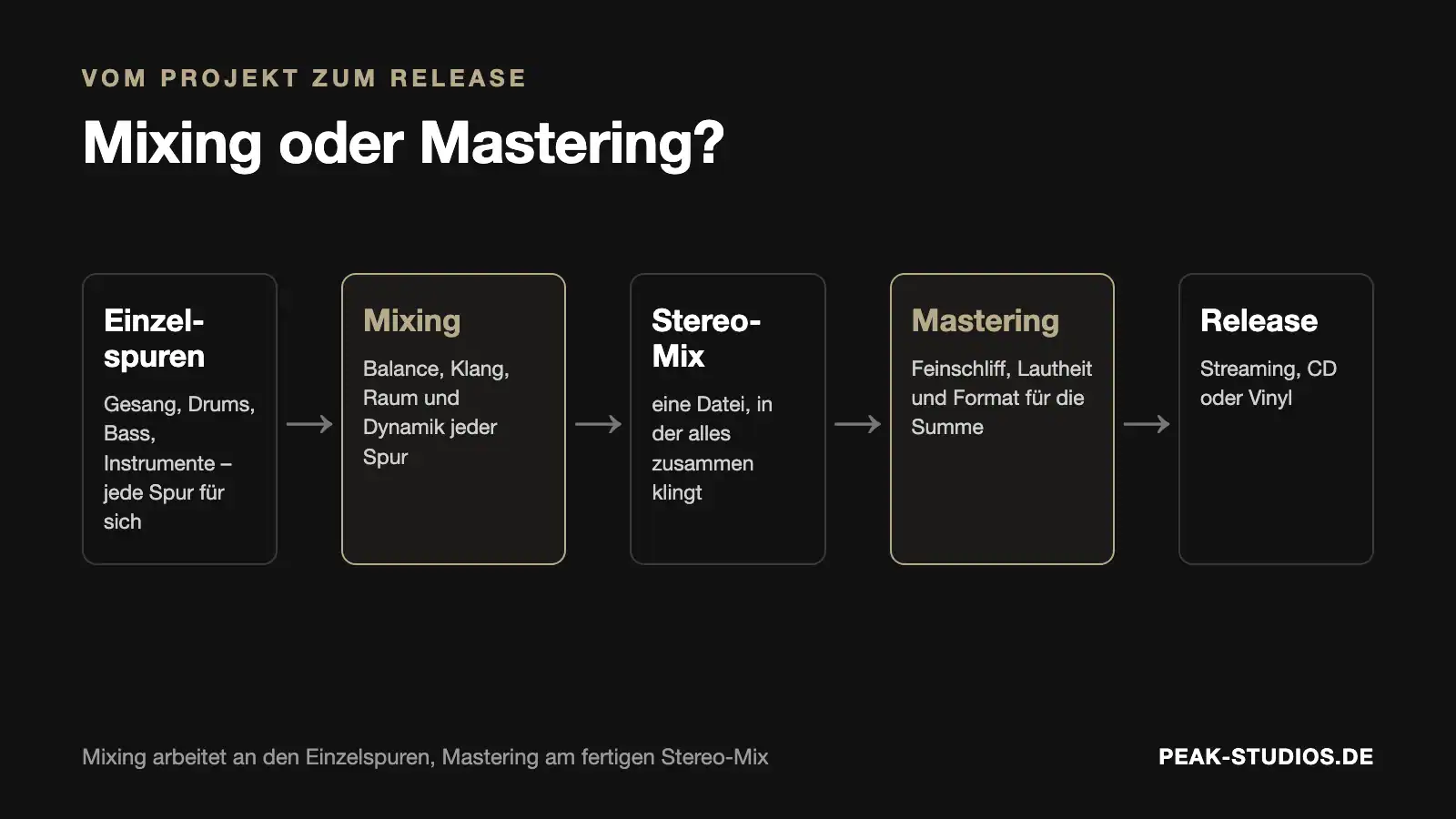
During mixing, vocals, drums, bass, and instruments are still separate. Therefore, I can adjust the volume, tone, space, and dynamics of each track individually until everything fits together. The details of what happens during this process are explained in the article. What is mixing?.
In contrast, mastering involves only one file. Therefore, every adjustment affects the entire song. This is about fine-tuning, loudness, and ensuring the song works well on any sound system and in any format. Our glossary explains the basics. Audio Mastering.
This order is not unique to us, by the way. Wikipedia also describes it. Mixing as the penultimate process in the recording studio and the mastering as final step of a music production, before it goes on sale.
There is also a third way in between: the Stem masteringYou provide two to five groups, for example vocals, drums, bass, and the rest. This allows for more flexibility than with a stereo file, without having to completely remix the song.
| mixing | Stem mastering | mastering | |
|---|---|---|---|
| You deliver | all individual tracks | 2 to 5 groups (stems) | a stereo mix |
| Intervention | each track individually | each group individually | only the sum |
| Objective | a harmonious mix | Fine-tuning with more leeway | Fine-tuning, loudness, format |
| It fits if | the mix is not yet finalized | The mix is almost right, but some groups are not. | the mix is ready |

Mixing or mastering? Five typical starting points
In practice, I encounter the same five situations time and again. Pick the one that suits you.
1. You have all the individual tracks, but no finished mix.
First, you need the mixing. Only when the balance, sound, and room acoustics are right is the final step worthwhile. You can book both of these services with us, one after the other.
2. You mixed it yourself and are satisfied.
Then mastering is sufficient. However, it's important how you export the mix: with approximately 3 to 6 dB. headroom and without Limiter on the total. The details are in our Preparation checklist.
3. You mixed it yourself, but you're not sure.
This is the most common scenario. After many hours working on your own song, you hardly notice its weaknesses anymore. That's why I recommend starting with the mix analysis. You'll receive a written report and a voice message. After that, you'll know whether your mix is ready or what still needs to be done.
4. You have recorded vocals and a beat as a stereo file.
This too is a matter for mixing. The vocals need to be integrated into the beat, and that only works with separate vocal tracks. The result is even better if you also get separate tracks from the beat. You can find more information in the article about... Vocals over beats.
5. You only have one stereo file, for example, an AI song.
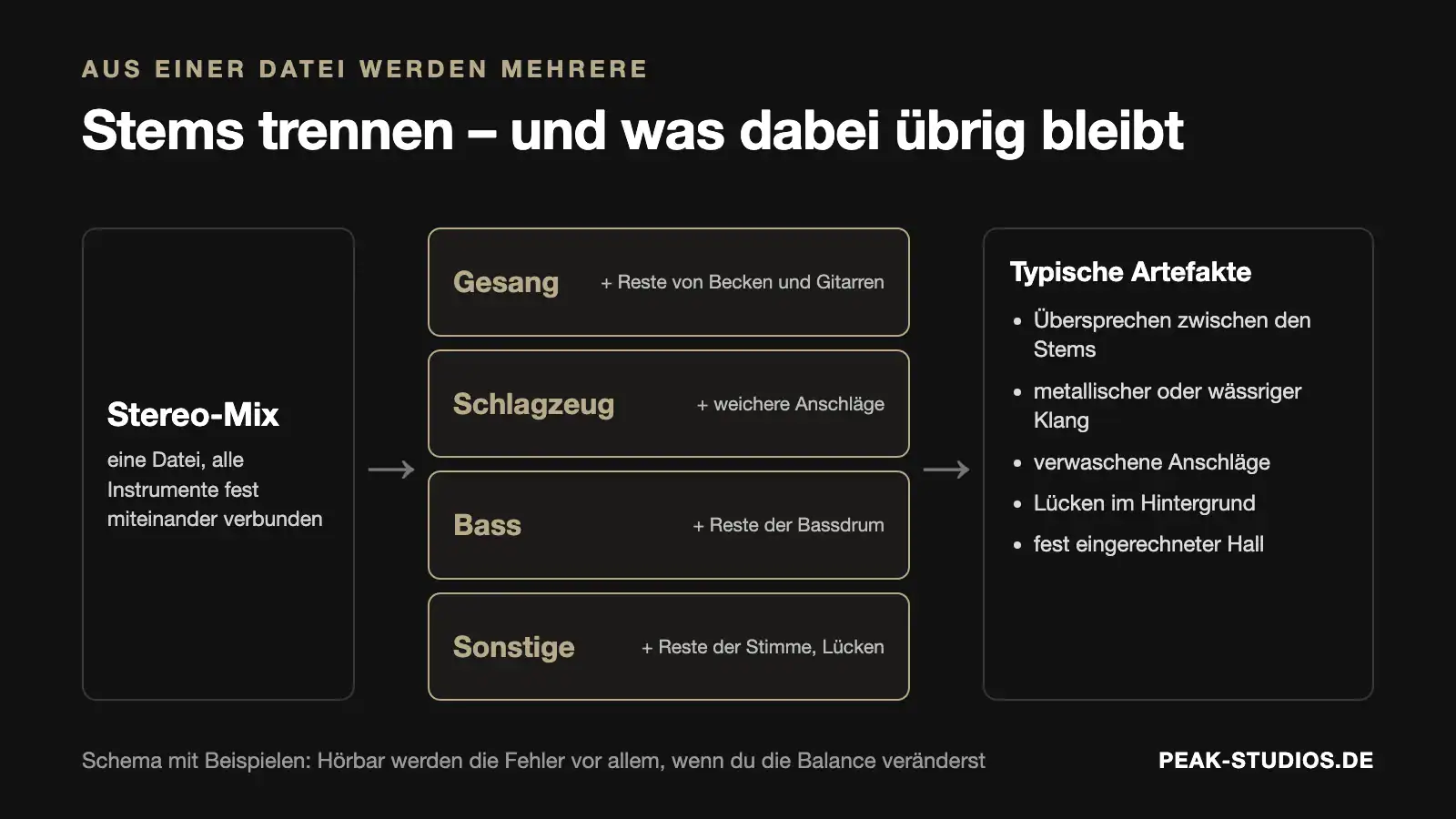
Initially, only mastering is possible. However, with AI-generated songs, it's worthwhile using separate stems, provided your tool offers this feature. This allows for significantly more correction. Our article explains what is and isn't possible. AI-controlled music masteringThe comparison also explains when each approach is worthwhile. Stem vs. StereoFinally, our article shows what happens when a stereo file is subsequently split. Stems separate.
You don't know if your mix is ready for mastering?
How to tell if mixing or mastering is missing
Whether mixing or mastering is lacking often reveals the nature of the problem. If a single element bothers you, it belongs in the mix. If, on the other hand, the song as a whole bothers you, it's more of a matter for the final step.
This speaks in favor of mixing
- The voice gets lost in the mix or is too far forward.
- Kick and bass are fighting for the same space – more on this in the article Mix kick and bass.
- The song sounds muddy or indistinct. More on this in the article. Avoid Muddy Mix.
- The reverberation obscures details, as in the article. Avoid too much reverb described.
- A single instrument is too loud, too muffled, or too sharp.
This speaks in favor of mastering.
- You like the mix, but it's noticeably quieter than other songs – our contribution fits right in. How loud should you master?.
- The song sounds good on headphones, but different in the car or on a mobile phone.
- The songs on an album don't match in sound and volume. This helps with that. Album mastering.
- You need the right formats for streaming, CD, or Vinyl.
You can also find a detailed list of typical problems in our tutorial about the ten most common mistakes in mixing.
What mastering can't save
The most common misconception is: "It'll all be fixed in mastering." Unfortunately, that's rarely true, and therefore the question of "mixing or mastering?" doesn't even arise as long as the mix still has weaknesses. Because only the summed mix is available at mastering, every adjustment changes everything simultaneously. For example, if I boost the vocals with an equalizer, the guitars and cymbals in the same frequency range will also become louder.
Therefore, the rule is: the better the mix, the better the master. Our article on the subject describes exactly where the boundary lies. technical limitations between mix and masterAnd the article explains why it's not a good idea to do both in one go. Mix and master at the same time?.
Dennis and I also talked about this in our podcast. In the episode about... rookie mistake Among other things, the discussion focused on the question of whether the last step saves everything.
STILL UNSURE WHAT YOUR SONG NEEDS?
Briefly describe your problem and what's bothering you. We usually get back to you within 3 hours (Monday to Friday).
- Personal point of contact
- Over 20 years of experience
- Highest quality standards
You can reach us by phone from Monday to Friday from 9 a.m. to 8 p.m.
What you send us for mixing or mastering
Depending on whether you choose mixing or mastering, we need different materials. Therefore, the correct export is crucial for a quick start.
- For mixing You need all individual tracks as WAV or AIFF files in 24 or 32 bit, with clean and concise names. The instructions explain how to export them. Export stems.
- For stem mastering You provide two to five groups that together exactly match your mix. What Stems The glossary explains exactly what they are.
- For mastering Is the stereo mix sufficient as WAV or AIFF in 24 bit, with headroom and without limiter, maximizer or normalizer on the master bus?
You can upload everything via our upload form. When we do a mixing job, we also listen to your tracks beforehand and tell you if anything is missing or needs to be re-exported.
Conclusion: Mixing or mastering? First, find the construction site.
Whether you need mixing or mastering depends on two questions: What can you deliver, and what's bothering you? Individual tracks and an unfinished mix lead to mixing; a finished stereo mix to mastering. And if you can't say for sure, that's not a problem, but rather the norm – that's precisely what the preliminary analysis is for.
If you want to learn how to make such decisions yourself, we work in the Teaching and coaching directly on your own songs. You can also learn more about me and my work on my profile page.
Frequently asked questions about mixing or mastering
Do I need mixing or mastering if I only have an MP3?
A single stereo file is only suitable for mastering. However, a WAV file is better because an MP3 has already lost quality. If you have access to the project, it's better to export the individual tracks or stems.
Can the last step save a bad mix?
Only to a limited extent. Mastering only provides the overall mix, so any correction affects the entire song. Individual problems, such as a vocal that's too quiet, therefore belong in the mix or stem mastering.
What distinguishes stem mastering from mixing?
In stem mastering, we work with two to five groups instead of all individual tracks. This allows for more corrections than with a stereo file, while preserving the mix itself.
Do I have to have both procedures done in the same studio?
No, that's not mandatory. However, having it done by one company has advantages because the mix and master can then be directly coordinated and you only have one point of contact.
Which is more complex: the mixing or the mastering?
Usually, the mixed package is the best option, as it processes each individual track. The effort involved also depends on the number of tracks. You can find the current packages in our price overview.