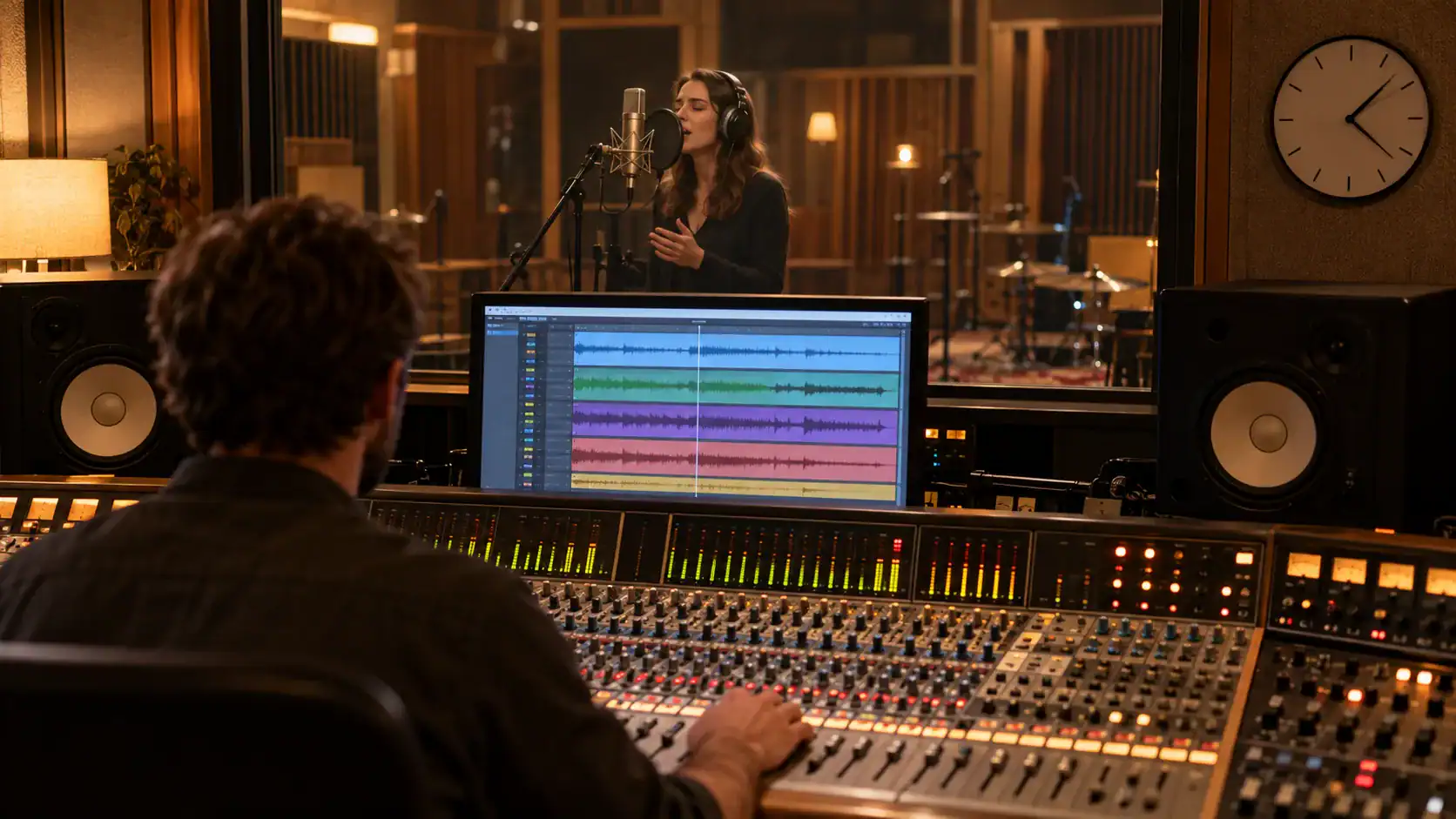
Professional mastering of AI-generated music: What's really missing after Suno?
AI-powered music is no longer a thing of the future. Tools like Suno, Udio, and other AI music generators now make it possible to create complete songs from lyrics, prompts, and musical specifications in a short amount of time. What used to be a complex production process involving songwriting, recording, arrangement, editing, mixing, and mastering suddenly seems possible at the touch of a button.
But this is precisely where a misunderstanding arises.
An AI-generated song is not automatically a finished release. Many songs sound impressive, emotional, or surprisingly professional at first listen. However, closer listening often reveals typical weaknesses: lack of punch, muffled or tinny sound, unbalanced vocals, technical artifacts, little depth, limited dynamics, or a mix that doesn't work reliably on different playback systems.
In our conversation with a client who had a complete AI-produced album, this became very clear. The basic idea was strong: personal lyrics, a unique story, and the desire to turn them into real songs. AI helped to make this idea musically tangible. But the path to a professional result was significantly more complex than many would expect.
AI music isn't simply created by a single prompt
Many people imagine AI music production to be very simple: you enter a few lines of text, roughly describe the desired style, and then receive a finished song. In practice, it often looks quite different.
The client honestly described in the conversation how he generated many versions, deleted them, recreated them, and adjusted them again. Some songs worked quickly, while others took significantly longer. Credits were used up, attempts were discarded, and prompts were repeatedly modified.
This highlights an important point: AI-generated music also needs decisions.
Which version is musically convincing?
Which voice suits the idea?
Which structure actually works?
Where does the AI create errors?
Where does the song sound emotional but technically weak?
Where do you need to generate new data and where is post-processing worthwhile?
Especially with longer projects like an album, it's not enough to just randomly release songs. You have to select, compare, evaluate, and constantly readjust.
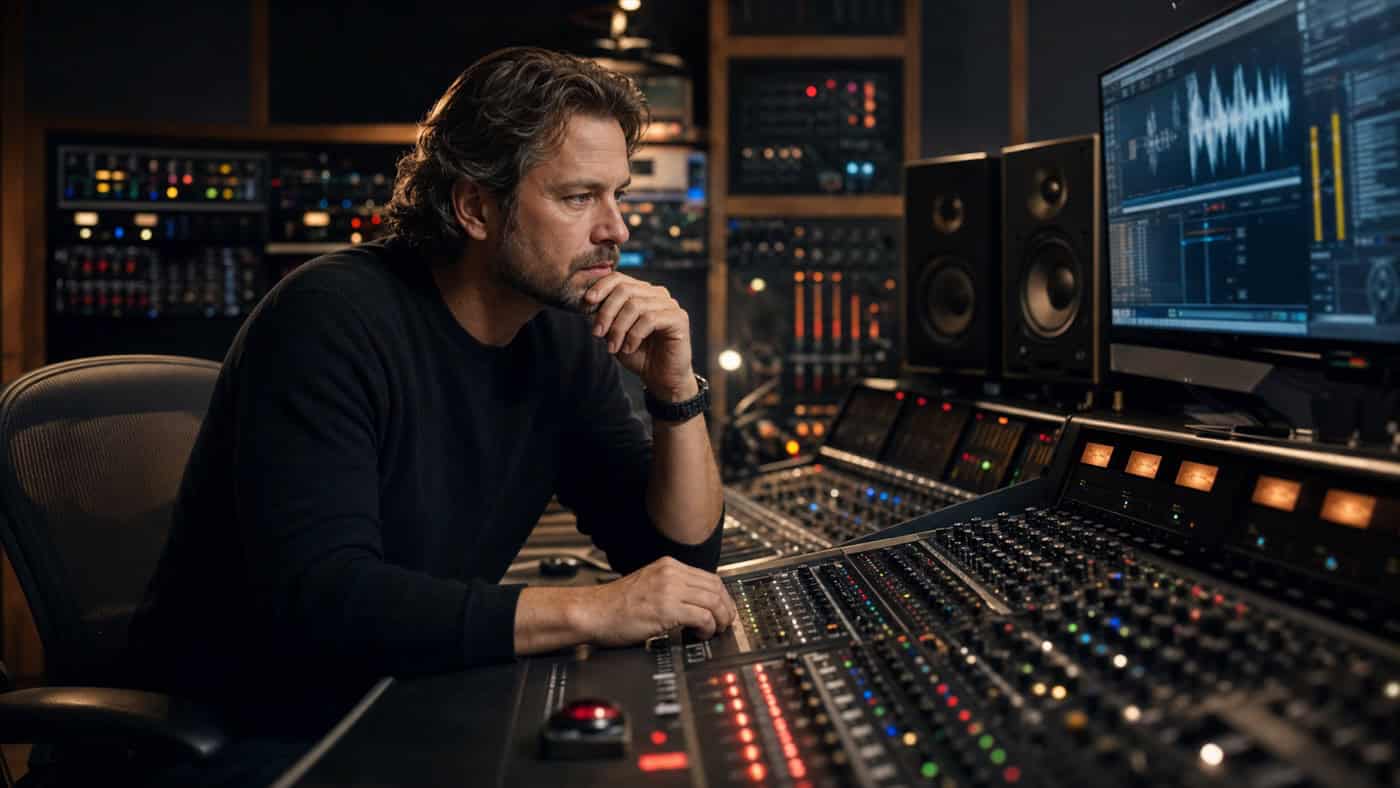
Prompting is a crucial factor in AI-generated music.
A key topic of discussion was prompting. Anyone working with AI-generated music quickly realizes that the quality of the results depends heavily on how precisely the musical instructions are formulated.
It's not just about genre labels like pop, rock, hip-hop, or EDM. Mood, tempo, instrumentation, vocal style, dynamics, song structure, and emotional direction are also crucial. The more vague the specifications, the more random the result becomes.
At the same time, AI-powered music still has clear limitations. Descriptions are not always implemented correctly. Sometimes the system misinterprets instructions. In some cases, even notes or stage directions can appear in the lyrics, although they were only intended as technical specifications.
This makes it clear: AI music production is not automatically easier than traditional music production. It's different. Instead of solely recording instruments or programming tracks, it involves working more with speech, selection, variations, and revision loops.
Anyone wanting to create better AI songs should delve deeply into prompting. Peak-Studios offers a tool specifically for this purpose. free Suno Prompt Generator.
Why many AI songs don't sound ready for release yet
Many AI-generated songs sound surprisingly good on first listen. Especially when the melody, lyrics, and mood are a good fit, the impression quickly arises: "This could be released immediately."
However, this is not always the case technically.
Typical problems with AI-generated music include:
tinny or thin tone
dull passages lacking clarity
lack of pressure in the bass and midrange
unstable or artificial-sounding vocals
Artifacts generated by the process
limited separation between voice and instrumental
unbalanced loudness
little spatial depth
Fluctuating quality between individual songs on an album
This doesn't mean that AI-generated music is inherently bad. On the contrary: many ideas are musically strong, emotionally resonant, and creatively interesting. But there's still a crucial production step between an "interesting song idea" and a "professionally releaseable track."
This is exactly where mixing, stem mastering, and mastering come into play. If you want to know which of these points specifically affect your song, our [link to relevant information] will help you. Mix analysis with written report from €25 Measurement data and a clear recommendation.
Stem mastering for AI music: Why separate processing often makes sense
The album in question wasn't simply a case of making a finished stereo mix louder. Instead, stem mastering was used. This means that certain components of the song, such as the instrumental and vocals, are processed separately.
This can be particularly useful with AI-generated music, because many generated songs offer limited correction options in the final stereo file. When vocals and music are completely blended, problems can often only be fixed to a limited extent. However, if vocals and instrumentals are processed separately, significantly better adjustment possibilities arise.
Stem mastering can improve, among other things, the following aspects:
Make vocals clearer and more understandable
Make the instrumental passages more powerful
reduce disruptive frequencies
open dull areas
To make heights sound more controlled and higher quality
Stabilizing the bass range
Professionally balancing loudness and dynamics
To sonically match songs within an album
The goal is not to completely replace AI. The goal is to process the existing material as professionally as possible.
You can find more information about stem mastering here:
The before-and-after effect: When an idea becomes an audible release
The most interesting moment in the conversation was when the client heard the before-and-after comparison. The original AI versions already had an emotional foundation. The songs worked both lyrically and musically. However, after the professional remastering, a significantly different listening experience emerged.
Suddenly, there was more power, more clarity, more depth, and more emotion. Passages that had previously sounded muffled or weak came across more clearly. The music felt less like an AI-generated draft and more like a finished song.
That's an important point: mastering won't turn a bad song into a worldwide hit. But if the basic idea is sound, professional processing can get a lot out of the existing material.
Especially with AI-generated music, the focus is often on unlocking the potential that is already present in the generated song.
Before you release your Suno or Udio track, it's worth taking a look at the legal aspects: Our guide clarifies who owns an AI-generated song and whether you are allowed to use it commercially. Copyright of AI songs.
AI is a tool, but not a replacement for quality control.
One of the most important insights from the discussion is that AI should currently be understood as a tool.
AI can inspire.
AI can quickly make ideas audible.
AI can help with songwriting.
AI can generate musical sketches.
AI can enable people to turn their own stories into music.
But AI does not automatically replace experience, critical listening, technical evaluation, and professional post-production.
A song needs to work on various systems: headphones, car, smartphone, Bluetooth speakers, studio monitors, and streaming platforms. This is precisely where the differences between a generated demo and a professionally produced release become apparent.
Anyone wanting to release AI-generated music should therefore not only ask: "Does this sound good?" but also:
Is the song technically sound?
Is the voice understandable?
Is the bass controlled?
Does the track sound stable on different devices?
Does the song have enough energy without sounding unpleasant?
Does the loudness meet modern streaming standards?
Do all the songs on an album work together sonically?
The generator alone cannot answer these questions. Experience in mixing, mastering, and music production is required.
Mastering of AI songs at Peak-Studios
At Peak-Studios, we focus intensively on AI music, modern music production, and the professional processing of AI-generated songs. It's not about celebrating or rejecting AI outright. What matters is the final, audible result.
If you're working with Suno, Udio, or another AI music tool and want to publish your songs, professional editing can be beneficial. Depending on the source material, different services are available:
mastering This is suitable if your finished song is already well-balanced and primarily needs loudness, clarity, punch, and streaming compatibility.
https://www.peak-studios.de/mastering/
Stem mastering This is useful if you have separate tracks or stems, for example vocals and instrumental. This allows for more targeted corrections.
https://www.peak-studios.de/mastering/stem-mastering/
mixing It is suitable when there are multiple individual tracks and the song needs to be fundamentally structured, balanced and designed in terms of sound.
https://www.peak-studios.de/mixing/
Mastering AI songs This is particularly interesting if your track comes from an AI tool and you want to know how far the material can be professionally improved.
https://www.peak-studios.de/mastering-von-ki-songs/
If you're unsure whether your AI song is ready for release, you can also upload your project directly or get in touch:
https://www.peak-studios.de/upload/
https://www.peak-studios.de/kontakt/
Who would benefit from professional mastering of AI-generated music?
Professional mastering of AI-generated music is especially worthwhile if you don't just want to listen to your songs privately, but actually want to release them. This is particularly true for:
Artists with AI-generated songs
Songwriters who want to set their own lyrics to music
Content creators with AI music projects
Producers who use AI as an idea tool
People who want to release a complete AI album
Musicians who want to improve the sound of Suno songs
Creatives who want to turn their personal story into music
If it's just a quick sketch or a private demo, the AI output is sometimes sufficient. However, if it's intended to be a professional release, post-processing becomes significantly more important.
Conclusion: AI music can do a lot, but it's not automatically finished.
AI-powered music is an exciting tool. It opens up new creative avenues and makes music production more accessible to many people. Personal ideas, lyrics, or stories, in particular, can be transformed into musical form more quickly.
Nevertheless, one crucial point remains: A generated song is not automatically a finished song.
Anyone wanting to release their AI-generated music should listen to it critically, identify technical weaknesses, and have it professionally processed. Stem mastering, mixing, and mastering can help transform a good AI idea into a significantly higher-quality listening experience.
AI can create music.
But professional music only comes into being through selection, evaluation, editing, and fine-tuning.
You can find more information about the video series "Become a Self-Employed Audio Engineer in 60 Seconds" here:
https://www.peak-studios.de/selbststaendig-als-audioingenieur/
FAQ: Frequently Asked Questions about the Recording Studio Business
Is it possible to have AI-generated music professionally mastered?
Yes, AI-generated music can be professionally mastered. The quality of the source material is crucial. If the song works musically and isn't too technically damaged, mastering or stem mastering can improve clarity, punch, loudness, and balance.
Is a song from Suno automatically ready for release?
Not necessarily. Many Suno songs sound good at first, but have technical weaknesses. These include tinny highs, muffled passages, unbalanced vocals, artifacts, or a lack of punch. Post-production is often advisable for a professional release.
What is better for AI music: mastering or stem mastering?
If only a finished stereo file is available, traditional mastering can suffice. However, if separate tracks or stems are present, stem mastering is often the better choice because vocals and instrumentals can be processed more precisely.
Is it possible to improve AI vocals?
To a certain extent, yes. AI vocals can be improved through EQ, dynamics processing, de-essing, saturation, volume adjustment, and spatial processing. However, strong artifacts or incorrect pronunciation cannot always be completely corrected.
Why does AI music sometimes sound tinny or artificial?
This is often due to the method of generation. AI models generate music from learned patterns and don't always deliver cleanly separated, natural-sounding signals. This can result in artifacts, harsh highs, unclear mids, or limited spatial depth.
Can mastering completely fix errors in AI songs?
No. Mastering can improve a lot, but it can't completely fix every technical flaw. If the original song contains significant artifacts, wrong notes, faulty vocals, or poor structure, the possibilities are limited. The better the source material, the better the result.
Is AI music worth it for an entire album?
Yes, if the concept, lyrics, song selection, and quality control are right. However, an album of AI-generated songs requires particularly careful editing to ensure that all tracks sound cohesive and don't come across as randomly generated individual tracks.
Does better prompting improve sound quality?
Partly. Good prompts can improve style, arrangement, mood, and structure. However, the technical audio quality remains dependent on the specific AI model. Therefore, good prompting doesn't automatically replace professional mixing or mastering.