Mixing 808 bass: fat, clean, and audible on every speaker
A 808 is the deep, long-lasting sub-bass sound that originally came from the bass drum of the Roland TR-808 drum machine and today forms the foundation of hip-hop, trap and many pop productions. Mixing 808 Bass This means, above all, three things: giving the bass space in the frequency spectrum, making it audible even on small speakers through targeted distortion, and rhythmically interlocking it cleanly with the kick drum – core craftsmanship in every professional hip-hop mixingThose who master these three steps will get a bass that carries powerfully without overpowering the mix.
Table of Contents
From drum machine to foundation: a brief look at the Roland TR-808
The story explains the sound: The Roland TR-808 (1980) was an analog drum machine whose bass drum consisted of a filtered, long-sustaining sine wave. Initially a commercial failure, the machine became legendary through electro, Miami bass, and Southern hip-hop – producers pitched the bass drum and played it melodically (the The history of the Roland drum machine is documented on Wikipedia. detailed).
Today, 808 sounds no longer come from the original hardware, but from samples and synthesizers that emulate the TR-808 character: a sine-wave core, long sustain, and optionally distorted overtones. What remains is the name – and the mixing challenge.
Why mixing 808 bass is so difficult
The 808 thrives in the low frequencies: its core typically lies between about 30 and 60 Hz – a range that smartphone speakers, laptops, and small Bluetooth speakers can barely reproduce. Yet, this is precisely where most people listen to music today. This explains the most common problem with the 808: in the studio or on headphones, the bass is massive, but on a mobile phone, it's simply lacking. away.
In addition, there are two further issues: The 808 competes with all other instruments for the lower frequency range – and it also rhythmically clashes with the kick drum, which occupies the same range at the same times. The solution is therefore a three-step process: Create space → Saturation → Sidechain. Next, we'll look at the parallel distortion trick, which is also used by Grammy-winning mixing engineers.
Step 0: Select the correct 808 and tune in
The best mix won't save a faulty source – that's why 808 work begins before the first plugin:
Sample selection. 808 samples differ significantly in attack (kick-like punch vs. soft onset), sustain length, degree of built-in distortion, and the cleanliness of their fundamental tone. Clean, sine-wave sounds are suitable for melodic, long basslines; samples with a hint of distortion are better for aggressive drill or trap beats. A sample with an impure fundamental tone (audible "wobble" during decay) makes any subsequent processing more difficult.
Tuning The 808 is a tonal instrument and must be tuned to the key of the beat – ideally so that the most important notes of the bassline land in the core range around 30–60 Hz. Notes played too low (below ~28 Hz) disappear on almost all systems; notes played too high lose their sub-character.
Use Glide consciously. The characteristic "glide" or "portamento" between two notes is a stylistic device in modern trap productions. During the glide, the fundamental tone moves through different frequencies – resonances then become particularly noticeable. Therefore, always double-check glide passages on multiple listening devices.
A word about layers in advance: Many producers layer a punchy kick over the attack or a mid-bass layer over the sub. Layering works—but each layer increases the phase and collision area. The following steps then apply to the sum of the layers, not to each one individually.
Does your low end sound muddy or disappear on your phone? Peak-Studios brings your 808 to life on any speaker.
Step 1: Make space – the bass range belongs to the 808
Before adjusting the 808 itself, the rest of the beat is cleaned up first. The goal: to eliminate frequencies below a few hundred Hertz. only the 808 (plus Kick).
Low-cuts on all melodic elements. Every instrument that doesn't need to contribute bass – i.e., bells, synths, guitars, samples – gets a high-pass filter. The practical approach: The low-cut in EQ Slowly push the frequency upwards, listening carefully to the point where the instrument starts to sound thin – then stay just below that frequency. For many melodic elements, this will land you in the 300–400 Hz range without any audible damage to the instrument. The resulting free space is precisely what the bass needs.
Utilize stereo width. The second lever is the panorama: melodic elements can be widened with a stereo imager or panned selectively to the sides. The bass, on the other hand, remains in the center – low frequencies belong in the center for physical reasons and mono compatibility. This creates a clear corridor at the bottom of the stereo image. You can find more information about panorama settings in the guide. Panning & Panorama.
Step 2: Saturation – how to make the 808 audible everywhere
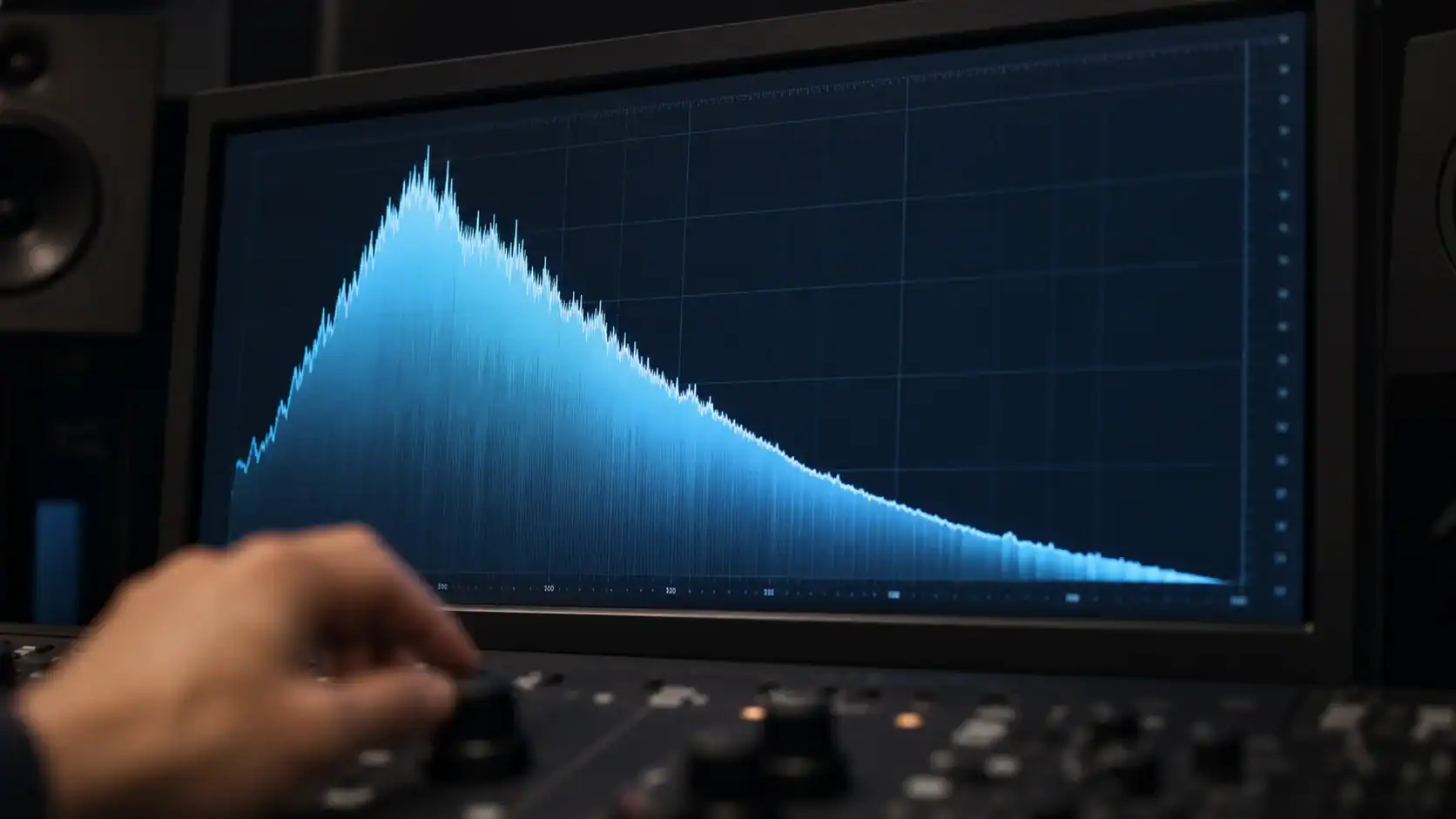
Now to the heart of the problem: How do you make a 40 Hz sound audible on a mobile phone that gives up at 200 Hz? The answer is a psychoacoustic trick: Distortion creates overtones. When the 808 is saturated or distorted, harmonic multiples of the fundamental frequency are created – 40 Hz becomes 80, 120, 160 Hz, and so on. Even a small loudspeaker can reproduce these overtones, and our ears reconstruct the bass impression from them (the effect is known as "missing fundamental").
In practice this means:
- Saturation or Waveshaper on the 808 – from subtle tape saturation to pronounced distortion, depending on the genre.
- Recapturing the new heights. Distortion also creates high-frequency harmonics that clash with vocals, snare, and hi-hats. Therefore, a steep hi-cut should follow the distortion – the 300–400 Hz range has proven to be a good starting point.
- Dosage according to style. Heavily distorted 808s, with prominent high frequencies, are a distinctive stylistic choice – but they can overpower vocals and instruments. For a more subtle yet present bass, lower the hi-cut.
Related, but not identical: Soft clipping It cuts off peak levels and makes the sound louder and more assertive – this also creates overtones, but primarily works on the dynamics. In practice, many engineers therefore combine both.
Step 3: Sidechain – Interlocking the 808 and Kick
The kick drum and the 808 occupy the same frequency range – in every genre, these two elements interfere with each other. If both collide simultaneously at full volume, the result is muddiness or uncontrolled pumping in the low end.
The standard fix is sidechain compressionA compressor on the 808 is controlled by the kick drum signal. Whenever the kick drum hits, the compressor briefly attenuates the bass – giving the kick its attack moment, then the bass continues to drive the signal. When set correctly (short attenuation, fast release), the effect isn't perceived as pumping, but rather as clean, crisp sound.
Alternatives and additions:
- Arrangement solution: Position the kick and 808 so that they overlap exactly as infrequently as possible – the cleanest solution if the beat allows it.
- Transient solution: To take the attack off the bass or to leave the attack on the kick drum (keyword) transients) and smooth the transitions.
- Don't forget tuning: An 808 that is not tuned to the key of the beat will sound out of tune even with perfect mixing.
Only when these three steps are mastered does 808 bass mixing become more about fine-tuning than a struggle – for example with the following professional trick.
The parallel distortion trick (“screamer track”)
Anyone who wants to mix 808 bass like the pros knows a more elegant variation of step 2 for maximum control – a trick used by Grammy-winning mixing engineers, among others. Instead of distorting the 808 itself, you build a parallel distortion track:
- Create a copy: The 808 will initially be routed to a second channel – the original remains untouched.
- Distort only the sub-area: On the copy, a steep high-cut is then applied at approximately 150 Hz – leaving only the pure sub-bass. This is then strong distorted (classically with a Tube Screamer-style overdrive; any powerful distortion plugin will work).
- Narrowing down the results: After distortion, the track is also trimmed: a low-cut around 200 Hz (the low frequencies are supplied by the original) and a high-cut around 400 Hz. What remains is a narrow band of newly generated harmonics in the lower midrange.
- Add to: This "screamer track" is then mixed below the original track to the extent required by the song.
The advantage over direct distortion: the original sub-bass and overtone content remain intact. separately adjustable. On large systems, the clean subwoofer takes over, while on small speakers the parallel track takes over – and the balance can be readjusted at any time without affecting the basic sound.
YOUR CONTACT TO PEAK-STUDIOS
Looking for a low-end phone that can handle everything from the club to your mobile? Send us a message – we usually get back to you within 3 hours (on weekdays).
- Personal point of contact
- Over 20 years of experience
- Highest quality standards
You can reach us by phone from Monday to Friday from 9 a.m. to 8 p.m.
808 Bass mixing and control: the three monitoring options
An 808 mix is only finished when it works in three listening situations:
- Studio monitors / good headphones – Is the low-end foundation solid? Is the sidechain pumping cleanly?
- Mobile phone/laptop speaker – Is the bass also recognizable as a tone (overtones!) or does it disappear?
- Automotive or consumer electronics Does it eventually sound boomy on certain notes? Then individual notes are too loud – a dynamic EQ on the problem frequencies will help.
This also includes a reference track: A professionally mixed song of the same genre, with the levels adjusted, immediately reveals whether your own low end is too fat or too thin – the ear adapts to any amount of bass during mixing, but the reference track doesn't. Therefore, anyone who regularly mixes 808-heavy music should build up a small playlist of such references.
808 and Loudness: What happens to the bass during mastering
One often overlooked point: Low frequencies consume a disproportionate amount of energy in the signal level budget. A mix whose 808 is delivered too hot forces the mastering limiter to duck the entire song with every bass hit – the result is either pumpy or lacks punch. Three consequences:
- Leave headroom. The bass should be present in the mix, but not dominate the overall sound – a controlled low end is a prerequisite for a loud, clean master.
- Mono below ~120 Hz. Stereo components in the sub-bass consume energy and make vinyl and club playback problematic.
- Know the loudness target. Our guide covers how to master loud hip-hop and rap productions with a dominant low end. How loud should hip-hop and rap master be?; all other topics related to the Master's program are also bundled in the Mastering Guide.
In short: The decision about how fat the bass will be is made in the mixing – how loud it reaches the listener, on the other hand, is made in the mixing. mastering.
Genre practice: not every 808 wants the same thing
The three steps apply everywhere, but the dosage differs:
- Trap/Drill: Samples are often already distorted, glide basslines and sidechain are clearly audible as stylistic devices. Parallel distortion is almost always useful.
- Boom-Bap/classic hip-hop: Bass rather round and short, less distortion, kick more dominant – here the arrangement often resolves the collision.
- Pop/R&B with 808 elements: Subtle saturation, conservative low end so that vocals and instruments retain their space.
- Phonk/Memphis styles: Deliberately distorted, overdriven sounds as the identity of the genre – here, the “unclean” version is the goal.
If you're unsure where your song stands: analyze current reference productions of the genre and compare the bass presence – the range is wider than you think.
Tools: Stock plugins are sufficient
None of the described steps require expensive specialized plugins – because every modern DAW includes the necessary tools: an EQ with steep filters (ideally with an analyzer), a waveshaper or distortion plugin for harmonic processing, a compressor with a sidechain input, a stereo imager for widening and mono control – and optionally a dynamic EQ for precision when individual notes stand out. A good starting point for exploring sound generation is also provided by... Ableton production tutorialsFor those who prefer to learn the techniques under guidance: In our One-to-one lessons for mixing and mastering Let's go through exactly these kinds of low-end cases together.
More important than the equipment, however, is the listening environment: If you can't hear your low end, you're mixing blind. Good headphones with a robust bass response are therefore a more reliable reference for this task than small monitors in untreated rooms.
Checklist: Mixing 808 bass in 10 points
- First, select a sample with a clean fundamental tone and tune it to the song's key.
- Then check the lowest notes (core range ~30–60 Hz)
- Then apply low-cuts to all melodic elements (auditory guidance, often ~300–400 Hz)
- Additionally, widen/spread the melodic elements – the bottom center remains free.
- Then apply saturation/waveshaper to the 808, followed by a steep hi-cut.
- Alternatively or additionally: the parallel distortion track (150 Hz hi-cut → distortion → 200–400 Hz band)
- Setting up the sidechain: The kick drum controls the bass compressor (short, fast release)
- Furthermore, keep the sub-bass mono – no stereo effect below ~120 Hz.
- Finally, listen together on monitors, mobile phone and consumer equipment.
- Finally, leave headroom for mastering.
These ten points are therefore intended as a work sequence – from the source through the mix to the handover.
Common mistakes in 808 mixing
- Boosting 808 instead of creating space. Turning up the bass instead of reducing the low frequencies of the other instruments results in a muddy sound.
- Distortion without a high-cut filter. Otherwise, unfiltered distortion overtones would take up space that could be used for vocals and snare drum.
- No sidechain, no arrangement check. Playing kick and bass at full volume simultaneously is the most common cause of an undefined low end.
- Inconsistent sample. Not tuned to the correct key – this is immediately noticeable on large sound systems.
- Based solely on a wiretap. Therefore, checking the mobile phone is part of the standard workflow.
- Stereo effects on the sub-bass. Width belongs in melody and effects, not below ~120 Hz.
Conclusion: Mixing 808 bass in three steps plus a pro trick
A fat 808 bass isn't some secret, it's simply a matter of skill performed in the right order: first create space (low-cuts + panning), then generate harmonics (saturation with a high-cut or parallel distortion), and finally resolve the kick drum collision (sidechain, arrangement, transients). Those who also pay attention to tuning and multiple monitoring setups will consequently get a bass that performs well from club systems to mobile phones.
If you'd rather have your beat or song brought to this level by professionals: Our Hip-hop mixing is specialized in precisely this low-end work – and in mixing Bass-kick balance is standard for all genres. The cost of that is shown by... Cost calculator in one minute.
FAQ: Frequently Asked Questions about the 808 Bass
How do you mix 808 bass effectively?
In three steps: First, create space by applying a low-cut to all melodic elements and moving them into the stereo field. Second, saturate or distort the 808s and limit the new harmonics with a high-cut so that the bass becomes audible even on small speakers. Third, resolve the clash with the kick drum using sidechain compression or arrangement.
What is the 808 bass?
The 808 bass is the deep, sustained sub-bass sound from the Roland TR-808 drum machine (1980). Originally a bass drum, the sound is now pitched and played melodically – it is the foundation of trap, hip-hop, and many pop productions.
Is 808 the same as bass?
No. “Bass” generally refers to low frequencies or bass instruments; the 808 is a specific sub-bass sound with its own sonic character (sine-like core, long sustain) that is used as a bass instrument.
What effect do 808 bass drivers have on the body?
Frequencies below approximately 60 Hz are not only heard but also felt physically as vibrations – on large systems, in the chest and abdomen. It is precisely this physical effect that makes 808-heavy music so effective in clubs; it is absent on small speakers, which is why overtones are so important in the mix.
Why can't I hear my 808 on my mobile phone?
Because small speakers can barely reproduce frequencies below ~150–200 Hz. The solution is not more volume, but overtones: saturation or a parallel distortion track makes the fundamental tone audible as harmonic multiples.
808 and Kick – which comes first?
The kick drum needs its attack, the 808 its sustain. Using a sidechain, the kick drum cuts the bass for milliseconds; alternatively, both can be placed offset in the arrangement. Without this separation, the typical muddy low end results.