Deezer's AI Music Detector: What this means for artists

On June 11, 2026, Deezer released a free AI music detector that can check playlists on around 20 streaming services—including Spotify, Apple Music, SoundCloud, and YouTube Music—for songs generated entirely by AI. This allows virtually anyone to identify AI-generated music without any specialized knowledge: The tool finds typical audio traces of generative models like Suno and Udio. For artists, producers, and labels, this means one thing above all: Authenticity, clean metadata, and traceable documentation are becoming essential, not just a "nice-to-have."

How AI music is created with Suno is explained in our [article/section/etc.] Suno Tutorial.

We at Peak-Studios see this from practical experience: We receive material daily for Mix and MasternThis increasingly includes songs in which AI tools have played a role. The technology itself is rarely the problem. The problem arises when no one can say where a track comes from, who created it, and under what license it's released. This is precisely where the new reality that Deezer has just made visible comes into play.

This post contains:

What exactly Deezer launched

Deezer has been operating its AI recognition internally since early 2025. What's new is that the service has now opened this technology up to end users as a free, public online tool – across all platforms. Users can connect their streaming library (Deezer says it supports around 20 services, including Spotify, Apple Music, SoundCloud, and YouTube Music), and the tool will flag playlist entries it classifies as entirely AI-generated. Previously, recognizing AI-generated music required a trained ear – now, a single click is all it takes. According to Deezer, the recognition works in 27 languages ​​and identifies tracks from the major generative models Suno and Udio with over 99 percent accuracy.

Important for context: Deezer claims to be the only major service that not only recognizes AI-generated music but also actively labels it, excludes it from recommendations, and removes it from editorial playlists. Other platforms like Spotify and Apple Music have so far pursued a labeling or transparency approach without fundamentally devaluing AI-generated tracks. With its public detector, Deezer is now essentially exporting its perspective beyond its own platform boundaries: Even those without a Deezer subscription can check other catalogs.

The numbers — and what they really say

The scale of it is what's really alarming. Deezer is registering according to own statements There are now almost 75.000 AI-generated tracks per day—that's around 44 percent of all newly uploaded songs and a total of more than two million tracks per month. The increase has been rapid: from about 10.000 tracks daily in January 2025, to 30.000 in September and 50.000 in November, to around 60.000 at the beginning of 2026, and finally 75.000 in the spring.

However, a closer look is warranted here, as a simplistic interpretation is misleading. The fact that almost half of the uploads are AI-generated does not mean that half of what is listened to is AI. On the contrary: according to Deezer, the actual consumption of AI-generated music remains very low, at only around 1 to 3 percent of all streams. Most of these millions of tracks are therefore hardly ever, if at all, listened to.

The real risk lies in the next detail: Deezer classifies this already small stream share as... up to 85 percent as fraudulent AI-generated streams are defined as those that don't stem from genuine listener interest but are artificially created, for example by botnets, to collect royalties. These streams are demonetized. According to the service, it identified and labeled approximately 13,4 million AI-generated tracks by 2025.

So, to be clear about the statement: It's not that "85 percent of the music" is fake. It's that up to 85 percent of the streams are from those AI-generated tracks that generate any streams at all—and this area puts a strain on the royalty pools from which real artists are also paid.

How AI mass uploads strain the royalty system

To understand why even a small share of streaming revenue is dangerous, one needs to briefly examine the mechanics of the payout. Most streaming services operate on a pro-rata model: all subscription and advertising revenue for a month flows into a large pool, and this pool is then distributed proportionally based on the volume of streams. Every stream—whether from a real fan or a bot—takes a tiny piece from the same pie.

This is an invitation to fraud: Anyone who uploads tens of thousands of AI-generated tracks in a short time and has them played artificially via automated streams can rake in massive amounts of micropayments. Every one of these fraudulent cents is ultimately missing for the artists with real listeners. Demonetizing fraudulent streams is therefore not harassment of AI, but rather a way to protect the common pool of income—and the detector makes the suspicious tracks visible in the first place.

How the AI ​​detector recognizes music — and where its limits lie

Generative audio models leave characteristic traces. Unlike a human recording, which reflects the room, microphone, playing errors, and mixing decisions, models like Suno or Udio generate statistically smoothed signals with recurring patterns—for example, in the distribution of overtones, in the behavior of transients or in the manner of stereo image and Hall flags are built.

Specifically, recognition systems look for patterns that human images typically do not show with this consistency: a strikingly constant pattern. Loudness profile Without natural dynamic shifts, smoothly interpolated transitions between notes instead of genuine articulation, recurring structures in the stereo image, and a frequency spectrum lacking the subtle irregularities of the room, microphone, and instrument. Human productions contain a "noise" of micro-details—breathing sounds, string strikes, minimal timing variations—that generative models have so far struggled to convincingly reproduce.
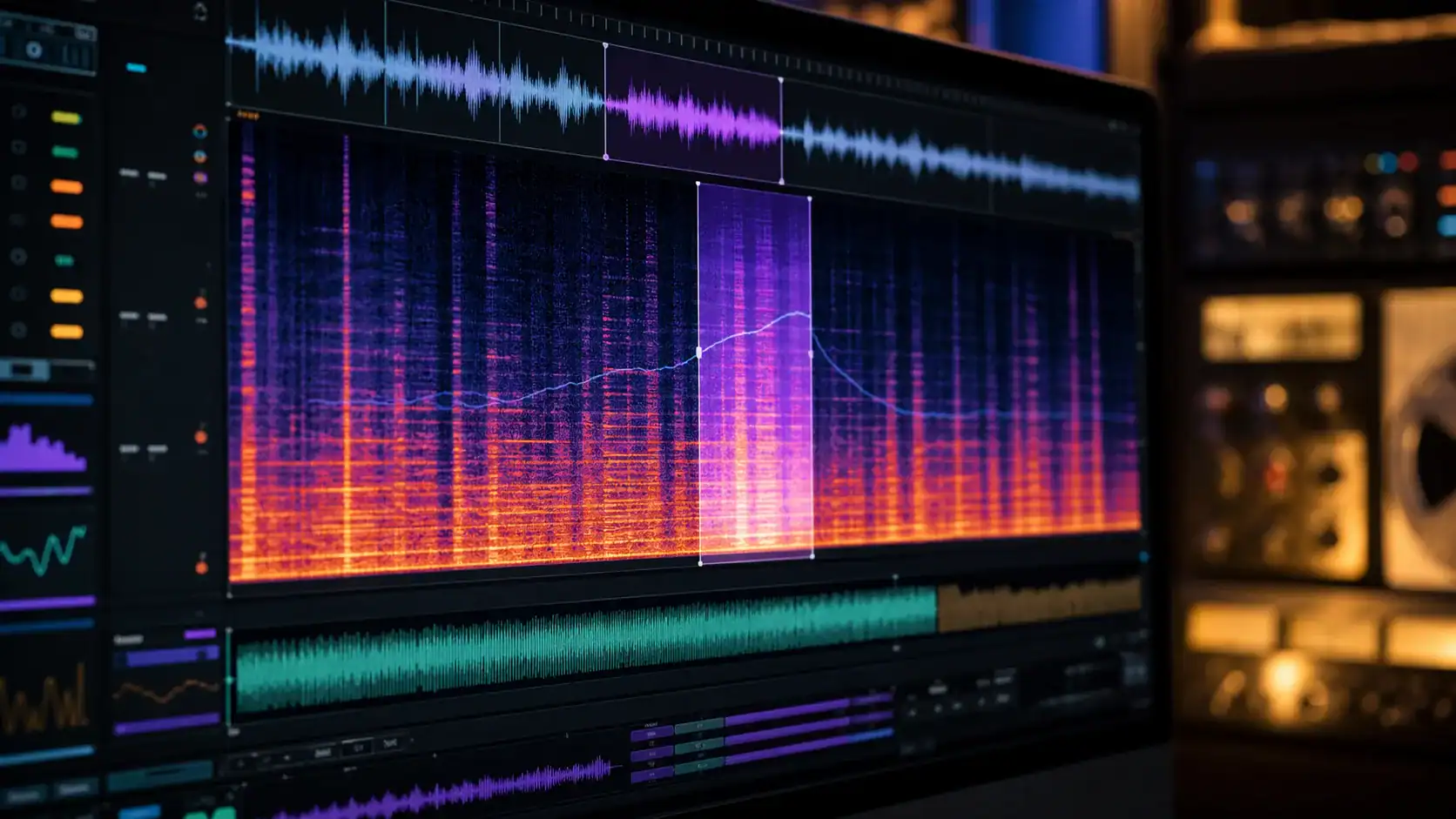
Audio analysis using spectrogram and waveform, which can be used to identify AI music.
Spectrogram analysis: Recognition systems search for patterns that human images do not show.

There are three things one should consider realistically. First The public detector targets tracks generated entirely by AI. Songs in which AI only partially participates—for example, an AI instrumental with real vocals—are technically much more difficult to categorize unambiguously. Secondly No detection system is perfect: A hit rate of over 99 percent leaves room for misclassifications in both directions. A marking is a signal, not a court ruling—but it can have real consequences. thirdly Is this an arms race: The better AI systems can recognize music, the more models are optimized to cover their tracks?

Anyone wanting a deeper understanding of how to measure the technical properties of a signal will find more information in our Audio Glossary the basics of concepts such as LUFS, True Peak or Dynamic Range — because precisely these kinds of indicators are part of what makes a production seem “human” or “synthetic”.

Unsure if your mix is ​​really good? Get an honest, professional assessment with our mix analysis – before you master or release.

Why this is far more than just a Deezer issue

The crucial point about the public detector is its cross-platform capability. Until now, the AI ​​debate could be dismissed as an internal problem of individual services. Now, a tool is available that can identify AI-generated music without accessing the platform itself—it evaluates catalogs from other services. This changes the dynamics:

  • listener They are given a tool to question their own playlists, creating pressure on all involved.
  • Curators and playlist operators They are becoming more cautious because a later AI-based tagging of a song in their list poses a reputational risk.
  • Rights holders and labels Arguments for a cleaner distribution of royalties are gained because the link between AI mass uploads and stream fraud has now been identified.
  • Sync and license customers (Film, advertising, games) will require proof of authenticity to avoid introducing legal gray areas into the project.

This means that AI is no longer just discussed as a creative tool, but as a risk to royalty flows — forcing services, distributors and artists alike to establish labeling systems and proofs of authenticity.

What AI music specifically means for artists, producers and labels

The good news first: If you work honestly and transparently, this development is your ally, not your enemy. The more mass-produced AI content and stream fraud are filtered out of the royalty pools, the fairer the distribution for genuine releases will become. The bad news: "Working honestly" isn't enough if you can't prove it.

Specifically, the focus is shifting from pure production to documentation. Three areas are becoming business-critical:

  • Metadata — all the information that travels with your song: title, artist, contributors, roles, release date, and unique identifiers. Incomplete metadata is now the most common reason for payout problems.
  • Unique identifiers — especially the ISRC, which makes every recording uniquely identifiable worldwide and creates a hard, verifiable trail.
  • Proof of production — the ability to show, if necessary, how a song was created: project files, Stems, Sessions, Participant lists.

For labels and distributors, this means: those who manage catalogs should now set up processes that enforce these three areas with every release — not as bureaucracy, but as protection of their own revenue.

Metadata and documentation: the new mandatory standard

For a long time, metadata was considered a bothersome add-on, something you filled out haphazardly just before uploading. That's over. In an environment where almost half of all uploads are AI-generated and platforms filter automatically, the quality of your metadata is a direct economic factor.

Music producer documents metadata and credits of a track on laptop in studio
Clean metadata and credits are a sign of trust today — and the best protection against payout problems.

Ideally, robust documentation for a release today includes:

  • Track level: final title, artist name(s), featured guests, ISRC, ISWC (for the composition), genre, language, release date, label/distribution.
  • Credits: All contributors with a role — songwriting, performance, production, recording, mixing, mastering. The clear separation of "who did what" distinguishes a human production from anonymous AI-generated mass-produced goods.
  • Technical delivery: correctly exported files in the correct resolution and without ClippingOur article describes how to do this properly. Guide to data delivery — including Stem export, if individual traces are to remain traceable.
  • Proof of origin: A brief note indicating if AI tools were used and to what extent. Transparency is increasingly becoming a requirement here.

The crucial point: This documentation is best created during production, not afterward. Anyone who only starts reconstructing credits during the upload process will introduce errors. Those who document properly from the beginning have the evidence readily available in case of a dispute.

Questions about AI, labeling, or your release? Write to us.

Whether you're unsure how to properly document an AI-powered track, whether a Suno or Udio song is release-ready, or what metadata is needed for streaming, syncing, and licensing—we'll help you honestly and straightforwardly. Write to us using the form or simply give us a call.

You can reach us by phone from Monday to Friday from 9 a.m. to 8 p.m.

How real music differs from AI music

From our daily work at the mixing console, we know: A handcrafted production sounds different because it consists of genuine decisions. Mix Each track is deliberately placed in the soundstage, its volume, depth, and frequency carefully balanced—with subtle inconsistencies that a model doesn't "invent," but rather that arise from the material itself. Mastering adds a final, audible human assessment: How loud can the song be without becoming fatiguing? Where does it need air, where does it need punch?

Hands on the analog mixing console — human craftsmanship distinguishes real music from AI music
Real production arises from audible decisions at the mixing console — a history that mass-produced AI products lack.

This decision-making process is not only relevant to the sound, but also an argument for authenticity. A song that has demonstrably gone through a professional mixing and mastering stage — with session files, version changes, and a mixing or mastering engineerThe artist who stands behind this has a verifiable production history. This is precisely the kind of history that anonymous mass-produced AI cannot boast. In a world where machines churn out music in seconds, the traceable human process becomes a distinguishing feature—and this is exactly how AI music can be identified.


AI as a tool or AI as a risk — our stance

We're not an anti-AI studio. AI tools can be useful in the workflow: for brainstorming, sound processing, and routine tasks. We also master songs where AI has played a role—that's legitimate as long as it's done transparently. If you want to have an AI-powered track professionally finalized, we can help; more on that in the article. Get AI to master songs.

The difference lies not in the tool, but in the attitude behind it. There is a clear difference between:

  • AI as a tool — a human makes the creative decisions, AI provides support, and the result is clearly attributable to a person who stands behind it.
  • AI as a mass — anonymous, automated uploads on an industrial scale, often without any real creative ambition, sometimes specifically for the purpose of extracting royalties via manipulated streams.

Deezer's detector targets the second category. Those who fall into the first have nothing to fear—provided the source is documented. For honest creators, the fact that platforms can identify AI-generated music is therefore not a risk, but a protection: it separates verifiable work from anonymous mass-produced goods.

The legal framework: EU AI Act, labeling and streaming rules

Important note: The following points provide a general overview and do not constitute legal advice. For binding information in specific cases, you should seek expert advice.

The political and legal framework is moving in the same direction as Deezer's technological move. The EU AI Act stipulates transparency and labeling obligations for AI-generated or manipulated content; the ability to recognize and label AI-generated music is therefore not just a platform whim, but part of a larger regulatory trend. At the same time, streaming services are tightening their terms of service regarding artificial streams and automated uploads, and in copyright law, the question of... who actually owns an AI song, including AI training data and the ability to protect purely AI-generated works, which are still in motion.

For you as an artist or label, this practically means: Don't assume that "anything that's technically possible is allowed." The requirements for labeling, origin, and a clean chain of rights are becoming stricter, not less so. Those who document transparently today are prepared for future obligations instead of having to chase after them.

What you should do to recognize AI music and work cleanly

You don't have to reinvent your studio. But a few habits will pay off from now on:

  1. Check your own releases. With the detector, you can identify AI-generated music before a licensee does — use it on your own tracks, especially if AI tools were involved. It's best to avoid surprises beforehand.
  2. Assign and document ISRCs properly. A unique identifier for each recording is the basis of any traceability.
  3. Maintain full credits. Who wrote, played, sang, produced, mixed, mastered? This list is your human fingerprint.
  4. Archive project files and stems. They are your proof of authenticity in case of doubt.
  5. Be transparent about your use of AI. A short, honest note protects you better than remaining silent — especially with regard to labeling requirements.
  6. Get someone else involved to help with the finalization. Professional mastering not only gives your song sound, but also a verifiable, handcrafted production stage — adding another layer of authenticity.

Ready for the finished sound? Have your track mastered by Peak-Studios – transparent, traceable and with a clear production history.

Conclusion: Authenticity becomes measurable

Deezer's AI music detector is less a technological marvel than a signal: the music industry has begun to make authenticity measurable and visible. The fact that AI-generated music can be identified is just the beginning—the numbers (75.000 AI tracks per day, 44 percent of uploads, up to 85 percent fraudulent streams in the AI ​​segment) show why this is necessary. For reputable artists, producers, and labels, this is an opportunity: those who document, label, and deliver cleanly—ideally with professional mixing and mastering—stand out from the crowd and protect their share of royalties. AI is not the enemy. But it transforms documentation and transparency into what they should have been all along—an integral part of every professional release.

FAQ: Frequently Asked Questions about the AI ​​Music Detector

The public detector primarily targets tracks generated entirely by AI (such as those from Suno or Udio). Hybrid tracks with human and AI components are technically more difficult to categorize and remain a gray area.

On Deezer, tracks identified as AI-generated are marked, removed from recommendations, and excluded from editorial playlists. Transparency is crucial: documented, partial use of AI is different from anonymous mass production.

No detection method is perfect. Your best protection is proof of authenticity: project files, stems, credits, and ISRC. This verifies human origin.

Because almost half of all uploads are AI-generated and platforms filter automatically, complete and accurate metadata is now a sign of trust and the most common way to avoid payout problems.

Yes — as long as the use is transparent. We finalize AI-powered tracks to release-quality sound; more on this in the article "Mastering AI Songs".

Image by Chris Jones

Chris Jones

CEO – Mixing and Mastering Engineer. Founder of Peak-Studios (2006) and one of the first online service providers for professional audio mixing and mastering in Germany.