Who owns an AI-generated song? Copyright and usage rights belong to Suno & Udio.

An AI-generated song from Suno or Udio raises two separate questions: Does it even create a Copyright Law the song – and are you allowed to play it loudly? Terms and Conditions of the Platform Use? The two are not the same. In Germany and the EU, copyright protection only arises where a human is involved in the creative process. Simply prompting is generally not enough. This guide explains what really applies to the copyright of AI-generated songs – and how you can secure robust rights.

Contents of this article

Technical terms explained simply

Before we begin: A few technical terms come up when discussing the copyright of AI-generated songs. Here are the most important ones explained in simple terms – so you can read the rest of the guide with ease.

  • Copyright: The right of a person who has created a work. In Germany, this right arises automatically – you don't need to register anything. The prerequisite: A person has created something creative.
  • Work: A unique, creative creation – for example, a melody or song lyrics. A mere idea or the push of a button is not enough.
  • Related rights: The right to a specific sound recording – separate from the right to the song itself. It protects the production rather than the composition.
  • Record manufacturer: Who produces a recording or pays for its production? With AI-generated audio, it's often unclear whether that's the user or the platform.
  • Ownership (Terms and Conditions): English for "property". In platform terms and conditions, it refers to what the platform contractually assigns to you – that is not automatically a copyright.
  • Usage rights / license: Permission to use something (e.g., to release a song). One can have a license without being the copyright holder.
  • Stems: The individual audio tracks of a song (e.g. vocals, drums, bass) are separated from each other – practically for mixing yourself.
  • Sample: A sampled excerpt from someone else's recording. Even short, recognizable samples can infringe on copyright.
  • Deepfakes: Artificially generated content that appears real – for example, a fake voice. This is subject to special transparency requirements.
  • EU AI Act: The EU's AI law. It does not create a new copyright law, but requires, among other things, that AI-generated deepfakes be labelled.

Four levels: What is actually protected in an AI song

The most common misconception regarding the copyright of AI-generated songs is lumping everything together. "My song" isn't a single legal right, but rather a bundle of several. Before asking "Do I own the song?", it's better to ask: "Which levels of copyright are actually involved here?" At least four come into play with an AI-generated track – and they can easily diverge.

  • The copyright of the song itself —that is, melody, lyrics, and structure. It protects creative work, but only if it originates from a human being.
  • The right to the specific recording (Technical term: neighboring right). This is different from the right to the song and primarily concerns the person who produced the recording.
  • The platform's terms and conditions. Suno or Udio can allow you to use the song via their terms and conditions – regardless of whether a legal copyright arises.
  • Other people's rights – on samples, uploaded material, foreign voices or familiar melodies.

Why this distinction is important: According to the terms and conditions, an AI-generated song can "belong" to you, yet still not be a legally protected work. Conversely, a track into which you've invested a lot of your own work can infringe on someone else's rights through a single sample from another source. Those who understand this read terms and conditions differently—and produce differently.

Who owns an AI song? The idea, the expression, and the human contribution.

Regarding the copyright of AI songs, a simple basic rule applies: Humans, not AI, make the decisions. What's important is not that you used a program – what's important is whether du whether you made the creative decisions or just pressed a button.

Idea or expression – where is the line drawn?

This is based on an old rule from copyright law: A mere Idea is free, only the concrete Ausdruck is protected. Someone who types "make me a sad pop song with a female voice" in Suno is only describing an idea. Nobody possesses ideas. However, someone who writes the lyrics themselves, provides a melody, determines the chords, transitions, and structure, and ultimately mixes it all, is shaping the Ausdruck – and that is exactly the person the law can protect.

Put simply: the more of your own creative work is involved, the more rights you have. The more the AI ​​does on its own, the fewer rights you have.

A quick overview

The following table categorizes typical situations – as of May 2026 and always dependent on the individual case. It is not a law, but a rough probability map for the copyright of AI-generated songs.

What you doGermany / EUUSAUK
Just a quick prompt, song uploaded unchangedRather no protection – pressing a button alone is not enoughCurrently mostly noMaybe. (Special rule), but controversial
Many attempts, in the end only one result was selectedSelection alone is usually not enough.Simply trying things out does not count as authorship.More or less recorded, but unclear
Your own lyrics, melody, or chordsGood chances of protection of your partsProtection of human parts possibleGood chances as an independent work
Own arrangement, editing, mixing and masteringProtection can be justified if it is truly one's own creative work.Selection and editing can be protected.The collaboration between humans and AI is a work in itself.
Fully automatic song without any real personal contributionAbout us no copyrightNot registrableSpecial case, legally unclear
Foreign music, samples, or "style" from foreign materialVery risky – foreign rights must be clarifiedAdditional risk with famous voicesAcquisitions can infringe on third-party rights

In short: If you sing your own vocals instead of using the AI ​​voice, or the Suno stems mix yourself, you're not just improving the sound – you're also improving your rights.

Two examples that illustrate the difference

Case A: Lisa types a prompt, presses "Generate" twenty times, and uploads the best result unchanged. Her only contribution is the selection. In Germany and the USA, this process hardly creates any separate copyright on the song.

Case B: Tom writes his own lyrics, hums a melody, has the instruments generated automatically, rebuilds the arrangement in his music software (DAW), edits, mixes, and masters. Tom has shaped the song himself in many ways – and is therefore in a much stronger legal position. Both of them "only" used AI. The difference lies in their own contribution.

Germany & EU: The human-centered standard

The German rule regarding the copyright of AI-generated songs is short and clear. The law states: "The copyright holder is the creator of the work" (Section 7 Copyright Act), and only "personal intellectual creations" are protected. The German Patent and Trademark Office therefore clearly states: A song that originates entirely from AI is not protected. If, on the other hand, you only use AI as a tool, it depends on the individual case.

Copyright on AI songs: What this means in concrete terms

So you don't become the author simply because you had the idea or pressed a button. You only become the author when you make your own musical decisions. The highest EU courts also draw this line: a work must be a person's "own intellectual creation," with "free and creative decisions." A song created solely by a machine can therefore hardly be considered a protected work in the EU.

If you further process AI material, the following also applies: It contains on the fret For copyrighted material, you need to clarify the rights to that material. AI doesn't make other people's rights disappear.

Ancillary copyright and the EU AI Act

There is a second level, the neighboring right (Simply put: your own right to a specific sound recording – separate from the right to the song itself). Whoever creates a recording has their own rights to it. However, with AI-generated audio, it's unclear who is considered the producer: you, the platform, or both. This is precisely why the platform's terms and conditions are so important.

We must temper a common hope: So far, there is no such thing in the EU. no A special rule automatically grants copyright to AI-generated songs. However, the important thing for you is... EU AI ActAnyone using AI to create deceptively realistic voices or "deepfakes" must disclose that the content is artificial. This will become more important in practice from August 2026. This doesn't create a new copyright law, but it affects everyone who works with synthetic voices – similar to the existing copyright regulations. Handling AI watermarks.

Prefer a real, professionally produced track to AI-generated randomness? Peak-Studios produces your music.

USA, UK & international: Where the rules diver

Once you start publishing internationally, it's worth looking beyond your borders. Copyright laws for AI-generated songs vary significantly from country to country.
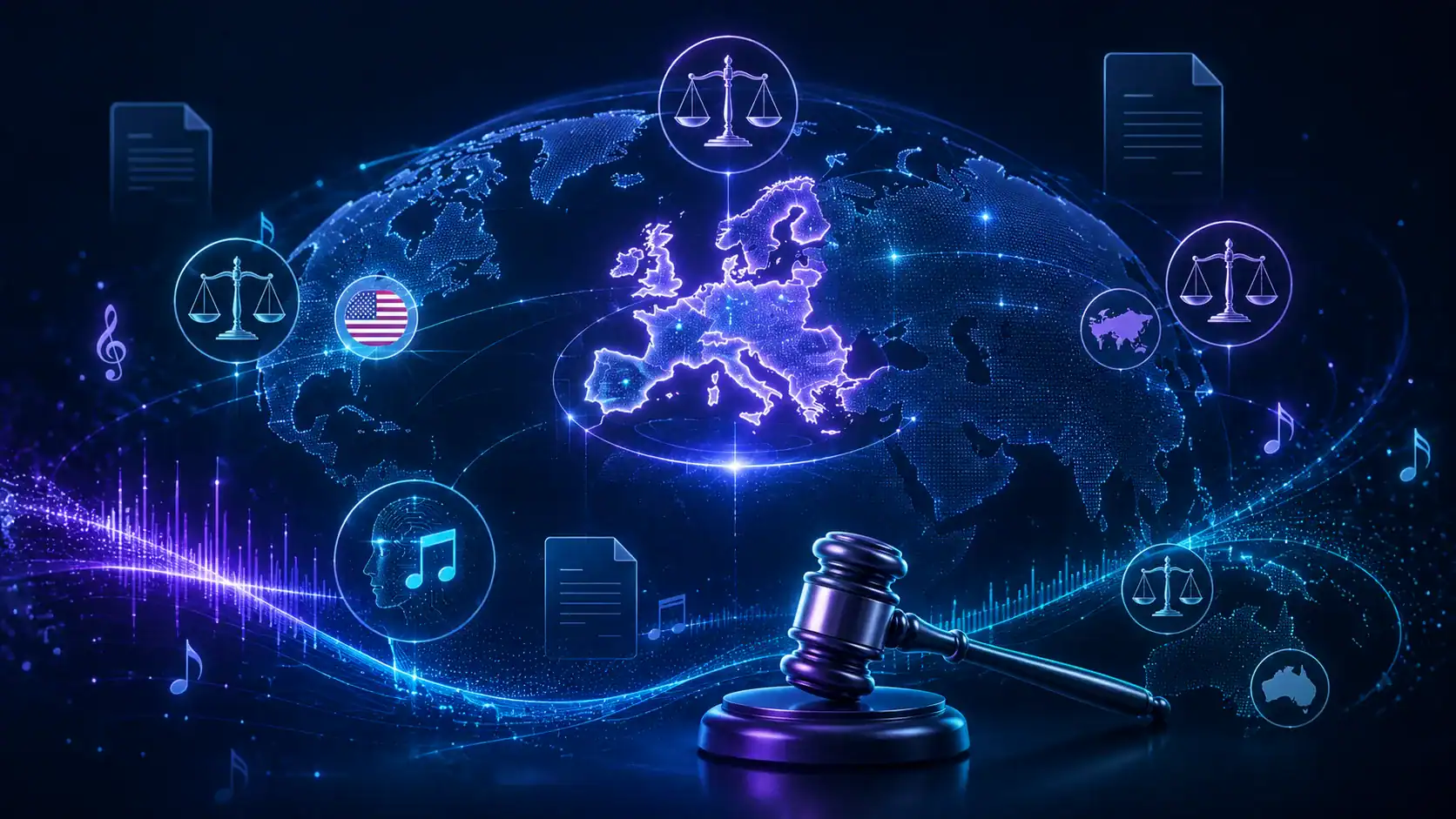
World map with Europe, scales of justice, US flag and gavel – AI music copyright in the USA, EU, UK and internationally
The standards for AI songs vary considerably from country to country.

USA: only humans are creators

The US is the clearest on this point. A US court confirmed in 2025 that only works created "by a human" are protected. The US authorities explain that purely AI-generated content is not protected, nor are songs where humans had too little control over the creative elements. However, your own lyrics, your choices, and your editing are protected. So, for an AI-generated song with its own lyrics, melody, and mix, US protection is possible – but only for the human-generated elements.

Great Britain and the rest of the world

The UK is a notable exception. There, even a work "without a human author" can be protected – as a so-called "computer-generated work." The author is considered to be whoever has made the necessary preparations. However, this is not entirely certain, as even in the UK there is debate about whether this still meets modern standards. The UK thus offers more leeway, but no guarantee.

Globally, the picture is mixed. Many countries adhere to the principle that "only humans are authors." Some (Ireland, New Zealand, India) have special rules, Japan decides on a case-by-case basis, and China is sometimes more open. For you as a publisher in Germany, the most important thing is this: While rules may be more relaxed or stricter abroad, this doesn't change your obligations here in Germany and the EU.

Suno & Udio's terms and conditions: Why "ownership" is not copyright

In practice, the terms and conditions are often more important than the theory. The biggest misconception is confusing "ownership" in the terms and conditions (meaning what the platform contractually grants you) with statutory copyright. A platform can allow you to use or sell a song, but that doesn't automatically create copyright on the song. Suno even states this in its help documentation: contractual ownership and copyright are not the same thing.

Suno: broad license, the tariff decides

At Suno (as of May 2026) you should know three things:

  • You are giving Suno very extensive rights. Even as a paying user, you allow Suno to use your content worldwide and permanently – among other things, to improve its own models.
  • The tariff and timing are what matter. Only paying users receive the rights to the output created during their subscription. Freely created songs may only be used privately – and switching to a paid plan later will affect these rights. not retrospectively.
  • Your song doesn't have to be unique. Suno can also show similar results to other users.

Udio: the platform retains the output

Udio is particularly worth a closer look. Udio Terms of Use (Checked against live text, as of May 2026) are significantly stricter than many realize. Unlike Suno, Udio reserves the right to... Ownership of the output Even before you begin: According to section 6.3, you only own your own source material; the generated song remains with Udio. Its use is only permitted for... private, non-commercial Purposes permitted. Clause 1.2 even prohibits downloading the song or uploading it to platforms like Spotify, YouTube, or TikTok – only sharing authorized links is allowed. And anyone using a Udio song publicly must, according to clause 6.4, indicate that it was created with AI.

Important: These are idiots general Terms and conditions apply. Whether paid plans allow more is likely stated in separate subscription terms and conditions, which you should review before publishing. The lesson regarding the copyright of AI songs: Never rely on the saying "AI songs belong to the creator," but always read the original lyrics.

Note: Platform terms and conditions change at any time. Always check the version valid at the time of creation before any commercial publication – ideally with a screenshot and date.

There's also a platform risk: Major record labels have been suing Suno and Udio since 2024. While settlements and licensing deals have been reported, the dispute continues. For you, this means that download options, export rights, and commercial permissions can change rapidly.

Samples, voices, artist imitation: the rights of others

The biggest dangers regarding the copyright of AI songs do not lie in one's own workflow, but where foreign material or a foreign identity comes into play. Three fields are particularly tricky.

Samples and external uploads

A sample (a piece from someone else's recording) is tricky: even a short, recognizable excerpt can infringe on the rights of the recording owner. Only if the sample is so heavily altered that it's no longer audible is it unproblematic. Therefore, anyone who feeds other people's audio, stems, or commercial tracks into an AI workflow falls under normal licensing law – not some special AI sphere.

Style is free – a voice is not.

A style as such is hardly protected: anyone can say "sounds like 80s synthwave". But as soon as the song replicates specific, protected parts of an actual song, it becomes a normal copyright issue again.

Things will get really tricky real voicesHere, further rights come into play. In Germany, a person's voice is protected; advertising is also prohibited from pretending that a well-known artist is involved if that's not the case. In the US, courts have ruled that even a fake "sounds like" voice can cause problems – even if the song is licensed. This poses a real risk for AI songs featuring the voice of a famous artist. The cleanest approach is almost always to use your own: own vocals on the AI ​​song to lay down, instead of imitating a stranger's voice.

Unsure about the rights to your AI song?

Whether you're unsure if a Suno or Udio track is safe for release, if the chain of rights is correct, or if you're allowed to use the song commercially: We'll listen to your track, tell you honestly what's possible – and take care of the mixing and mastering if desired.

You can reach us by phone from Monday to Friday from 9 a.m. to 8 p.m.

Five common misconceptions about AI songs

Persistent half-truths surround the copyright of AI-generated songs. We hear five of them again and again – and all five can be costly.

Myth 1: "AI made it, so everyone is free to use it." False. Just because a purely AI-generated song often doesn't have its own copyright doesn't mean it's free. Terms and conditions, recording rights, and especially other people's rights to the material remain in effect. "No protection" is not the same as "freely usable."

Myth 2: "The terms and conditions state ownership, therefore I have the copyright." Contract and law are two different things – Suno themselves say so. A clause in their terms and conditions allows you to use the product, but it doesn't replace copyright, which doesn't actually exist.

Myth 3: "I'm paying for Pro now, so my old free songs also belong to me commercially." The tariff applies at Suno not retrospectivelyAnything you created for free remains subject to the terms and conditions in effect at the time. The date of creation is what matters.

Myth 4: "It's allowed to use the style of artist X, because style is free." Style alone is hardly protected – but the line is thin. As soon as specific, protected parts of a song or a recognizable voice are copied, it quickly becomes a legal problem. Using "in the style of" as an advertising claim is particularly risky.

Myth 5: "Created for free means freely usable." Free songs on many platforms are intended for private use only. Anyone using a free track in a paid advertisement risks violating the terms and conditions – regardless of copyright.

The common lesson: Keep the three levels Platform agreement, legal protection and rights of others Separate them cleanly. The next section will help with exactly that.

Practical guide: How to secure legally sound rights
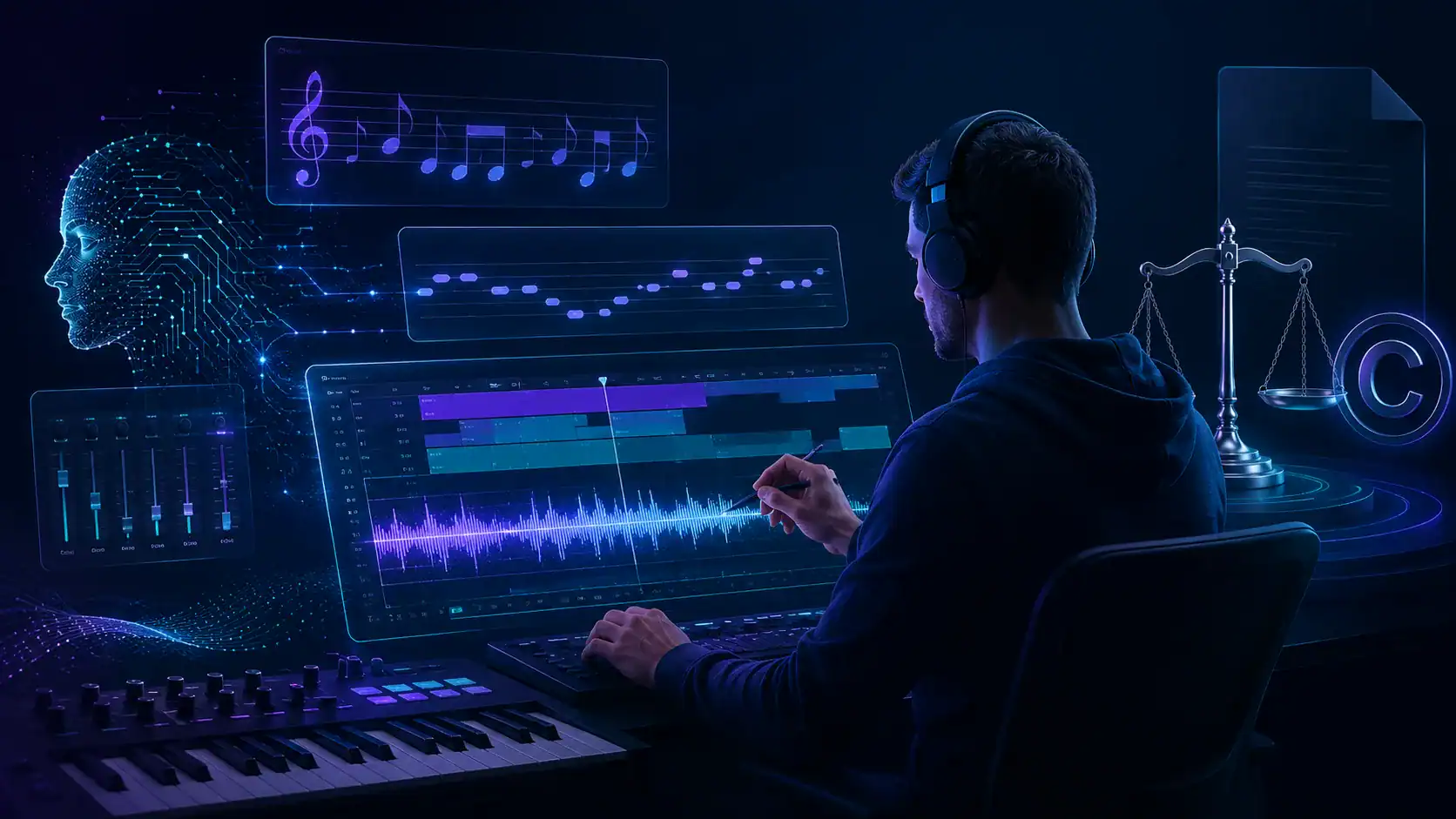
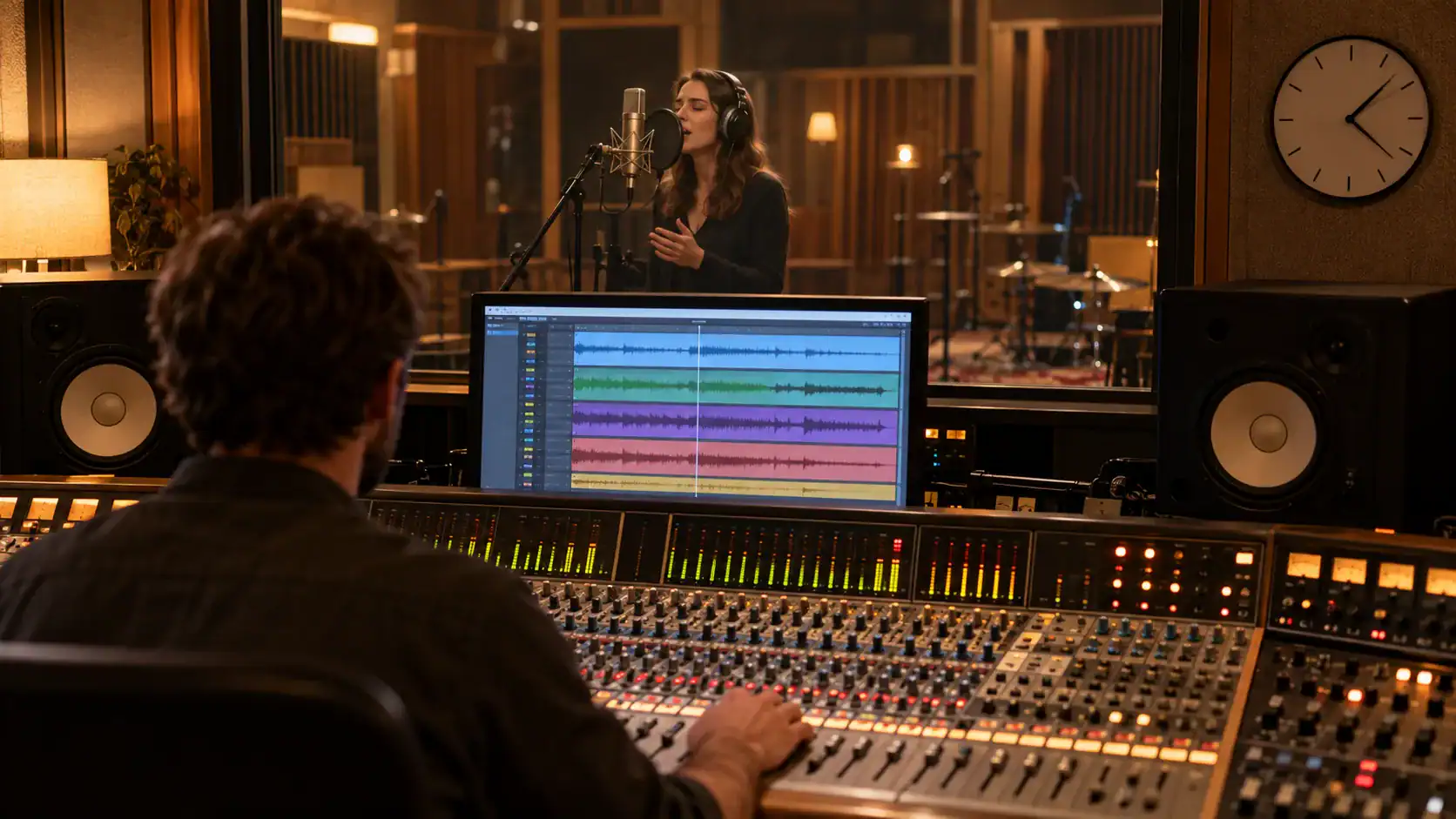
Music producer mixes an AI song on a DAW with headphones, AI face and scales of justice in the background
The more you produce, mix, and master yourself, the sooner you will acquire your own rights.

From all this, a simple strategy for the copyright of AI-generated songs follows: Use AI not as sole author, but as a tool. The more of your own creative work it contains, the more likely a court is to recognize your authorship.

Five steps to copyright your AI song

  1. Write your own text instead of simply adopting the AI ​​text.
  2. Original melody to specify – to sing, play, or sketch.
  3. Choose consciously instead of blindly taking the first result.
  4. Export stems and arrange and edit it yourself in the music program.
  5. Mix and master yourself or Let it be mixed and mastered.

The last point isn't there by accident. A good mix and clean mastering are precisely the decisions that strengthen your rights – and incidentally transform a generic AI export into a track that truly stands out on streaming platforms. By using AI as a starting point and entrusting the finishing touches to real professionals, you win twice over. That's exactly what Peak-Studios is here for: We get the maximum potential from your Suno or Udio material – and you retain control.

Secure evidence: your release folder

Just as important as the production itself is proving that the work is yours. In Germany, copyright arises automatically upon creation – you don't need to register anything. Nevertheless, you should document what you've done yourself. Create a folder for each song containing:

  • Date and all interim results
  • the complete prompt list,
  • the first raw versions,
  • the project file from your music program including stems,
  • brief notes on which decisions (melody, editing, mix) are yours,
  • a screenshot of the terms and conditions including the tariff at the time of creation.

If others are involved, briefly document in writing who is responsible for what part. This folder is not legal advice, but it will show in case of a dispute, which parts really come from humansOne last tip: Be honest. “Created with AI, lyrics and final production by me” is smarter than “100% my original song” if your own contribution is unclear.

Note: This article provides general information and does not constitute legal advice. Copyright law for AI-generated songs varies considerably depending on the individual case – on the human contribution, the materials used, and the platform's current terms of service. For commercial releases, artist impersonations, voice cloning, samples, or international releases, you should seek legal counsel beforehand. Last updated: May 2026.

Ready for the finished sound? Have your AI track mastered by Peak-Studios – transparently and at release quality.

FAQ: Frequently asked questions about copyright in AI songs

Depending on your contract and terms and conditions, you may be contractually entitled to use it. However, in Germany and the EU, legal copyright only arises if a person has shaped the creative expression. Simply prompting is generally not sufficient.

This depends heavily on the platform. On Suno, commercial use is typically tied to a paid subscription and doesn't apply retroactively to previously released free songs. Udio's general Terms of Service (as of May 2026), on the other hand, restrict the use of the output to personal, non-commercial purposes and retain ownership of the output – further rights may arise from separate subscription terms. Always check the current original text and exclude third-party rights.

Based on current knowledge, this is usually not the case in Germany/the EU and the USA. Crucial are original, expressive contributions such as lyrics, melody, arrangement, editing, mixing, and mastering.

Pure style is hardly protected, but as soon as protected expressive elements or a recognizable voice are reproduced, copyright, personality rights, and unfair competition issues arise. This is a high-risk area.

There is no general requirement for every AI-generated song. However, the EU AI Act requires transparency regarding deepfakes, i.e., artificially generated or manipulated audio content that appears real. This logic will become more practically relevant from August 2026.

Document your creative process: Prompt history, DAW sessions, stems, versions, and a screenshot of the applicable terms and conditions including the date. This will allow others to trace which parts are your own later on.

Image by Chris Jones

Chris Jones

CEO – Mixing and Mastering Engineer. Founder of Peak-Studios (2006) and one of the first online service providers for professional audio mixing and mastering in Germany.