
Impulse response: the acoustic fingerprint of rooms and devices
A clap of hands in a church, and you immediately hear how large the space is. This exact reaction is called the impulse response. This article explains what it describes, how it is measured, and what it is used for in the studio – from convolution reverb to room correction.
What is an impulse response?
The impulse response is the signal with which a system reacts to a very short impulse. In systems theory, it is also referred to as the shock response. The impulse is an ideal, infinitely short bang containing all frequencies simultaneously. The response to this therefore reveals the entire transfer behavior of the system.
In audio engineering, this means that an impulse response describes how a room, a loudspeaker, or a device alters the sound. It is best known through convolution reverb, a specific type of reverberation. reverb.
What is contained in an impulse response?
Imagine a loud bang in a hall. The direct sound reaches the microphone first, followed shortly by the first reflections from the walls, ceiling, and floor, and finally the reverberation fades away. This pattern is different for every room and every microphone position. That's why we also speak of the room's sonic fingerprint.
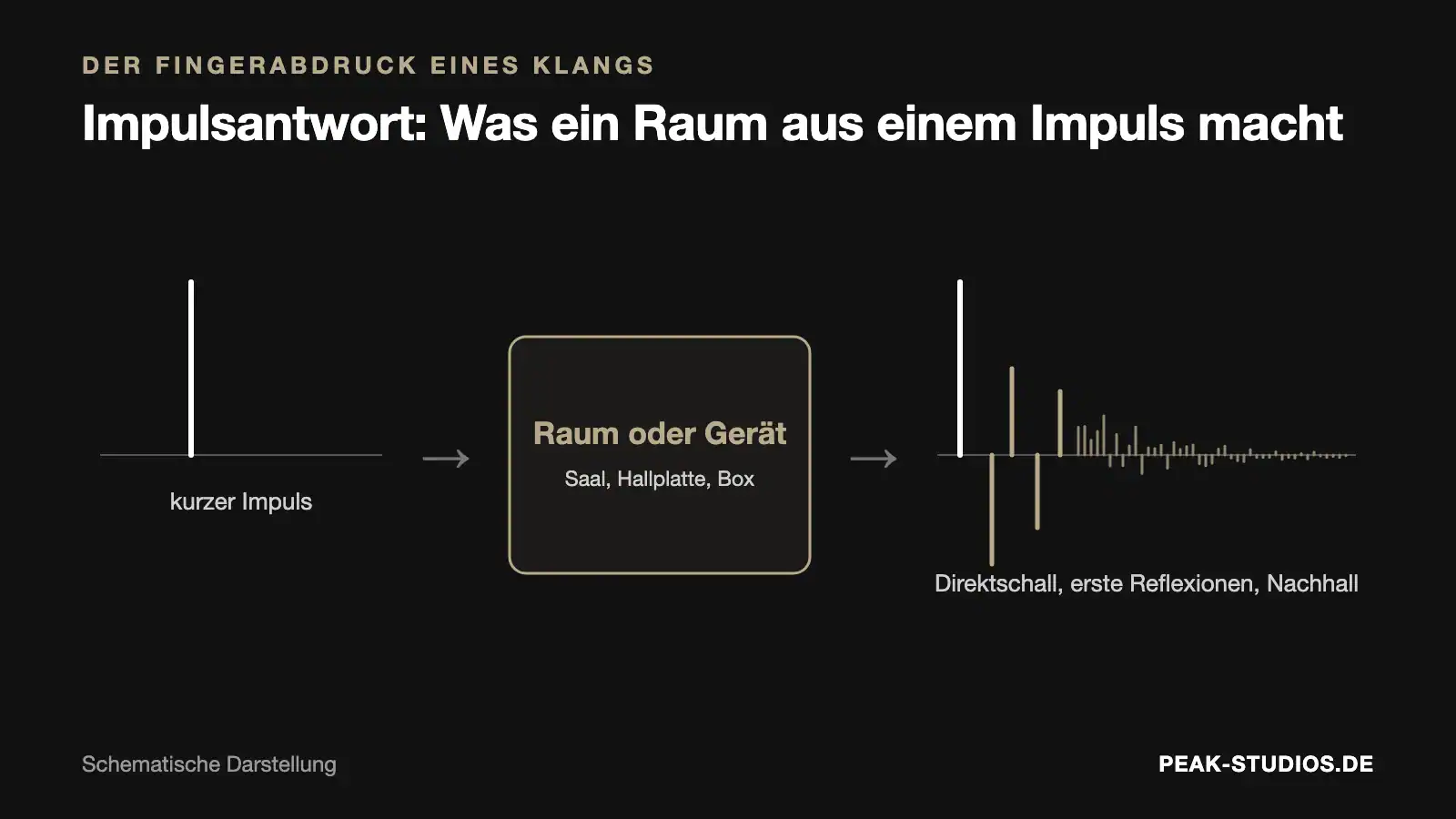
The frequency response can also be calculated from the impulse response, since both describe the same system – once over time, once over frequency. It therefore also shows which tones a room emphasizes and which it absorbs.
How is an impulse response measured?
In practice, there is no single ideal impulse. Therefore, the room is excited with a test signal, and the result is recorded with a microphone. Three types of signals are common:
| Test signal | Thats how it works |
|---|---|
| bang | A short, loud event comes closest to the impulse. |
| Sinussweep | A tone glides through all frequencies, the answer is then calculated backwards. |
| White noise | The transmitted and received signals are compared. |
When measuring noise, interfering noises are filtered out by comparison if they are not part of the test signal. A stereo impulse response also requires a stereo microphone, and a neutral microphone is suitable for neutral results. Measurement MicrophoneIt is important to note that the listening perspective always corresponds to the position of the microphone during the measurement.
What is the impulse response used for in the studio?
A measured impulse response allows the sound of a room to be transferred to any dry signal. The underlying computational method is called convolution. This results in three typical applications:
- Convolution reverberation: The voice sounds as if it were recorded in this very hall. More information can be found in the... Wikipedia article on convolution reverberation.
- Boxing simulation: This also allows you to capture the sound of a loudspeaker box along with a microphone. Many amp simulations are based on this principle, which is covered in our glossary. Reamping classifies as an alternative.
- Room correction: Room correction software also works by measuring the room at the listening position and calculating a correction from this.
We also discussed the purpose and limitations of spatial correction in our second podcast episode spoken. And the article shows just how much the space itself matters. Small space, great acoustics.
What are the limitations of the impulse response?
An impulse response is a snapshot in time. It only fully describes a system if it is linear and does not change over time. This leads to two important limitations:
- No distortion: Saturation, oversteer, or the behavior of a Compressor They are not included because they depend on the level.
- No movement: Modulations as in a Flanger They cannot be depicted because the sound is constantly changing there.
Convolution reverb also has practical disadvantages. The calculation requires significant computing power. Furthermore, the impulse response is rigid and only adjustable to a limited extent. Slight latency can also occur. An algorithmic reverb, on the other hand, is more flexible, but sounds less like a specific, real space.
Impulse response in the mix: three tips
In everyday use, you'll primarily encounter the impulse response as a file within the Hall plug-in. Our glossary explains what such a plug-in is, by the way. VST pluginTo ensure the impulse response works in the mix, these three steps will also help:
- Choose the right space instead of adjusting it later: Because an impulse response can hardly be changed, the choice of stimulus determines the outcome.
- Use Hall as a send: This way the dry signal is preserved, and you determine the proportion separately.
- Filter Hallweg: A Equalizer The reverb cuts out bass and harsh treble to keep the mix clear.
Our instructions show you how to adjust the other controls. Adjust reverb in 10 stepsAnd if the mix is already blurring in the room, this article will help. Avoid too much reverb continue.
Conclusion: a bang that reveals everything
The impulse response summarizes what a room or device does to the sound. Therefore, it forms the basis for convolution reverb, speaker simulation, and room correction. However, its limitations become apparent when distortion or movement come into play. Those who want to not only simulate but also utilize real spaces will also find information in our... recording studio in Wuerzburg or by Recording studio in Berlin .
Spatiality in the mix that truly fits
Does your song sound either dry or muddy, and the right space just won't come together?
👉 Request online mixing from Peak-Studios now!
If you'd like an initial assessment, we'll listen to your song in a mix analysis
FAQ – Frequently Asked Questions about the Impulse Response
What is an impulse response in simple terms?
It shows what a room or device does with a very short bang. It contains direct sound, reflections, and reverberation – in other words, the entire sound character.
What does the abbreviation IR mean in Hall plug-ins?
IR stands for Impulse Response. It refers to the file containing the sound of a measured room or device, which is loaded into the convolution reverb.
How do you record the sound of a room yourself?
You play a test signal in the room, for example a sine sweep, and record it with a microphone. Appropriate software then calculates the room's response from this recording. A loud bang also works, but is less accurate.
How does convolution reverb differ from algorithmic reverb?
Convolution reverb is based on measurements of a real room and therefore sounds very realistic, but it is inflexible. Algorithmic reverb, on the other hand, is calculated and can be adjusted more freely.
Can you also use it to emulate a compressor or distortion effect?
No. The method only captures linear, constant behavior. Distortion and compression, however, depend on the level and therefore cannot be captured in a single measurement.