
dBFS: Decibel Full Scale in digital audio technology
Why dBFS values are always negative
Unlike analog level scales, the digital scale has an absolute upper limit: It cannot go beyond full scale output. Therefore, the scale counts from this upper limit. down – A signal at −6 dBFS therefore has 6 dB of headroom up to the ceiling; you can find the formal definition in the Wikipedia entry on the digital level scaleThis reserve is the headroom, and consciously managing it is one of the basic tasks in Mix and mastering, because every summing, every EQ boost and every compression shifts the audio level in the DAW further towards the digital ceiling.
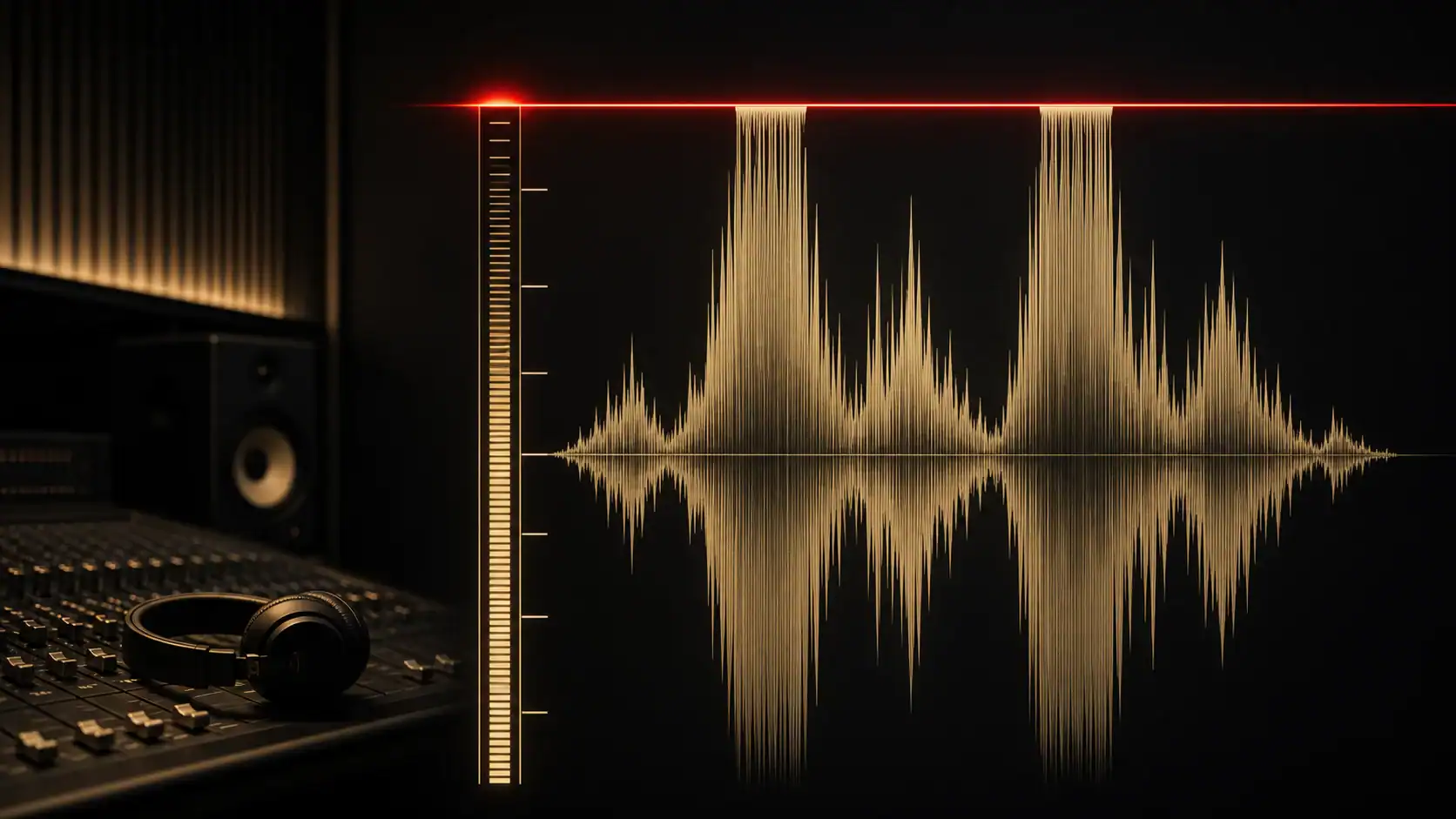
0 dBFS and clipping: the hard digital ceiling
If a signal exceeds its maximum output level, the system can no longer reproduce the waveform – instead, it flattens the peaks. This digital Clipping However, it sounds different from analog saturation: harsh, scratchy, and without warning. Therefore, you control the approach to the ceiling with a Peak meter, which displays the sample values on the scale – in the DAW, in metering plugins, and in many recording tools. Short transients They reach the limit significantly earlier than the average level – material rich in transients therefore needs more reserve.
Sample Peak vs. True Peak: why dBTP is added
The sample peak refers to individual sample values. During the conversion back to an analog voltage – in the D/A converter –converter – and in streaming codecs the reconstructed signal between However, two samples vibrate at a higher frequency: These Intersample peaks Therefore, only the true-peak measurement in dBTP (decibel true peak) captures the signal. A master whose sample peaks are exactly at 0 dBFS can actually be overdriven. Therefore, the following applies to streaming master a True Peak-Ceiling of a maximum of −1 dBTP is a common guideline.
Level is not loudness: the difference to LUFS
The maximum technical level says nothing about how loud a track is. actsA sine wave and a dense drum bus signal can have the same peak value – and yet sound completely different in loudness. Perceived loudness is therefore measured by ear. LUFS (Loudness Units relative to Full Scale – this scale also refers to full digital output). LUFS is the basis for, for example, the... Loudness normalization the streaming services; the classic average level is also described by the RMS-value. Anyone who wants to check all three dimensions of their track can do so for free with our Loudness meter do it in the browser.
Bit depth, signal-to-noise ratio and the scale downwards
The scale ends at full output at the top – but is limited at the bottom. Bit Depth The usable range: As a rule of thumb, each bit provides around 6 dB of dynamic range, so 24 bits theoretically offer about 144 dB between full scale and quantization noise. In practice, this means that with 24-bit recordings, conservative recording levels (guideline: peaks around -12 to -6 dBFS) cost virtually no quality but reliably protect against clipping – both during recording and mixing. Finally, when reducing the bit depth for release... Dithering in the game.
Demarcation: only one of many dB scales
However, digital full scale is only one of many reference points: dB SPL measures sound pressure in the air, dBu measures electrical voltages in the studio, and that VU Meter Referenced to 0 VU as the analog operating level – depending on the calibration, this corresponds to approximately -18 dBFS. Our glossary entry provides an overview of all variants and the underlying logarithmic scale. DecibelAnd if you want to know if the levels, headroom, and loudness of your mix are suitable for release, we'll take a look at it professionally. online mastering in detail.
FAQ – Frequently Asked Questions about dBFS
What does dBFS mean?
The abbreviation stands for "Decibel Full Scale" – the level scale of digital audio systems. 0 dBFS is full scale, i.e., the highest representable value; all signal levels are therefore specified as negative values relative to this.
Why are dBFS values negative?
Because the scale is referenced at its upper limit: A digital system cannot represent more than full output. Therefore, the counting starts at the upper limit and works downwards – the value describes how much reserve remains before reaching the digital ceiling.
What happens at 0 dBFS?
When the system reaches full output, it's at its limit. Anything beyond that is clipped: the waveform loses its peaks, resulting in harsh digital clipping – audible as a scratchy distortion.
What is the difference between dBFS and dBTP?
One measurement considers the individual sample values, while dBTP (True Peak) measures the signal reconstructed between samples via oversampling. Intersample peaks can exceed full scale, even though no single sample reaches the limit – therefore, a maximum of -1 dBTP is a common guideline for streaming masters.
What is the difference between dBFS and LUFS?
One scale describes the technical level (peak values), while LUFS describes the loudness measured by the listener. Two tracks with identical peak levels can still differ significantly in LUFS – loudness is what matters for streaming, while level is what matters for overload protection.
What does 0 dBu or 0 VU correspond to in dBFS?
There is no fixed physical relationship, as this is a calibration convention between the analog and digital worlds. Common calibrations include −18 dBFS ≈ 0 dBu (EBU recommendation R68) and −20 ≈ +4 dBu according to SMPTE (US studio practice) – each as a guideline. Therefore, anyone using analog outboard gear should know their converter's reference setting.