Adlibs: Meaning, recording and mixing like the pros
Adlibs These are short, spontaneous interjections, repetitions, or sounds ("Yeah," "Skrrt," "Gang") that, in rap and modern pop, appear as a second vocal layer behind or between the main vocals. The term originates from Latin. ad libitum (“as desired”) and originally referred to freely improvised passages. Today, however, ad-libs are a standard compositional tool: they fill pauses, reinforce hook lines, give the song energy, and function sonically almost like tonal percussion. Properly recorded and mixed – for example, in professional hip-hop mixing – they noticeably elevate a track; however, if poorly placed, they can disrupt the flow of a song.
Table of Contents
Where do adlibs come from – and why are they everywhere?
ad libitum It means "at will" – in theatre, film and jazz the term has long stood for improvised interjections before hip-hop adopted it (the The University of Hamburg explains the linguistic origin of the term.In rap, ad-libs have evolved into their own art form over decades: from the hype shouts of the 80s and 90s through the Southern trap era to the acts that have definitively made the stylistic device their trademark – such as the Migos with their percussive one-word answers or Travis Scott with his reverb-drenched shouts (a good introduction to the BR Puls provides a cultural history of the stylistic deviceIn German rap, experts consider artists like Kalim, Reezy, and Faroon to be particularly skilled at using ad-libs musically rather than arbitrarily.
The fact that adlibs can be heard in almost every release today has a simple reason – they fulfill several functions at once:
- They fill gaps. Space is created between two lines – a short interjection maintains the energy without competing with the main voice.
- They reinforce statements. A repeated keyword acts like an exclamation mark.
- They structure things. Recurring signature sounds make artists recognizable – often a single sound is enough.
- They have a rhythmic effect. Well-placed adlibs behave like tonal percussion: sonically, they belong almost more to the beat than to the voice.
The most important rules for recording arise precisely from this last observation.
Recording ad-libs: the three rules of the pros
Anyone analyzing the ad-libs of strong reference acts will repeatedly encounter the same three commonalities. They aren't hard and fast rules – but those struggling will almost always benefit from following them.
1. Stay on the root note or fifth
A striking number of professional ad-libs are tonally focused on the keynote of the key —or on the fifth. Both notes blend seamlessly into almost any chord of the beat and sound "smooth": The vocal accompaniment carries the energy without drawing attention away from the main vocals. In practical terms, this means: Determine the key of the beat (if necessary, using a key finder tool or piano VST), then consciously sing on that note. If you're not entirely sure of the pitch, you can adjust it later using pitch editors—the ear is much more forgiving of a slightly artificial sound in background layers than in the main vocals. Our guide explains more about automatic pitch correction. Auto tune.
2. Short and percussive instead of complex
Ad-libs should be easy to digest. Long, melodically complex phrases in the background overwhelm the listener and clash with the lead vocals. Short, explosive shouts—almost like an additional percussion element—support the flow and rhythm. Even if an interjection consists of several words, it should be on point and percussive, not drawn out.
3. Adjust the energy to match the main voice
A common beginner mistake: high-energy lead vocals but low, mumbled, laid-back interjections – or vice versa. Contrasts can work artistically; however, if you're unsure, adjust the energy of the second vocal part to match the lead. A high, powerful performance demands high, powerful interjections. This maintains the song's flow.
Including ad libs: the session workflow

Besides the three basic rules, the recording workflow determines how much usable material ends up on the mixing console. The following sequence has proven effective:
- Complete the main chant first. Ad-libs react to the main vocals – only when the takes and comping of the lead track are complete is the session worthwhile for the second layer.
- Write down the first time you hear it. The best interjections come intuitively: Let the song play and note down where a shout or a repetition spontaneously suggests itself. These gut-feeling markers are almost always better than interjections planned on paper.
- Sing several variations for each part. Three to five takes per position – different words, pitches, and intensities. In comping, the winning element is what gives the song energy without overpowering the lead vocals.
- Consistent microphone position, deliberately varied distance. For background vocals, the distance to the microphone can be slightly greater than for lead vocals – this eliminates proximity bass and acoustically pushes the soundstage further back during recording.
- Double what needs to be worn. Double important shouts left/right (two real takes, not copies) – this will later create the natural width in the mix.
A word about spelling: Adlibs, ad-libs or ad libs They mean the same thing – the Germanized compound spelling dominates in the rap context, while dictionaries mostly list “Ad-lib”.
Your vocals are ready, but the second layer isn't quite right yet? Peak-Studios mixes your ad-libs so they complement the music instead of being distracting.
Mixing adlibs: the basic chain
Before delving into specific sounds, it's worth taking a look at the processing chain that underlies almost all professional ad-lib sounds. It differs from the main voice processing in one crucial aspect: the second layer is intended to into the background – present enough to get through, but never in front of the main voice.
- Tuning: First, fast, hard autotune (short correction time, 100% correction) – this is almost standard in modern rap productions, as the slightly synthetic sound is desired here.
- Gate (if required): Anyone who then heavily distorts or compresses the audio should first mask breathing and room noise with a [unclear - possibly a specific tool or device]. Noise Gate Remove it – otherwise the distortion will amplify any background noise.
- Compression: Then one Compressor With a very fast attack (close to 0 ms) and long release (in the range of several hundred milliseconds), the plane remains stable and even, without audible pumping.
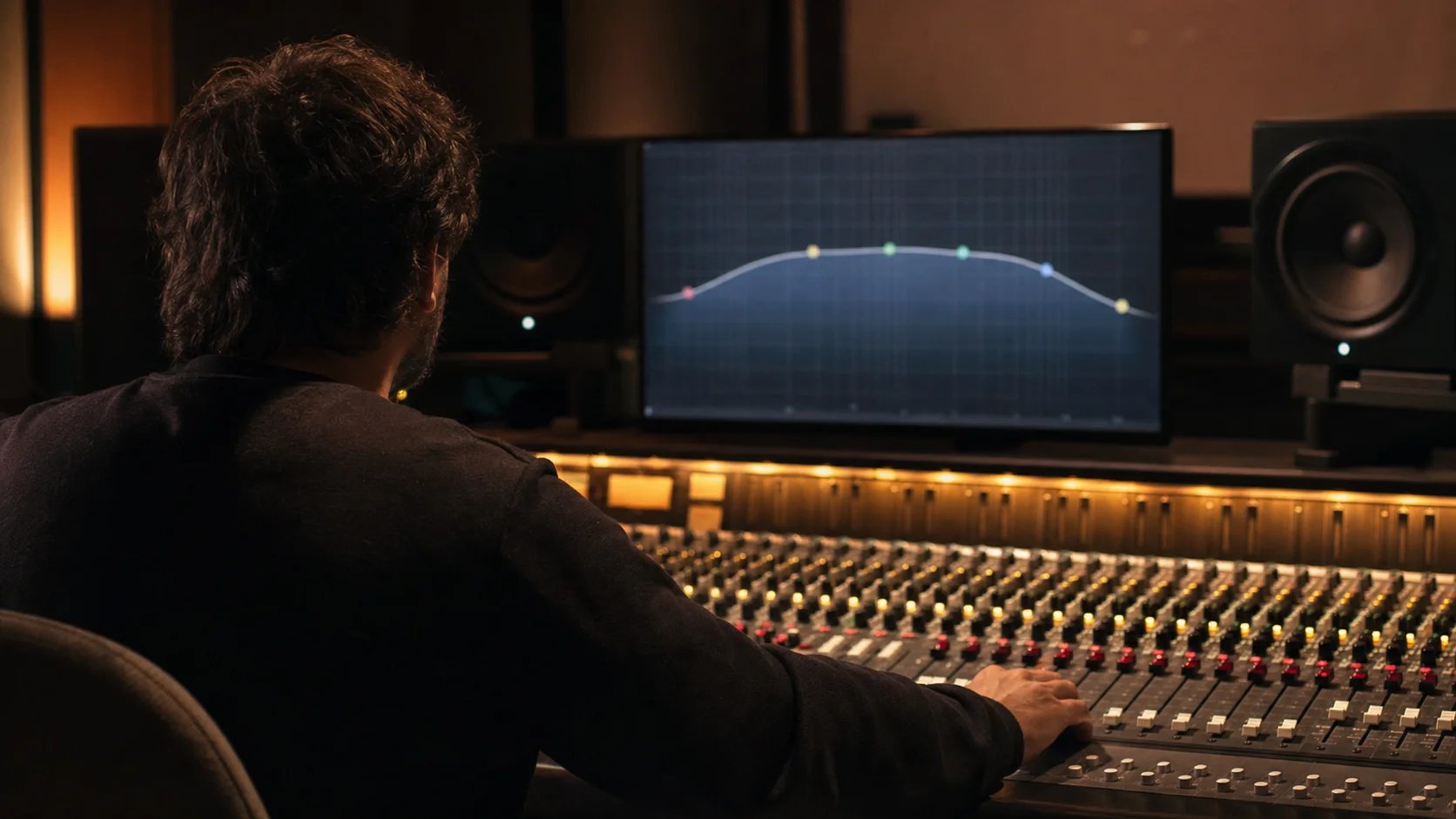
- EQ bracketing: The most important step: Generously cut the low frequencies (depending on the sound, between about 300 Hz and 1 kHz upwards) and significantly reduce the high frequencies (often starting at 4–6 kHz). What remains are the mids – this is where the vocal cue can cut through without competing with the bass, lead vocals, or hi-hats.
- De-essing: S sounds are particularly noticeable and unpleasant in the background – a De-Esser Therefore, it belongs in almost every Adlib chain.
- Width: Furthermore, a stereo spreader or doubler widens the soundstage and creates space in the middle for the main voice.
- Space and conclusion: Finally, a short reverb Spatiality, while a delay makes the insertion audible for longer and sound more modern.
A professional tip on the side: If the compressor to the end of the chain, behind the reverb When set, it also compresses the reverb tail – making it louder and audible for longer. While this is a matter of taste, it's a good example of how the order of a Vocal chain a design element.

9 Professional Adlib Sounds at a Glance
The following sound archetypes cover a large portion of what can currently be heard in rap and trap productions. The descriptions are based on recreated chains from mixing practice – specific values are starting points, not dogmas.
| # | Sound | sound character | Key ingredients (typical) |
|---|---|---|---|
| 1 | Phone/Radio | Old mobile phone speaker, thin, centered | EQ: Cut everything below ~1 kHz and above ~4,5 kHz; Compression: 0 ms attack / long release; slight distortion; short reverb + delay |
| 2 | spaceship | Futuristic, floating | Reverb ~2,3 s in small rooms; Chorus for texture; Flanger for rotation; Compressor at the end |
| 3 | Wavy Delay | US Trap, energetic | Short, quiet reverb, but loud, fast delay (e.g., quarter note) with long feedback; low-cut around 400–500 Hz; slight saturation + chorus |
| 4 | Echo Box | Fast echoes, "small bare room" | Very fast 1/16 delay with a long decay; otherwise basic chain |
| 5 | Distortion Signature | Aggressive, guitar-like distorted sound | Gate → Compressor → Low-Cut ~400 Hz → heavy distortion → EQ with two narrow bands around ~800 Hz and ~2,5 kHz, everything else removed |
| 6 | Doubler | Sounds like real duplicates. | Chorus set as a doubler; saturation; de-esser; short reverb; targeted delay instead of long reverb. |
| 7 | Warm/R&B | Soft, natural, washed out | "Bathtub EQ": Warmth at the bottom, clarity at the top, mids heavily attenuated (up to ~12 dB); wide spreader; reverb added ~1,6 s more; less autotune |
| 8 | XL-Trap | Large standard trap hall | Long reverb (~3,2 s); EQ cuts around ~600 Hz and ~6 kHz; chorus texture; clean de-essing |
| 9 | stutter | Rhythmically chopped, modern | Tremolo/LFO that rhythmically splits the signal; then basic chain |
Two observations from practical experience on this topic: Almost all of these sounds use fast, strong autotune. – The artificial character is part of the aesthetic; the exception is the warm R&B interludes. And: The EQ makes the difference. The sounds differ primarily in which narrow frequency ranges are retained. Once you understand the principle, you can customize each of these sounds instead of guessing at presets.
When ad-libs hurt your song
As effective as good ad-libs are, there is, however, an inconvenient truth: Not every song needs them. Since the big trap acts popularized the technique, many artists use interjections simply because they're "required" – not because the song calls for them. The result then sounds contrived. Experienced engineers therefore recommend:
- Less is more. Minimalist, “safe” interjections (short, on one note, sparingly placed) never disrupt the flow – overloaded tracks, on the other hand, often do.
- Delays instead of adlibs. A gap in the song doesn't necessarily require an interjection. A delay on the last word of the line almost always maintains the flow and vibe better – and also sounds more modern than a heavy reverb.
- The gut feeling test. A rule of thumb from experience: If you have to think about a vocal line for a long time, it's usually the wrong one. The best ones, on the other hand, come spontaneously when you first hear your own vocals.
- Energy before quantity. A precisely placed shout in the right place therefore beats ten others that aren't there at all.
This also demonstrates the value of an experienced mixing engineer: Anyone who listens to the song from the outside immediately recognizes where a gap needs a delay, an insert – or deliberately nothing at all.
Place adlibs in the mix: volume, panning, depth
The best chain is useless if the placement isn't right. Three basic principles:
Volume: The second level is audibly seated behind the main voice. A proven workflow: First, set the bus volume loud enough to be noticeable – and then turn it down until it's just barely audible. When in doubt, go quieter, because your ear will fill in the rest.
Panning: The center belongs to the main vocal. Interjections, on the other hand, are placed at the sides – either as true doubling (hard left/right) or as a widened mono signal. Mono compatibility is also important: therefore, listen to extreme stereo effects on a mono speaker. You can find the basics in the guide. Panning & Panorama.
Depth of field: EQ settings (reduced bass, reduced treble) and the room ambience automatically push the soundstage backward. For added contrast, keep the main vocals dry and only give space to the interjections – this creates a clear foreground/background impression. The guide explains how much room ambience is appropriate. Avoid too much reverb.
YOUR CONTACT TO PEAK-STUDIOS
Do you want to bring your vocals, including ad-libs, up to release quality? Send us a message – we usually get back to you within 3 hours (on weekdays).
- Personal point of contact
- Over 20 years of experience
- Highest quality standards
You can reach us by phone from Monday to Friday from 9 a.m. to 8 p.m.
Common mistakes in Adlib mixing
- Too loud. The classic. Adlibs are seasoning, not the main course.
- Full frequency spectrum. Unfiltered, the second layer clashes with the bass, beat, and main vocals – without EQ bracketing, the rest of the chain hardly works.
- Distortion without a gate. Strong distortion dramatically amplifies breaths and room noise; without a gate, it immediately sounds unclean.
- Same processing as the main voice. The background layer needs its own, significantly more restricted chain.
- Against the flow. If it's tonally off (neither the root nor the fifth), rhythmically out of sync, or energetically inappropriate – then it's better to leave it out.
- No de-esser. Sibilant s-sounds in the background quickly sound cheap, especially with a strong treble boost on the main voice.
The good news: All six mistakes can be systematically avoided with the basic chain and the three recording rules.
Hook vs. Verse: How Adlibs Work
However, not every song position can tolerate the same density:
In the hook The interjections can be the most dense – meaning repetitions of the main message, energetic shouts, and doubled layers. Here, they lend the mix depth and give the chorus the feeling of "more voices." However, the hook itself must remain intelligible; therefore, the interjections fill the pauses, not the words.
In the verse In contrast, restraint is key – short, percussive interjections at the ends of lines, movement only where the main vocals allow. Minimalist, tonally stable interjections maintain the narrative flow.
In transitions (Pre-hook, last line before the drop) are ultimately a dramaturgy tool: a rising call, a pitched signature word – the listener receives the signal "something is coming now".
Those who are unsure can also follow a simple rule of thumb: In the verse, at most every other line should have a comment, in the hook it can be more dense – and at least one part of the song should remain completely without one, so that the dense parts have an effect.
Listen to references: What you can learn from the best
The fastest way to learn is through active reference listening. Take three songs by artists known for their strong ad-lib work and listen specifically to the second vocal layer: What note are the ad-libs on relative to the beat? How long are they? Where in the stereo field are they positioned, and how much space do they have compared to the main vocals?
You'll often notice that the interjections are shorter, quieter, and tonally simpler than you remember them – the perceived grandeur arises from placement and effects, not quantity. This discrepancy between perception and actual mix is therefore the most valuable lesson for your own production.
Conclusion: Adlibs are a tool – not a mandatory program
Ad-libs are an integral part of modern rap and pop: they provide energy, structure, and memorability. The professional formula is remarkably consistent – tonally based on the root note or fifth, short and percussive, energetically matching the lead vocal, subtly filtered in the mix, and deliberately placed behind the lead vocals. Equally important is the opposite realization: a song without ad-libs is not inferior to any song with poor ad-libs.
If you want your vocals – including ad-libs, doubling, and effects sweeps – mixed by experienced engineers: Our Hip-hop mixing is specifically specialized in rap productions. For all other genres, you'll find our regular [website/platform]. mixing-offer – and with the Cost calculator You'll know in one minute approximately how much your project will cost.
FAQ: Frequently Asked Questions about Adlibs
What is an adlib?
An ad-lib is a short, often improvised interjection or sound that, in rap and pop music, acts as a second vocal layer behind the main vocals – for example, word repetitions, shouts, or signature sounds. Ad-libs fill pauses, reinforce statements, and add energy to the song.
What does "ad libbed" mean?
"Ad libbed" is the English verb "ad libitum" and means that a passage was freely improvised – without a fixed script or notated melody. In a studio context: spontaneously recorded additional takes, either sung or rapped.
What does "ad libitum" mean?
Ad libitum is Latin for "at will". In music, it denotes passages whose execution is left to the performer's discretion – from this developed the modern meaning of ad-libs in rap.
How do you mix ad-libs?
A typical approach involves a dedicated processing chain: fast autotune, compression with a quick attack, an EQ that heavily cuts the bass and treble, a de-esser, stereo widening, and a short reverb plus delay. Crucially, the vocal interjections should be audibly positioned behind the main vocal.
On which note should adlibs be placed?
The root note or fifth of the song's key has proven effective – both fit into almost any chord and don't distract from the main melody. If necessary, the key can be determined with a key finder.
Does every song need adlibs?
No. Ad-libs are a stylistic device, not mandatory. If they don't work convincingly, a delay at the end of the line usually maintains the flow better – or the gap can be deliberately left open.