
Noise Gate: How to selectively block out background noise
What is a noise gate?
A noise gate works like a door for your audio signal: If the level is above a defined threshold (the ThresholdIf the signal falls below a certain threshold, the gate remains open and the signal passes through. If it falls below this threshold, the gate closes and mutes the channel. This eliminates background noise precisely when no music is being played or sung – such as the hum of an amplifier during breaks, or other distracting sounds. hum or breathing and room sounds between two vocal phrases.
Thus, the gate is the counterpart to the compressor: During the Compressor While the gate tames loud signals, it takes care of the quiet ones – together they form the Dynamic Range a recording.
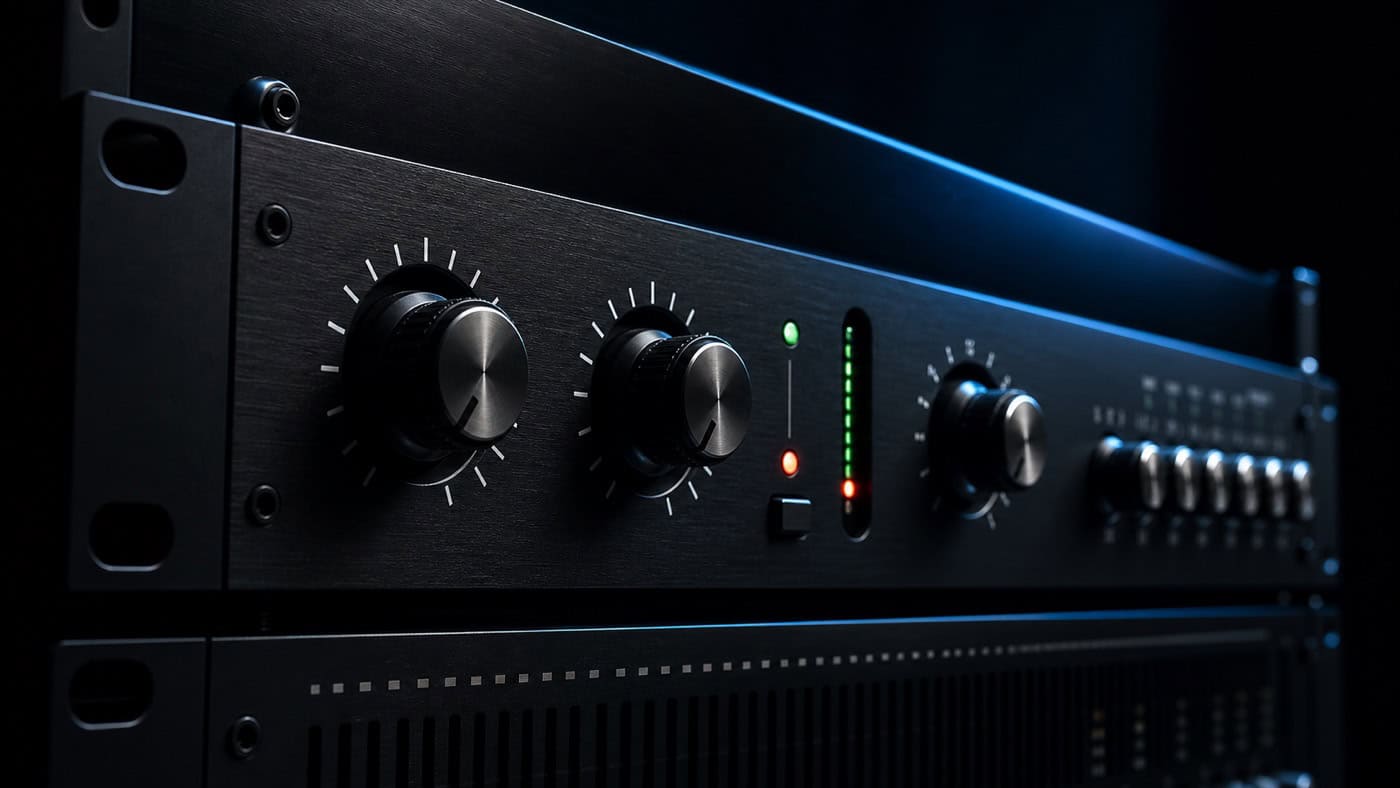
How does a noise gate work?
You control the behavior of a gate via several key parameters:
- Threshold: The threshold at which the gate opens. The most important control.
- Attack: Attack: how quickly the gate opens when the signal exceeds the threshold.
- Team: how long it will remain open at least after opening.
- Release: how gently it closes again.
- Range (Floor): how much it is lowered – instead of being completely silent, often only by a few Decibel, which sounds more natural.
Consequently, the interplay determines the sound: Too fast a timing makes tones sound choppy, while too slow a timing allows background noise to slip through.
Typical applications
- Vocals: Remove breathing sounds, room noise and crosstalk during pauses without affecting the singing.
- Drums: "Isolate" individual drums so that, for example, the snare microphone does not constantly pick up the hi-hat (crosstalk).
- Electric guitar: Suppress the noise from high-gain amps during breaks in playing.
Used creatively, a gate on a Hall signal also the famous Gated Reverb-effect – that is, the crisp, abruptly cut-off snare sound of the 1980s. As a plugin or hardware device, the gate is therefore a standard tool in every production; the signal processing Furthermore, the fundamentals are documented encyclopedically..
Setting the noise gate correctly – and common mistakes
The crucial first step is setting the threshold: Set it just above the noise floor and well below the desired signal level. A good rule of thumb is approximately... 1 dB above the noise levelEqually important is the Position in the signal chain – in the studio, the gate is usually located at the very beginning of the track, before EQ and compressor.
The most common mistakes: a threshold that is too high, cutting off quiet fade-outs and making the recording sound "choppy"; release times that are too fast, causing an audible "pumping" effect; and the misconception that a gate can save a noisy recording – because noise during of the signal remains; the gate only works during the pauses.
Noise gate in professional mixing
In professional production, the gate is a quiet but effective tool: When used correctly, it's virtually inaudible; you only hear the absence of unwanted noise. Therefore, it's often implemented subtly with a range reduction rather than a hard cut, and integrated into a well-thought-out production. Vocal chain embedded mixing at Peak-Studios – so that your recording sounds clear and controlled, without sounding artificial.
Conclusion: What matters when gardening
A noise gate is ultimately a simple principle with a powerful effect: it silences what should be silent. Crucial factors are a cleanly set threshold, the correct position in the signal chain, and not overly aggressive timing. When used correctly, it remains inaudible and simply ensures that your tracks sound clear and uncluttered.
Get your mix professionally and professionally edited now
Clean tracks are the foundation of every good mix – from the correctly set gate to the finished production. Leave that to the professionals: Have your song mixed at Peak-Studios.
FAQ – Frequently Asked Questions about Noise Gates
Where should the noise gate be placed in the signal chain?
In the studio, the gate is usually placed right at the beginning – directly on the track, before the EQ and compressor. For an electric guitar, it belongs after the distortion or in the FX loop, so that it captures the amplified noise and not the clean input signal.
How do you set the threshold correctly?
Set the threshold just above the background noise and well below the desired signal – as a rule of thumb, about 1 dB above the noise level. Too high a threshold will cut off quiet sounds, too low a threshold will let the noise through.
What is the difference between a noise gate and an expander?
Both attenuate quiet signals. A gate closes abruptly (fully open or fully closed), while an expander reduces the signal gently and continuously – this makes the expander sound more natural, the gate more consistent.
Why do you need a noise gate for vocals?
It removes breathing sounds, room noise and crosstalk in the pauses between phrases without affecting the singing itself – thus keeping the vocal track clean.
What do Attack, Hold, and Release mean at the gate?
Attack is the opening speed, Hold the minimum opening time, Release the closing speed. Values that are too fast sound choppy, values that are too slow allow unwanted noise to pass through.
Can a noise gate save a noisy recording?
Only to a limited extent: It filters out background noise during pauses, but noise during the desired signal remains. A clean recording is always the better starting point.