
Proximity effect: why being close to the microphone boosts the bass

The closer you get to a directional microphone, the fuller and bassier your voice sounds. This phenomenon is called the proximity effect. This article explains where it comes from, which microphones are affected, and how you can avoid it or use it to your advantage.

The proximity effect is the overemphasis of low frequencies that occurs when a directional microphone is placed very close to the sound source. It affects microphones with cardioid, supercardioid, or figure-eight patterns. Increased distance or a low-cut filter reduces it; a pure pressure microphone with an omnidirectional polar pattern does not exhibit it. In vocals and speech, it is also intentionally used to create a fuller sound.

What is the proximity effect?

The proximity effect, also known as the near effect or proximity effect, describes a bass boost when the microphone is very close. As soon as the mouth or instrument is close to the capsule, a directional microphone picks up low frequencies much more strongly than mid and high frequencies. This makes a voice sound warmer and fuller, but also quickly dull or boomy.

The effect is therefore not a defect, but a design characteristic. Even at the Recording Does the distance therefore influence the sound even before a Equalizer comes into play.

How does the proximity effect occur?

Directional microphones are pressure gradient receivers: their diaphragm reacts to the pressure difference between the front and back of the capsule. At low frequencies, this difference is small from a distance, so manufacturers compensate for it with a bass boost. However, as the microphone moves closer to the sound source, the pressure difference at low frequencies increases significantly. This combination results in an overemphasis of the bass frequencies.
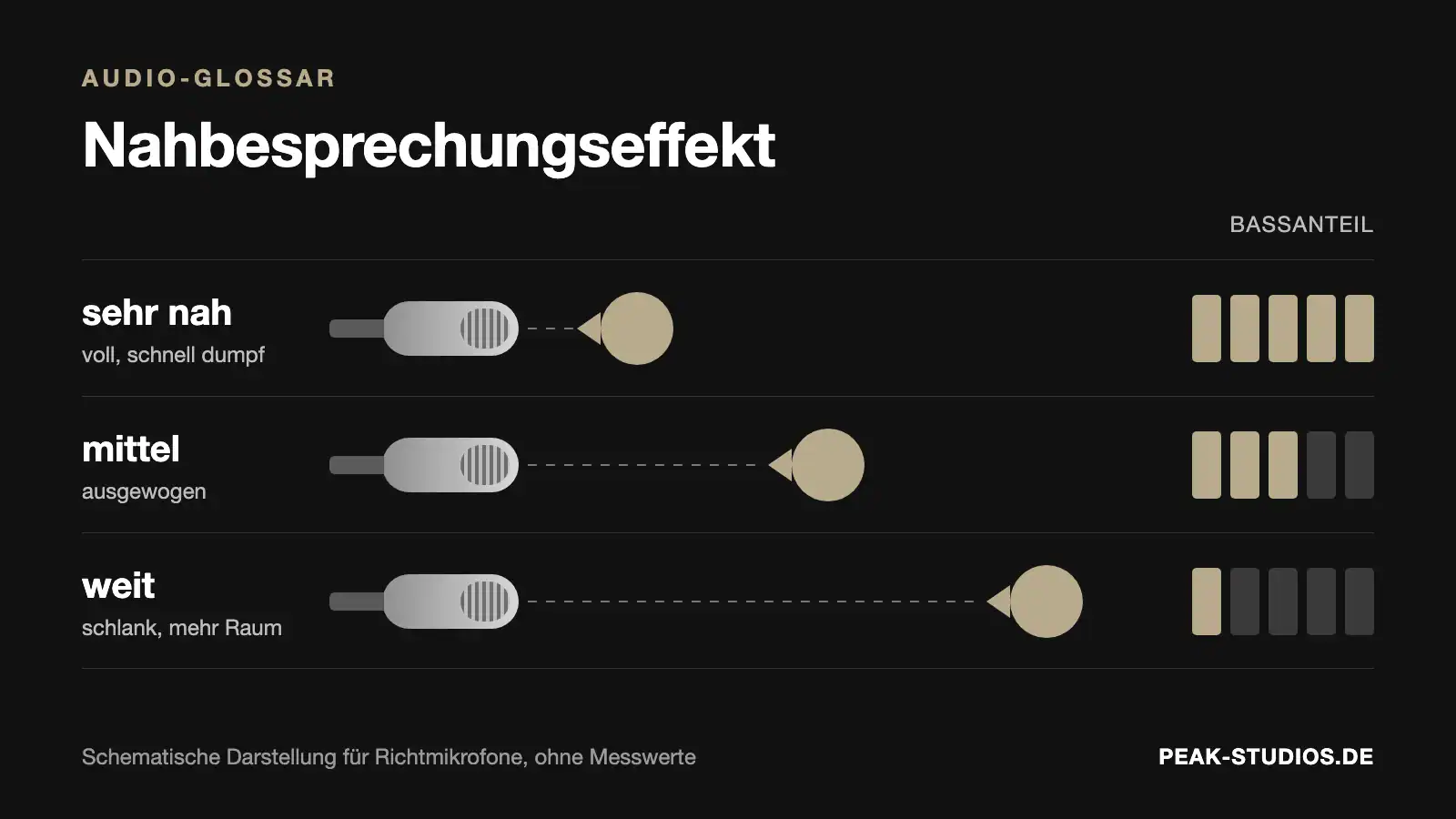
Proximity effect (schematically): The closer the sound source is to the directional microphone, the greater the bass component becomes.
Schematic representation: Distance to the directional microphone and bass content

The proximity effect occurs when the microphone is within approximately one wavelength of the source. Because low frequencies have long wavelengths, their near field extends further. Consequently, the bass frequencies are emphasized first, while the mid and high frequencies remain almost unchanged. You can find more information about the microphone's design in [link/reference]. Wikipedia article on pressure gradient microphone.

Which microphones exhibit the proximity effect?

The directional characteristic is crucial, as it reveals the capsule's design:

polar patterndesign typeBass boost from close range
Kidney, superkidney, hyperkidneyPressure gradient receiverja
Eightpure pressure gradient receiverja
Spherical (pressure microphone)Pressure receiverno
sphere made of double membranetwo gradient capsulesYes, but reduced

Almost all vocal and speech microphones have a cardioid polar pattern and are therefore affected – dynamic models as well as condenser microphones. Phantom Power, On Measurement Microphone In contrast, it works as a pressure receiver with a spherical characteristic and therefore remains neutral even at close range.

Proximity effect in singing, speech and podcasting

In practice, the effect is both a tool and a source of error. As a stylistic device, it creates the full, intimate voice familiar from radio and audiobooks. Singers also play with distance – quiet passages close to the microphone, loud ones with more distance.

However, it becomes a problem as soon as the voice sounds muffled or the distance fluctuates. Then, with every head movement, the bass response also changes, and speech intelligibility suffers. Additionally, at close range, breaths and mouth sounds are significantly louder in the recording.

We experienced exactly this in our own podcast: In episode 1, Dennis was sitting very close to the microphone. As a result, his voice was noticeably bassier in the raw recording than Chris's. Several listeners also complained about the breathing sounds. The changes we subsequently made are explained in the article about... second podcast episodeThose starting out on their own will also find the basics in our guide. Create a podcast. Our singing also helps Mixing tips for vocals.

This is how you avoid too much bass when recording.

The easiest way to solve the problem is directly at its source. There are five proven methods for doing this:

  1. Increase distance: Even a little more distance noticeably reduces the bass.
  2. Keep the distance constant: A pop filter also serves as a spacer.
  3. Position the microphone slightly to the side: A kidney hardly reacts to the pressure gradient when the pressure is applied perpendicular to the main direction; furthermore, plosives do not hit the capsule frontally.
  4. Enable high-pass filter: Many microphones and preamplifiers have a switch for this.
  5. Select ball characteristics: It doesn't show the effect, but it does take up more space.

We've also found a short test recording to be useful: speak for 30 seconds and then listen together through headphones. This way, any overly bassy sound becomes apparent before the actual recording begins. The article about [topic missing] collects further common pitfalls. The most common mistakes in home recordingHard surfaces near microphones, however, cause a different problem, namely the comb filter effect.

Correcting the proximity effect in the mix

If the recording is already complete, excessive bass can usually be corrected quite easily. The first method is a Low Cut, which attenuates everything below the vocal range. A low-shelf subwoofer, on the other hand, works more gently and only slightly reduces the entire bass range.

If the distance fluctuates during recording, a fixed filter is insufficient. In that case, a dynamic EQ or a... Multiband Compressor, which only intervenes if the bass becomes too strong. The right balance is crucial: removing too much bass results in a thin voice. Removing too little, on the other hand, risks a [missing word - likely "missing word"]. mushy mix.

Furthermore, the correct order is important. Compressor It amplifies quiet components like breaths, so we lower them first and only compress them afterwards. Our [section/document/etc.] finally shows how the components interact. Vocal chain for beginners.

Conclusion: Distance is the primary tone control

The proximity effect is inherent to every directional microphone. Those familiar with it can control whether a voice sounds thin or full simply by adjusting the distance. The crucial factor is maintaining a consistent distance – this allows for smooth adjustments in the mix. For those who prefer studio recording, our recording studio in Wuerzburg and in the Recording studio in Berlin correct.

Get your voice professionally edited now

Does your voice or singing recording sound muffled, boomy, or fluctuate in the bass?
👉 Request podcast editing services from Peak-Studios now!

We also handle the entire process for songs. online mixing – including vocal editing.

FAQ – Frequently Asked Questions about the Near Focus Effect

The closer you get to a directional microphone, the more bass it picks up. That's why a voice sounds fuller and warmer at close range, but muffled at too close a distance.

This is present in all directional microphones, i.e., cardioid, supercardioid, hypercardioid, and figure-eight patterns. A pure pressure microphone with an omnidirectional characteristic, however, does not exhibit it; an omnidirectional microphone with a dual diaphragm only shows it to a reduced degree.

Both are possible. As a stylistic device, it makes voices sound fuller, which is why speakers and singers use it consciously. However, it becomes distracting when the recording booms or the bass level fluctuates due to changing distance.

Maintain a consistent distance, use a pop filter as a spacer, and speak slightly to the side of the microphone. A high-pass filter on the microphone or preamplifier also helps.

Mostly, yes. A low-cut filter or a low-shelf filter attenuates the bass evenly. If the distance varies, a dynamic EQ works more precisely because it only intervenes when there is too much bass.