How the slope of equalizer filters affects audio mixing
When you mix audio tracks, it is important to understand how technical details affect the sound. One of these details is phase shift, which becomes especially relevant when using equalizers and filters with steep slopes. This article explains why phase shifts occur, how they affect your mix and how you can avoid or minimize them.
Why do phase shifts occur?
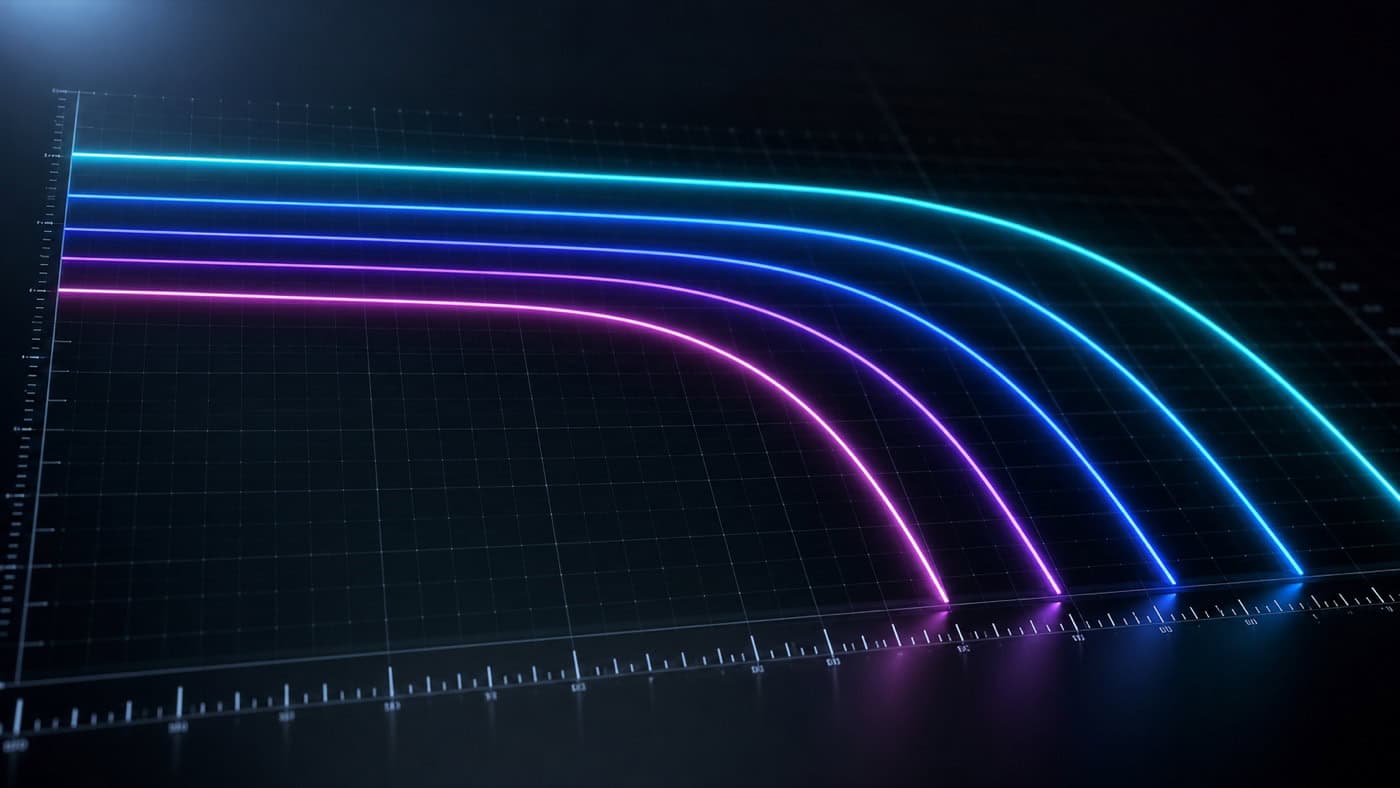
Phase shifts occur when a filter or equalizer changes the phase of an audio signal. This happens because the filter treats certain frequencies differently. Particularly steep filters, which have a slope of more than 12 dB per octave, cause larger phase shifts. This is because such filters are higher order, which means they use more poles and zeros in the frequency domain. These additional poles and zeros cause the phase of the signal to be changed more.
Effects of phase shifts on mixing
When mixing audio tracks, extreme phase shifts can cause several problems:
Comb filter effects: Combining two audio tracks with different phases can cause comb filtering effects. This means that certain frequencies are attenuated or amplified, which can produce an unnatural and hollow sound. These effects are particularly noticeable when the same or similar signals are mixed together, for example when using microphones in different positions to record the same instrument.
Loss of clarity and definition: Phase shifts can affect the temporal coherence of the signal. This means that transient elements, such as drum hits, lose clarity and definition. This can make the mix sound muddy and diffuse because the temporal structure of the signal is disrupted.
Stereo width problems: Phase shifts can affect the perception of stereo width. If left and right channels experience different phase shifts, this can result in blurred stereo imaging. This means it becomes more difficult to accurately identify the position of instruments in space, which can reduce the spatial depth of the mix.
Phase correlation: In complex mixes, the phase relationship between tracks needs to stay coherent. Large phase shifts can reduce phase correlation. This becomes especially problematic when the mix is checked in mono or played through speakers, because frequencies that sound clear and present in stereo may become weaker or disappear in mono.
Your recordings are done, but the mixing isn't quite as you imagined it?
Phase correlation in detail
Phase correlation describes how well the phase relationship between two or more audio signals matches. Good phase correlation means that the signals work together harmoniously, while poor phase correlation indicates interference and cancellation.
Stereo balance and spatiality: Phase correlation directly affects the perception of stereo balance and the spatial distribution of sounds in the mix. Good phase correlation ensures that instruments and voices are clearly and precisely positioned in the stereo field, resulting in a natural and pleasant listening experience.
mono compatibility: Many monitoring systems, such as cell phones or certain speakers, play audio signals in mono. Poor phase correlation can cause important parts of the mix to disappear or sound thinned out when played back in mono. This is because phase cancellations can occur when the signals are mixed together.
Checking the phase correlation: It is helpful to check the phase correlation regularly during mixing. There are special metering tools that show how well the phases of the different tracks correlate. A value close to +1 means a good correlation, while a value close to -1 indicates a strong antiphase, which can lead to cancellations.
Mono compatibility in detail
Mono compatibility is the ability of a stereo mix to sound good when played back in mono. When a stereo mix is played back in mono, the left and right channels are combined into a single signal. With this combination, phase problems can lead to phase cancellation.
Phase cancellations: These occur when two signals with equal frequencies and opposite phases are combined. This results in the affected frequencies being partially or completely canceled in the mixed signal. These cancellations can make the mix sound thin, lifeless, or unbalanced.
Detecting phase cancellations
Mono Review: An easy way to detect phase cancellations is to periodically listen to the mix in mono. Many DAWs (digital audio workstations) offer the ability to switch between stereo and mono playback.
Phase correlation meter: These meters indicate the phase correlation between the left and right channels. A value close to +1 indicates good correlation, while a value close to -1 indicates possible phase cancellations.
Visual inspection: Some analysis tools provide visual representations of the phase relationship between channels, which can help identify problem areas.
Avoiding phase cancellations
Panning and balancing: Make sure that there are not too many similar signals (e.g. duplicate guitar recordings) in exactly the same stereo range. Intelligent panning allows you to optimize the phase relationships between the channels.
Phase Rotate: When recording with a microphone, rotating a microphone a few degrees can help minimize phase cancellation.
Using phase correction tools: There are special plugins designed to detect and fix phase problems.
Timing adjustments: Small shifts in timing between left and right channels can help avoid phase cancellation.
Powerful analog sound so that your track remains competitive? Try our analog mastering!
Linear phase equalizers: pre- and post-ringing
Linear phase equalizers are often used to avoid phase shifts that occur with minimum phase equalizers. These equalizers ensure that the phase of the signal remains intact by processing the signal symmetrically. However, this has a side effect called pre- and post-ringing.
Pre-Ringing: Pre-Ringing occurs before the actual signal arrives. It is a type of pre-echo that can be particularly audible with transient signals. This pre-echo occurs because the filter processes the signal symmetrically around the time of the frequency change, which means that energy is also radiated before the actual signal.
Post-Ringing: Post-ringing is an after-echo that occurs after the actual signal. It is a type of ringing that extends the original signal and extends into the time after the signal.
Effects of pre- and post-ringing
Loss of naturalness: Pre- and post-ringing can affect the naturalness of the sound, especially with percussive or transient signals such as drums and percussion. These effects result in an unnatural sound that can be perceived as unpleasant.
Reduced transient clarity: The clarity of transients can be greatly affected by pre- and post-ringing. Transients are the sharp peaks in the signal that mark the beginning of a sound, and they are important for the definition and clarity of the mix. Ringing can blur these peaks, making the sound softer and less distinct.
Sound coloration: Although linear phase equalizers preserve the phase of the signal, pre- and post-ringing can lead to sound coloration that is particularly undesirable in high-quality audio productions.
When is a minimum phase equalizer better?
Real-time applications: In live situations or real-time editing where latency is an issue, minimum phase equalizers are often the better choice as they introduce no or very little latency. Linear phase equalizers can introduce latency due to the way they process, which can be disruptive in real-time applications.
Transient playback: For applications where transients must be preserved clearly and precisely, minimum phase equalizers are often more suitable. They cause no pre-ringing and only minimal post-ringing, preserving the clarity of the transients.
natural sound: Minimum phase equalizers can provide a more natural sound because they alter the signal less and do not produce unnatural pre- or post-echoes.
Conclusion
Understanding and mastering phase shift is an important aspect of audio mixing. Extreme phase shifts caused by steep filter slopes can lead to comb filtering effects, loss of clarity, stereo width issues, and poor phase correlation. Phase correlation plays a critical role in the clarity, spaciousness, and mono compatibility of your mix. Linear-phase equalizers can avoid phase shifts, but they introduce problems such as pre- and post-ringing that can make the sound unnatural. By using equalizers consciously, using linear-phase equalizers when necessary and minimal-phase equalizers in other situations, and using phase correction tools, you can minimize these negative effects and achieve a clear, coherent, and professional mix.
What does slope of an EQ filter mean in dB per octave?
The filter slope describes how much a filter attenuates frequencies beyond its cutoff frequency, measured in decibels per octave. A 6 dB/octave filter attenuates by 6 dB per octave and operates gently, while 12 or 24 dB/octave filters are significantly more aggressive. Steeper slopes correspond to a higher filter order and cut off frequency ranges more precisely, but they also have a greater impact on the signal's phase response.
What slope should I choose for a low-cut or high-pass filter when mixing?
For gently thinning out low frequencies under vocals or guitars, 12 dB/octave is often sufficient because it produces little phase shift and sounds natural. Steep slopes of 24 or 48 dB/octave are useful if you want to remove unwanted frequencies like footfall or rumble without compromise. The steeper the slope, the more pronounced the phase shifts near the cutoff frequency, which is why you should test the effect within the context of the mix.
What is the difference between minimum-phase and linear-phase equalizers?
Minimal-phase equalizers shift the phase depending on the filter curve and operate with virtually no latency, resulting in a natural and responsive sound. Linear-phase equalizers keep the phase constant across all frequencies, thus avoiding phase shifts, but introduce latency as well as pre- and post-ringing. Minimal-phase types are suitable for creative manipulation and real-time applications, while linear-phase equalizers are better suited for phase-critical tasks such as mastering or parallel processing.
Why do steep EQ filters produce more phase shift than shallow ones?
Steep filters have a higher order and therefore more poles and zeros in the frequency response. Each of these points further alters the phase of the signal, so the phase shift accumulates with increasing slope. Filters with more than 12 dB/octave therefore cause significantly larger phase shifts around the cutoff frequency, which can lead to comb filtering effects and noisy transients when combining multiple tracks.
Can I even hear phase shift caused by EQ slopes on a single track?
On an isolated track, pure phase shift is usually barely audible because the human ear is poor at perceiving absolute phase differences. It only becomes critical when phase-shifted signals are mixed with related tracks, such as multiple microphone setups or doubled recordings. In such cases, frequencies can cancel each other out or reinforce each other. Check such instances in mono and with a phase correlation meter to identify problems early.