Pre-ringing in music production – causes and effects
When a linear-phase filter in a DAW compensates for the signal's timing, an unwanted pre-artifact can occur before the actual sonic event – this phenomenon is called pre-ringing. It occurs particularly with narrowband EQ adjustments at high gain. Q-value and can noticeably impair the clarity and naturalness of the sound.
What is pre-ringing?
Pre-Ringing is an artifact of linear-phase filters, such as those used in DA or AD converters This effect occurs when the filter affects the signal before the actual event. This creates a kind of echo or lingering noise that precedes the main signal. In some cases, this impairs the clarity and naturalness of the sound.
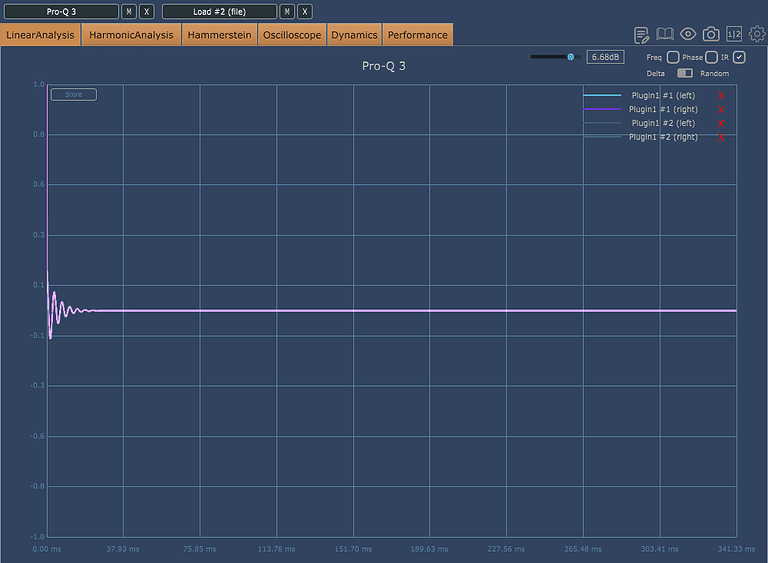
Post-ringing - normal impulse response of a minimum-phase equalizer
How does pre-ringing occur?
Pre-ringing is primarily caused by the use of linear phase filters in digital signal processing. These filters are often used in digital equalizers and other audio processors in music production. Linear-phase filters preserve the phase relationship between the different frequency components of the signal is maintained. However, when narrow-band filters are used to affect specific frequencies, linear-phase filters can cause the filter to intervene before the actual frequency range, thus creating pre-ringing. This happens because the filter tries to maintain the phase relationship between different parts of the signal, resulting in unwanted pre-reverb effects .
Pre-ringing is the downside of linear-phase EQs — how to avoid it in mastering is shown in the Mastering Guide in the context of all EQ strategies.
All linear phase EQs result in one total delay of the signal, which is automatically compensated for by the DAW. When the DAW compensates for this delay, it creates an artifact called pre-ring.
With subtle EQ changes, this effect can be ignored. However, with higher Q values, steep filter slopes and large gain changes, the effect becomes more audible. Additionally, higher resolution processing modes (for better low frequency response) result in higher latency, making the pre-ring effect even more pronounced.
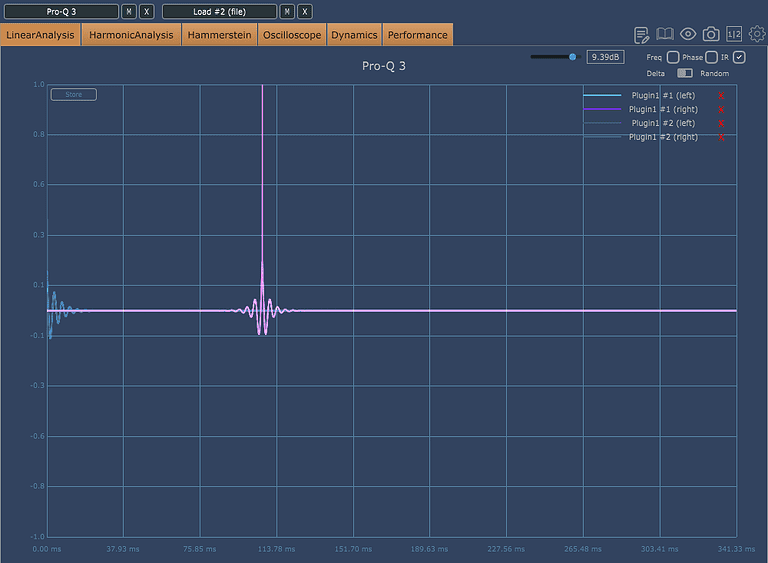
Pre-ringing - delay in the impulse response, as well as a clearly visible wave before the actual main impulse
When is a linear phase filter useful?
Linear phase filters are particularly useful when the phase relationship between the different frequency components of a signal is important, such as in mixing or mastering of music, where phase information can influence spatial perception and sound quality. They are often used when it comes to maintaining the transparency and naturalness of the sound. Linear phase filters are also useful in situations where Phase shifts should be avoided, for example when using Multiband compressors or -limiters to shape the signal without affecting spatial perception.
When do linear phase filters not produce pre-ringing?
Linear phase filters usually do not produce pre-ringing when applied to wide frequency ranges This is especially true as long as the filter slope is not extremely steep. It becomes particularly problematic with narrowband filters that have a steep slope. The article on this topic explains the basics. digital filters.
The following video clearly shows when no pre-ringing occurs.
On your mobile phone while you're out and about?Your audio files are usually stored on your computer – no problem:Send later from the computerWould you rather get started right away? Then a download link (WeTransfer, Dropbox…) is sufficient in the file step – uploading is not mandatory.Selected! You can easily send your files from your computer later.mobile-friendlyGet a price estimate – request a quote now, no obligation. You can upload files directly or send them later from your computer.Files not readily available?No problem – a download link (WeTransfer, Dropbox, etc.) is sufficient. Your request will still reach us immediately.Show download link fieldOr go back a step and select "upload later".
You are currently viewing placeholder content from Calendly. To access the actual content, click the button below. Please note that data will be passed on to third parties.