
Vocoder: The robot voice from Modulator and Carrier

From Kraftwerk and Daft Punk to Kanye West and Bon Iver: The vocoder transforms voice and synthesizer into the famous "singing robot." Here you'll learn how the technology works, where it comes from – and how to set it up in any DAW.

A vocoder (from "voice encoder") is an effect that transfers the timbre of a human voice to a second signal – usually a synthesizer. The voice (modulator) controls the volume of individual frequency bands of the instrument (carrier) via a filter bank. Unlike Auto-Tune, a vocoder does not correct pitch – the played notes come entirely from the instrument.

How a vocoder works: Modulator and carrier

Every vocoder initially needs two input signals:

  • Modulator (MOD): The voice. It provides speech intelligibility – that is, the temporal movement of vowels and consonants.
  • Carrier (CAR): In addition, there's the carrier signal, typically a synthesizer. It provides pitch and timbre. Waveforms rich in overtones, such as sawtooth waves, have proven effective – because the more overtones the carrier has, the more present and intelligible the result.

Put simply, the voice "shapes" the instrument in real time: If you say an "O," for example, the synth receives the frequency balance of an "O." The played notes—and thus melody and harmony—come exclusively from the instrument.

Filter bank and noise level: the technology behind it

Internally, the effect first breaks down the voice via a Analysis filter bank into many frequency bands and continuously measures how much energy is contained in each band. These envelopes then control the corresponding bands of a Synthesis filter bank, through which the carrier signal passes. The more bands, the clearer and smoother the result; fewer bands, on the other hand, sound more robotic and rough.

Many plugins also offer a Noise levelAdding some noise actually improves the intelligibility of consonants (S, T, F sounds), which a tonal carrier alone can hardly reproduce – and also makes the sound deliberately “dirtier”.

A practical tip for mixing: It's best to treat vocoder pads like a choir – i.e., low-cut, De-essing If needed, and in a wide panorama, so that the soundstage supports the main vocal instead of obscuring it. Those who prefer to leave the interplay to professionals can... Have it professionally mixed.

Short story: from the telephone line to the stage

The vocoder was developed in the 1930s at Bell Labs – originally to transmit speech over telephone lines in a bandwidth-saving manner; during World War II, the technology was used for speech encryption. The effect finally entered music in the 1970s: Kraftwerk made the synthetic voice a stylistic principle, followed by electro, funk, and pop – culminating in modern productions where vocoder choirs carry entire hooks, prominently featured in the work of Bon Iver and Kanye West.

This heritage also explains why the term still refers to speech codecs in communications engineering – the music effect and the codec share the same origin. More on the technical history can be found in the... Background article on speech synthesis technology in Wikipedia.

The basic setup in the DAW
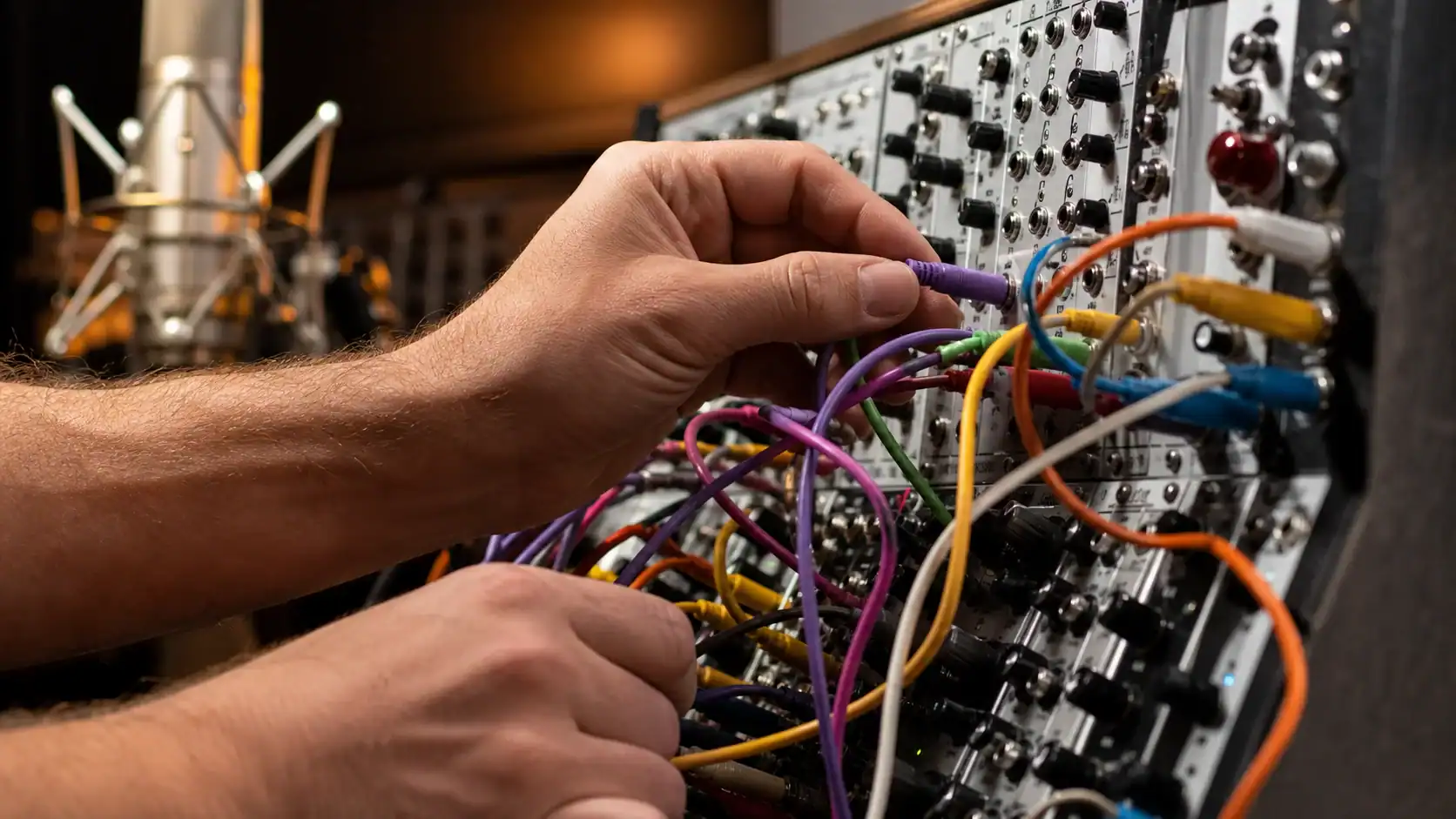
Vocoder setup: Patch cable connected to the modular synthesizer, microphone in the background

The routing is similar in every DAW – only the names vary:

  1. Create three lanes: First, the voice, synthesizer, and the effects instance.
  2. Send both sources to the effect – depending on the DAW, via sidechain routing or by placing the instance as an insert on the carrier and receiving the voice as a sidechain input.
  3. Assign MOD and CAR: Then select the voice as the modulator and the synth as the carrier.
  4. Play in the chords: The pitch comes exclusively from the carrier note. Therefore, chords in the song's key are usually played – this creates the multi-part choral effect. A simple starting point is the root note + fifth + octave; for fuller sounds, major and minor voicings are used.
  5. Adjust the balance: The mix control ultimately determines the ratio of dry voice to effect signal; the noise level also controls the intelligibility of consonants.

If the tones have already been recorded, a mixed signal is immediately audible after routing – from then on, the levels are adjusted by ear.

Vocoder, Autotune or Talkbox?

The three "robot voice" effects are constantly confused – but their principles are fundamentally different:

PowerConcept Typical sound
VocodersVoice shapes a synthesizer (filter bank)Synthetic choir, robot voice; sounds come from the instrument
Auto tunePitch correction of the real voiceThe voice remains a voice; with a hard setting, the familiar pitch-jump effect occurs.
TalkboxThe instrument sound is shaped via a tube in the mouth.Very organic and "speaking" due to genuine mouth resonances.

As a rule of thumb: If you want your own voice to sound artificial, Autotune is the tool to use. If, on the other hand, you want an instrument to speak or sing, you'll need a vocoder (electronic) or a talkbox (electroacoustic).

Conclusion: A once-in-a-century effect that is easy to build.

The vocoder is one of the oldest effects in audio technology – and also one of the most accessible: two sources, one filter bank, chords in the song's key. Therefore, by cleanly routing the modulator and carrier, choosing a synth sound rich in overtones, and treating the pad in the mix like a choir, you can achieve the full spectrum from subtle harmony layers to the iconic robot voice – all without any special hardware.

Get it professionally mixed now

Do you want vocoder pads, effects, and vocals to blend perfectly together in your song?
👉 Book mixing & mastering at PEAK Studios now!

Tip: You can find related terms in our Audio Glossary – from autotune to converters.

FAQ – Frequently Asked Questions about the Vocoder

It transfers the sound shaping of a voice to an instrument: A filter bank analyzes the voice in frequency bands and uses this data to control the same bands of a synthesizer. The instrument "speaks"—the pitch comes from the notes played.

The vocoder was developed in the 1930s by Homer Dudley at Bell Labs – initially for speech-saving telephone transmission, later also for voice encryption. It entered pop music in the 1970s, prominently through Kraftwerk.

The most important families: pitch correction (Autotune and pitch editors), vocoder and talkbox for synthetic voices, room effects (reverb, delay), modulation (chorus, flanger, phaser), dynamics (compressor, de-esser) and creative effects such as stutter, tape stop or harmonizer.

Autotune corrects or stylizes the pitch of your real voice. A vocoder completely replaces the vocal sound with an instrument that you play in chords. For the "T-Pain sound" you need Autotune, for the "Daft Punk choir" a vocoder.