
What is Dolby Atmos? Definition, technology, and stereo questions.

Dolby Atmos Atmos is an object-based 3D audio format from Dolby Laboratories: Instead of storing pre-defined speaker channels, individual sound objects are transmitted along with positional metadata. A renderer then calculates in real time how the sound will play on the respective system – in a cinema with ceiling speakers, on a soundbar in the living room, or binaurally on regular headphones. Introduced in cinemas in 2012, Atmos is now also widespread in TV series, games, and music streaming (spatial audio).

How Dolby Atmos works technically

An Atmos production consists of two layers: a channel-based "bed" (typically 7.1.2) for atmosphere and basic sound, and up to 118 freely positionable audio objects. Each object carries metadata describing its position in three-dimensional space – including its height plane above the listener. Only during playback does the renderer decide which speakers reproduce the object. This makes the format scalable: the same production works in cinemas with over 60 speakers, in home theaters with 5.1.2 or 7.1.4 setups, and via binaural rendering on any headphones. Furthermore, an Atmos master is ultimately delivered as an ADM BWF file, not as a conventional stereo audio file; the technical fundamentals are documented. Dolby Laboratories in the official technical overview.
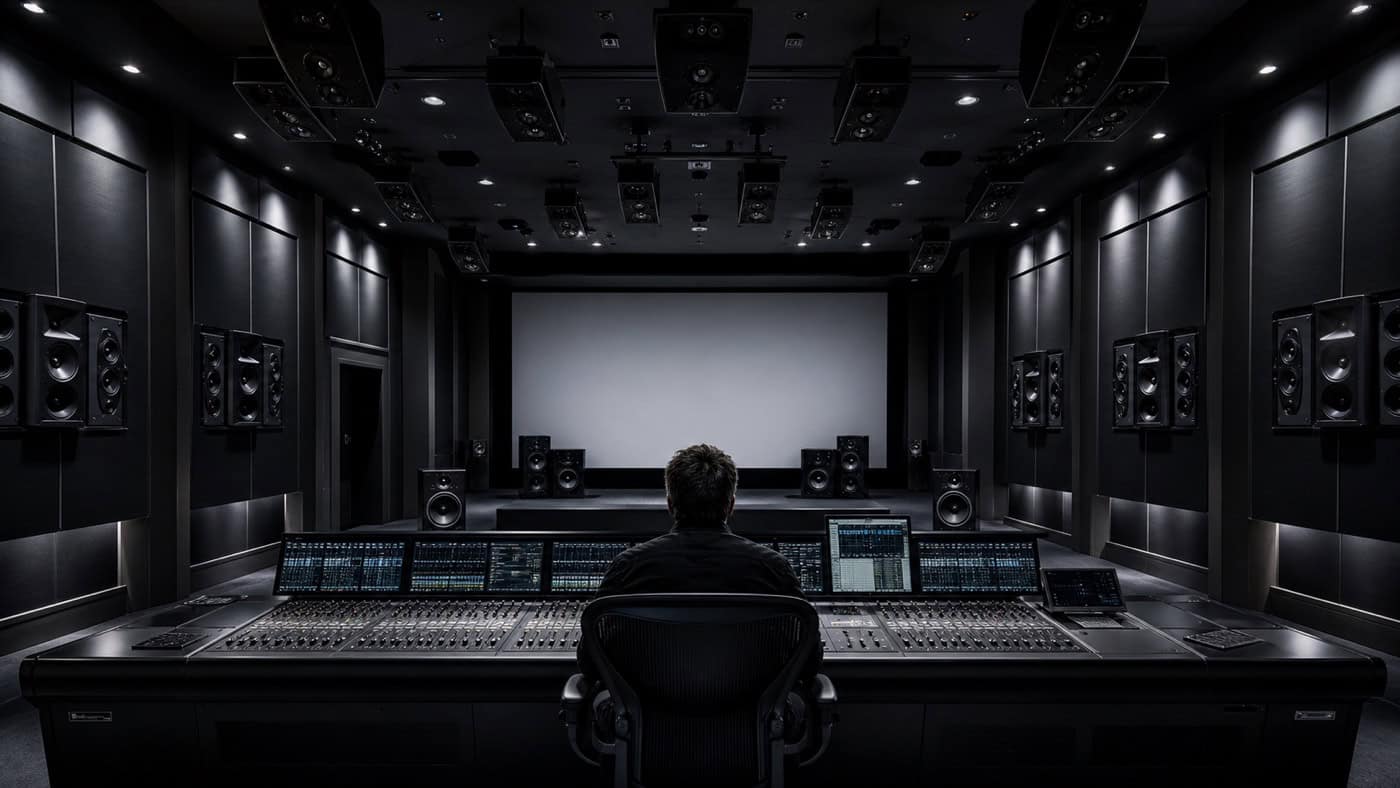
Professional Dolby Atmos mixing room with ceiling and wall speakers in dramatic theater lighting and mixing console in the foreground.

Where you can encounter Atmos

Atmos has been established in cinemas and home theaters (Blu-ray, streaming services like Netflix or Disney+) for years, as well as in soundbars, AV receivers, and many TVs. In music, it gained momentum in 2021 when Apple Music launched Spatial Audio with Dolby Atmos; Tidal and Amazon Music also stream Atmos mixes. Spotify, however, does not yet offer Atmos. On mobile devices and headphones, the playback device renders the 3D effect binaurally – so no special hardware is required.

Dolby Atmos in music production

An Atmos music mix is ​​not created from the finished stereo sum, but from the individual tracks. Stems In production, vocals, drums, synths, and effects are placed as objects or bed components in 3D space. The workflow is therefore fundamentally stem-based – anyone planning an Atmos release needs cleanly organized, separately available stems for their production. The Dolby Atmos renderer in DAWs like Logic Pro, Pro Tools, Cubase, or Nuendo serves as the tool; separate, more traditional delivery guidelines also apply. Loudness specifications (LUFS) than with stereo streaming.

Why every Atmos release still needs a stereo master

Dolby Atmos is never the sole format of a release: streaming services still require a classic stereo master upon delivery – the Atmos mix is ​​an additional version that only plays on compatible devices and services. CDs, vinyl, radio, clubs, and the vast majority of listening situations also remain stereo. Therefore, the foundation of every release is a professional stereo master. online mastering; if the traces are already separate, this also offers the possibility of Stem mastering an – the same stem-based way of working on which Atmos workflows are also based.

Do you need Dolby Atmos for your release?

It's not mandatory: A release without an Atmos track is perfectly acceptable on all platforms, as listeners and platforms will primarily access the stereo version. However, Atmos becomes interesting if your distribution supports it, your genre benefits from spatial sound, and there's a budget for a separate 3D mix. A sensible prioritization means: first a strong stereo master, then – optionally – the Atmos track as an additional format.

FAQ – Frequently Asked Questions about Dolby Atmos

An Atmos-enabled source (e.g., Apple Music, Tidal, Netflix) and a compatible playback device: soundbar, AV receiver with height channels, many TVs – or simply headphones, because mobile devices render Atmos binaurally.

It's a different format, not a replacement: Atmos can reproduce space and height, while stereo remains the reference for music production, clubs, radio, and most listening situations. A bad mix won't be improved by Atmos – and every release needs a strong stereo master first anyway.

Apple Music (Spatial Audio), Tidal, and Amazon Music stream Atmos mixes. Spotify does not yet offer Dolby Atmos. Netflix and Disney+ are among the streaming services for movies and TV series.

Not really: A true Atmos mix is ​​created from the individual tracks or stems that you place as objects in the soundstage. Automatic upmixes from the stereo mix are considered a compromise in terms of sound quality. Anyone planning an Atmos setup should therefore organize their production using stems.

No – Atmos is optional. Streaming services always require a standard stereo master; the Atmos version is an additional version for compatible devices. The sensible order is: first a professional stereo master, then optionally Atmos.

5.1 is channel-based: The mix is ​​fixed to six speaker channels. Atmos, on the other hand, is object-based: Sound objects with positional data are only distributed to the existing speaker setup during playback – including height channels and headphone binauralization.