
Quantization noise - Causes, effects & solutions

Quantization noise refers to the error signal that inevitably arises when converting an analog signal to a digital one: Because continuous amplitude values ​​are rounded to discrete steps, a small deviation remains – the audible or measurable noise. The higher the Bit DepthThe finer the steps and the lower the quantization noise.

What is quantization noise?

Quantization noise is created when analog signals are converted to digital signals. Continuous values ​​are converted into discrete steps, resulting in slight deviations and noise. This noise is the result of the difference between the actual analog signal and its digital representation.
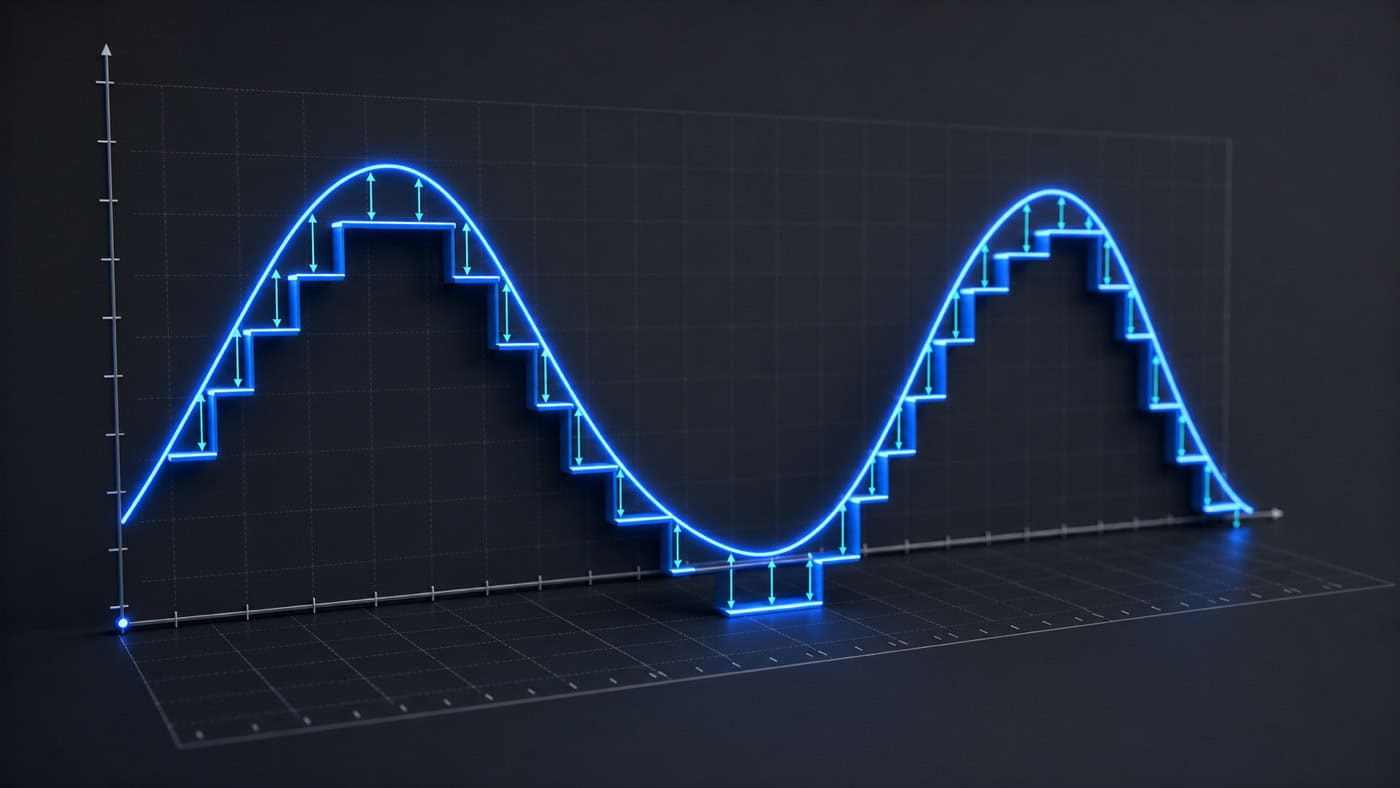
3D visualization of a quantized audio waveform with a stair-step effect and a blue glowing gradient on a dark background.

How does quantization noise arise?

The process of quantization involves dividing a continuous signal into a limited number of discrete levels. This inevitably leads to an approximation in which fine details of the original signal are lost. Quantization noise occurs because the mapping of an analog value to the nearest digital level represents a small but significant source of error.


Mathematical basics:

Quantization noise can be described mathematically by the signal-to-noise ratio (SNR), which indicates the ratio of the strength of the signal to the strength of the noise. For an n-bit quantization method, the SNR can be simplified by the formula SNR = 6.02n + 1.76 dB.

Quantization noise is the fundamental digital boundary — why dithering in mastering addresses this is explained by the Mastering Guide .

Applications in digital signal processing:

  • Audio processing: Quantization noise can cause audible distortion in digitized audio signals. Techniques such as dithering are used to minimize these effects.
  • Image processing: In image processing, quantization noise leads to visible artifacts, especially in areas with fine color gradations.
  • Telecommunications: Here, quantization noise affects the quality of the transmitted signals and requires noise reduction techniques.

Methods for reducing quantization noise

  • Dithering: A technique that adds controlled noise to reduce the perceptibility of quantization noise.
  • Oversampling: Increasing the signal sample rate to distribute and reduce quantization errors.
  • Noise shaping: Shifting the noise to less disturbing frequency ranges.

Applications in digital audio

Quantization noise is relevant in many areas of digital audio:

  • Music industry: Control the volume of concerts and recordings.
  • Industry and construction: Compliance with noise protection regulations and protection of workers.
  • Everyday: Assessment of noise pollution from traffic, household appliances and events.

Case studies and practical applications

Real-world applications of quantization noise techniques can be found in modern audio and image processing programs, in telecommunications, and in the processing of sensor data. In audio engineering, for example, dithering is often used to improve sound quality when digitizing music.

Future prospects

Current research is focused on developing new algorithms and techniques to further reduce quantization noise. Advances in hardware technology and computing power also enable the application of more complex real-time noise reduction methods.

Quantization noise occurs when analog signals are converted to digital signals and deviations occur due to discretization.

Quantization noise arises during the quantization process, in which a continuous signal is divided into discrete levels, resulting in small errors.

Methods for reducing quantization noise include dithering, oversampling, and noise shaping to minimize the perceptual effect of noise.