Mastering AI songs
What you absolutely have to consider with AI music
AI-generated music often sounds impressive – but rarely finished.masteringof AI-created songs is crucial to correct technical coldness, unbalanced frequencies or lack of dynamics and to ensure a professional sound for Spotify, YouTube & Co.
Table of Contents
- How to improve the quality of AI songs
- How professional AI mastering worksAI-generated tracks bring their own mastering challenges — this guide shows you how to handle them professionally.Mastering Guide.
What does “AI music mastering” actually mean?
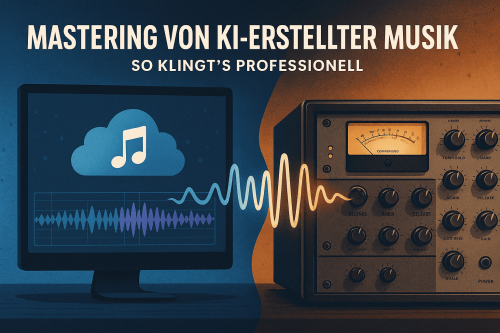
Mastering is the final step in the production process – even for music that was generated entirely or partially by AI.Whether withSuno, Share, Birch, boomyor other tools: The raw AI output must be technically optimized to meet professional standards.
👉 Goal: aconsistent, dynamic, streaming-compatible sound.
TheSuno Prompt GeneratorYou will create structured prompts for better and more reproducible Suno results.
Why is export from Suno, Udio & Co. not enough?
AI systems generate music algorithmically – this means:
- no consciousDynamic design
- little feeling forMix-balance
- often highly compressed,“flat” waveforms
- missingstereo width or unnatural transients
A mastering process helps to compensate for these deficits and brings the production to acompetitive level.
📌 More about this in the specialist article byProduction Expert:How AI is Changing Music Production
The most common sound problems with AI music
These symptoms are particularly common with AI tracks:
| Problem | Explanation |
|---|---|
| ❗ Hard transients | Kick, snare or vocals cut aggressively through the signal |
| ❗ Overemphasized mids | AI tends to exhibit an artificial presence in the 2–4 kHz range. |
| ❗ Flatness | Depth of field, no musicaldynamics |
| ❗ Stereo weaknesses | Mono-heavy signalsor unnaturalPanning |
| ❗ Artificial-sounding vocals | Especially atgenerated votes– often sound nasal or synthetic |
🧠 Especially whenStemsor stereo files from AI platforms can be aprofessional masteringmake the difference.
How to improve the quality of AI songs
AI-generated songs often soundtechnically correct, butemotionally weak. If you have yourImprove AI songsyou should pay attention to the following points:
- Check sound balanceMake sure the frequency response is balanced – many AI songs have overly present mids or muffled highs.
- Add saturation and analog warmthThrough targeted saturation or analog mastering tools, you canMaking AI songs betterwithout overdriving them.
- Rework transients and grooveTransient designers allow you to precisely control the punch of the kick and snare – this improves the sense of rhythm.
- Adjust stereo imageMany AI songs are mono-centric. A targetedStereo wideningmakes the production sound significantly “bigger”.
🎧 Peak-Studios offers special tools in the analogStem mastering-process toTo sustainably improve AI song quality– even with generated vocals we help you create a professional track.
How professional mastering of AI songs works
The mastering process is technically identical to conventional material – but theApproach is often corrective:
- Analysis of the frequency spectrum→ Conspicuous peaks or resonances are neutralized
- Dynamic processing→ Use ofMultiband compression, Limiting, possibly saturation
- Stereo editing→ Stabilize the center signal, broaden the side components
- Level adjustment and loudness target values→-14 LUFSfor Spotify, -1 dBTPTrue Peak
📈 Peak-Studios relies onanalog summationand high-end gear like Masalec, Dangerous or Chandler to refine sterile AI sounds.
Tools and techniques in use
Some plugins and techniques that are particularly commonly used when mastering AI songs:
- FabFilter Pro-Q4– Frequency fine correction
- Ozone Advanced– All-in-one solution for AI stems
- Gyraf G22 / Dangerous Compressor– for analog saturation
- Soothe2– dynamic EQ against sharp resonances
- De-Esser– indispensable for AI-generated vocals
💡 Tip: AI productions are not worse – theyjust behave differently. Mastering should respond to this.
Loudness standards & platform specifications
AI songs must also meet platform standards – otherwise there will be distortions during streaming:
| Platform | Max. True Peak | |
|---|---|---|
| Spotify | -1-2 dBTP | |
| Apple Music | -1-2 dBTP | |
| YouTube | -1-2 dBTP | |
| Tidal hifi | -2-2 dBTP |
📌 Source:Intersample Peaks – Why 2 dB True Peak Headroom is better.
A professional mastering takes these values into account and delivers the filein the best possible quality of the platforms.
Already atOnline mixing services You should pay attention to the right preparation so that mastering for streaming services can get the best out of your track.
Mini tip for AI producers
🎯Export your AI songs unmastered, in 24-bit WAV, without limiters.So yourmastering engineermake full use of the potential – without peaks that have already been irreversibly compressed.
Conclusion: AI doesn’t need humans – but human mastering
Whether chart hit or lo-fi loop –Artificial intelligence is revolutionizing theMusic Production , but the final touch remains (still)Human craftsmanship.Only with professional mastering does AI music sound like it came from a real studio –transparent, dynamic and ready for the audience.
🛠️ Peak-Studios offers analog & digital online mastering starting from €65.→ Start mastering now
Besides good sound quality, the legal situation also matters: What are the legal considerations when it comes to...Copyright of AI songsOur guide will tell you who owns the song and whether you're allowed to use it.How to correctly label your AI track, as shown in our current guide.
FAQ
Does AI music even need to be mastered?
Yes – exporting from Suno or Udio is not sufficient for professional requirements.
How can I improve the quality of AI songs?
The quality of AI songs can be significantly improved through targeted mastering—for example, with EQ corrections, saturation, stereo enhancement, and transient processing. The use of analog tools can also refine sterile AI sounds.
Which formats should I provide for mastering?
Optimal: WAV, min. 24 bit, 44,1 or 48 kHz – without limiter or clipping.
Are AI stems or individual tracks also mastered?
Yes, for example asStem masteringfor better control over mix balance.
Do AI vocals sound worse?
Often yes – they require special processing (de-esser, saturation, formant correction).
How much does mastering AI tracks cost with you?
Digital mastering from €65, analog mastering from €89. Optionally included.mix analysis .