Properly labeling AI music: AI-generated vs. AI-supported
If you use AI in your music or release AI-generated songs, this directly affects you. In this guide to AI music labeling, we explain honestly and without scaremongering what the new industry standard actually means, what the difference is between "AI-generated" and "AI-assisted," how to correctly label your release for distribution, and why the voluntary label is different from the legal labeling requirement under the EU AI Act. We also answer the question our customers ask us most frequently: Does professional mixing or mastering change the AI classification of your song?
Table of Contents
What was decided? An overview of the new industry standard
On July 10, 2026, a coalition of major music associations unveiled a joint, two-tiered labeling standard for sound recordings. Among the participants are the IFPI (the global umbrella organization for the music industry), the US-based RIAA, the independent music association A2IM, the European associations WIN and IMPALA, the Recording Academy (the organization behind the Grammys), the actors' and musicians' union SAG-AFTRA, and the Human Artistry Campaign. In Germany, the BVMI (Federal Association of the Music Industry), as an IFPI member, supports the standard.
The reason for this is the sheer volume of AI-generated content: In April 2026, around 44 percent of the tracks uploaded daily to Deezer were AI-generated – roughly four times as many as a year earlier. When such a large portion of new music is created using artificial intelligence, listeners need a reliable indication of what they are actually listening to.
The gist of it in a nutshell: In the future, there will be two visible labels for music – “AI-generated” and “AI-assisted”. These will be displayed via a track's metadata on streaming platforms, similar to the “Explicit” label for offensive lyrics that already exists today.
Three things you need to know about AI music labeling
To properly understand the new standard, three points are particularly important:
- First: It's voluntary.This resolution does not create any legal obligation, there is no fixed deadline, and no sanctions mechanism. The associations are relying on a broad, global voluntary commitment from the industry.
- Secondly: It only applies to the audio recording.Lyrics, composition, music video and cover art are explicitly not included.
- Thirdly: The person providing the information is initially the rights holder himself.According to the trade press (Hollywood Reporter), it remains unclear who verifies the accuracy of the information and how borderline cases are decided. AI recognition is intended to fill this gap.
Source for the facts: theOriginal press release from the RIAAfrom July 10, 2026, as well as the reporting fromhot onlineand the trade press (as of 10.07.2026).
AI-generated vs. AI-supported: a comparison of the two levels
The entire standard hinges on one question: Who recorded the lead vocals and main instruments – a human or a generative AI? This is precisely what determines the classification. The following table compares the two levels, closely following the published wording.
| feature | AI-generated | AI-assisted |
|---|---|---|
| Core definition | Generative AI has generated all or the majority of the creative elements of the recording. | The recording was essentially created by humans and expresses human creativity; generative AI was only used for individual expressive elements. |
| Lead vocals | generated via AI prompt possible | sung by people |
| Main instruments | generated via AI prompt possible | played by humans |
| Typical example | AI lead vocals, AI main instrument, or a track generated entirely via prompt | A human-written song in which AI contributes, for example, an effect or a secondary element. |
| Label idea | large “AI” symbol | small “ai” symbol |
The key rule to remember: As soon as the lead vocals or a central instrument originates from the AI prompt, the track is considered "AI-generated." Only if a human is involved is the track considered AI-generated.he did the vocals and the main instruments himselfIf AI has contributed only individual expressive elements, the label "AI-assisted" applies. The threshold for "AI-generated" is therefore low – a single prompt-generated main element is sufficient. For AI music labeling, this means that even one prompt-generated main element will shift your label to "AI-generated."
Does human mixing or mastering make my AI song "AI-assisted"?
That's the question musicians ask us most often – especially when they're working on a project.song produced with Suno or Udiowant to have it professionally finished. The short answer:According to the wording of the standard, the answer is no.
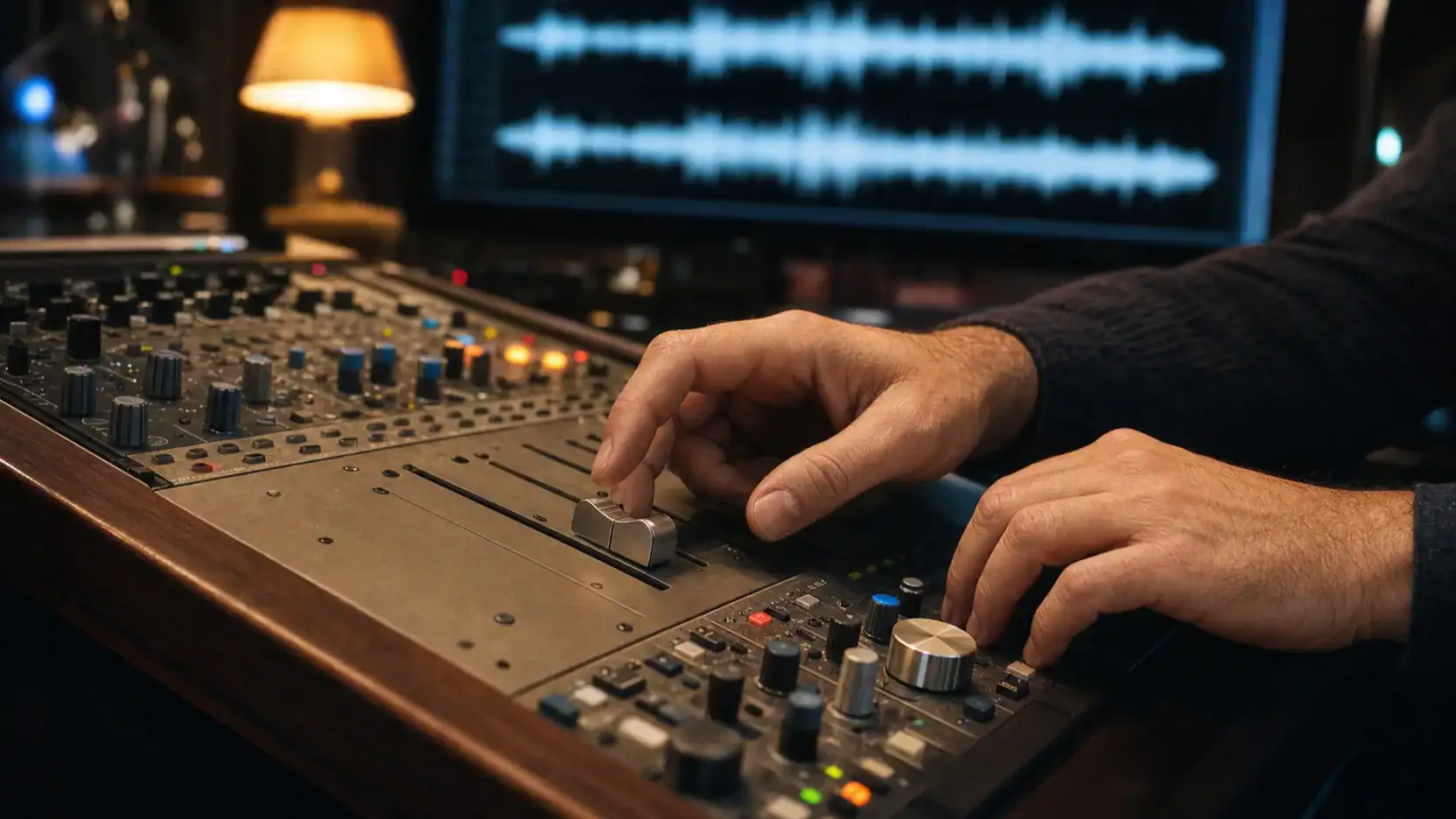 Mastering an AI song on an analog console: Post-production does not change the AI classification (Image: AI-generated illustration – symbolic image)
Important note: This is our classification based on the current state of published definitions, not a statement from the associations, and not legal advice. None of the sources published so far even mention mixing or mastering. We derive the answer logically from the definitions.
Why mastering doesn't change the AI rating
The reason lies in the wording of "AI-powered": it explicitly states that humans must have recorded the lead vocals and main instruments. Mixing and mastering are post-production processes – the further processing of finished material. They are not the "recording" of vocals or instruments and do not create any new creative elements. A track whose vocals and instruments originate from AI therefore remains "AI-generated," even if a human subsequently mixes and masters it to a high standard. Human mastering does not change the classification to "AI-powered."
And what if you sing and play the parts yourself?
Conversely, a song that you yourself have sung and played, and which is then professionally mixed and mastered, is unquestionably a human song – at most "AI-assisted" if generative AI has contributed a single expressive element. Purely analytical or tool-like functions in mastering (such as EQ matching or loudness analysis) are not "generative AI that generates creative elements" and, according to the wording, probably don't even fall under the label. This, too, is a matter of interpretation and not explicitly regulated.
Practical advice for you: The rating is based on the origin of the vocals and main instruments, not on post-production. "We professionally master your song" doesn't change the AI's classification of the supplied material – but it does significantly affect the sound quality. Frankly, mastering doesn't turn your AI track into a human-made piece of work. It makes it louder, clearer, and more competitive on streaming platforms. If you want to elevate an AI song to a professional level, this is the way to go.Professional mastering of AI songsExactly the right step – but for quality reasons, not as a detour around a label.
Did you create an AI-generated song with Suno or Udio? We'll bring its sound up to release quality – honestly assessed and professionally mastered.
Questions about labeling or mastering your AI song?
Write to us – we'll answer your questions about AI music, releases, and sound quality. We usually get back to you within 3 hours (on weekdays).
-
Personal point of contact
-
Over 20 years of experience
-
Highest quality standards
You can reach us by phone from Monday to Friday from 9 a.m. to 8 p.m.
Law vs. industry standard: EU AI Act and voluntary labeling
This is where most of the confusion arises, which is why we're making a clear distinction. There are two completely different levels, both called "AI labeling," but they regulate different things.
Thelegal levelis the EU AI Act, specificallyArticle(Transparency obligations). It applies from August 2, 2026. For music, this means, in simplified terms: Providers of generative AI – i.e., tools like Suno or Udio – must mark their synthetic audio outputs in a machine-readable way so that systems can recognize that the content is AI-generated. In addition, there is a labeling requirement for deepfakes. This obligation primarily applies to AI providers and is binding throughout the EU.
Thevoluntary levelis the new industry standard of music associations. It is a human-readable label for consumers (the two symbols on the platform), voluntary and more narrowly limited to sound recordings.
Both levels of AI music labeling aim for the same fundamental goal – transparency regarding AI origins – but they are not the same. The voluntary industry standard can indeed help meet the expectations of the AI Act in music distribution. However, it does not replace the legal, machine-readable labeling requirement for AI providers. One level is a technical signal in the data stream, the other a visible symbol for listeners.
One detail you should be aware of: Discussions surrounding the final EU Transparency Code of Conduct and potential deadlines took place in 2026. We are deliberately not mentioning a specific date here that we cannot verify with a primary source. For your specific situation – especially if you are publishing commercially – the advice is: if in doubt, seek legal counsel (detailed information at the end of the article).
Properly labeling AI music upon release: step by step
How do you label your song in practice? The labeling doesn't happen on the platform itself, but rather during the upload process.Uploadabout yourSales(Distributor). From there, the information travels as metadata through the chain to the streaming platform. Here's how to proceed:
Labeling AI music: the five steps
- Check the origin honestly.Does the lead vocals or a main instrument come from an AI prompt? Then it's "AI-generated." Did you sing and play everything yourself and only use AI for a minor element? Then it's "AI-assisted." It's best to make this classification before uploading.
- Use the AI specification fields at the distributor.Many distributors (for example DistroKid or iMusician) now have an AI disclosure step in the upload process. There you can usually specify separately whether vocals, instrumentals, lyrics, or an entire composition were created with AI.
- Set the metadata truthfully.Technically, the information is provided via the metadata standard.DDEX, via which distributors already provide all track information to the platforms. Since September 2025, for example, Spotify has supported a DDEX extension for AI credits that differentiates granularly between AI vocals, AI lyrics, and AI instrumentals, and this is visible in the song credits.
- Expect detection.False information can be exposed: Services like Deezer use AI detectors that identify AI tracks and demonetize streaming fraud. Apple rejects AI uploads altogether in some cases. Honest labeling protects you from bans and demonetization.
- Clarify the master's degree separately.The label refers to the origin, not the sound quality. Whether you master your track yourself or have it mastered professionally is purely a quality decision – and doesn't change the AI rating.
If you want to understand more deeply how platforms recognize AI music in the first place, we've covered that in detail in the article on...Deezer AI Music Detectorexplained.
What the standard does NOT cover
The standard has deliberate gaps – and you should be aware of them so you don't get a false sense of security. The following are not covered:
- Lyrics:A text written entirely by AI will not receive a label as long as the vocals and instruments are human.
- Composition:Even a melody or harmony entirely invented by an AI model does not require labeling as long as humans sing and play it.
- Music video and cover art:Separate rules apply to image and video content, not this music standard. Important: AI-generated image content will be subject to the machine-readable labeling requirements of the EU AI Act from August 2, 2026.
Furthermore, there's a second major criticism: the voluntary nature of the process. Those who use AI for fraud won't disclose it anyway – and honest artists might shy away from the label for fear of stigma. That's precisely why AI detectors are intended to supplement self-disclosure. For you as a reputable musician, this means that with AI-driven music labeling, honest disclosure isn't a disadvantage, but rather protects your reputation and your royalties.
A related topic is the technical watermark used by AI tools like Suno to mark their output. Why you should be aware of such watermarks.Do not remove watermarksWe will explain that separately.
Conclusion: Label honestly, sound professional.
The new industry standard finally brings a common vocabulary to a confusing field: "AI-generated" when vocals or main instruments are created by AI, "AI-assisted" when the song is human and AI only provides assistance. It is voluntary, covers only the audio recording, and runs parallel to the legal labeling requirement of the EU AI Act, which will obligate AI providers from August 2, 2026.
For you as a musician, the most important takeaway regarding AI-generated music labeling is this: Label honestly, because detectors will flag false information anyway – and the rating depends on the origin of the vocals and instruments, not on post-production. Professional mastering won't turn your AI-generated song into a human-made work, but it will make it competitive.
Do you have an AI-generated song or a track you recorded yourself and want to bring it up to release quality? Upload your material – we'll give you an honest assessment of its sonic potential and master it professionally. You can see the costs transparently in our [link to pricing information].Mixing and mastering prices.
Frequently asked questions about AI music labeling
Is AI-generated music labelled on Spotify?
Partially. Since September 2025, Spotify has supported AI credits via the DDEX standard and displays them in song credits – but only if the rights holder specifies them during upload. A comprehensive, mandatory labeling system does not yet exist (as of July 2026). The new industry standard aims to standardize precisely this.
Does AI-generated music need to be labelled?
Two answers: The industry standard from July 2026 is voluntary – it does not create an obligation. However, the EU AI Act requires AI providers to mark their output in a machine-readable format from August 2, 2026. For your specific commercial release, you should seek legal advice if you are unsure.
Is AI-generated music royalty-free?
Not automatically. "Royalty-free" means that no GEMA-protected rights exist for a work. Whether this applies to an AI-generated song depends on the tool used, its terms of service, and who is considered the copyright holder. This is a legal question, not a matter of labeling – more on this in our article on...Copyright in AI-generated songs.
Is AI music illegal?
Based on current knowledge, AI-generated music is not generally illegal. Problems arise when training data is used by others, voices are imitated without consent, or false information is provided during distribution. Legality and labeling are two separate issues – and each case is a legal question, so you should seek legal advice if in doubt.
How can I recognize AI-generated music?
This is achieved through metadata labels (if set) and AI detectors like Deezer's, which analyzes tracks and outputs an AI score. We have described the technical details of how this works.
Who is responsible for labeling AI-generated music?
Initially, the rights holder is responsible for providing the information during the upload process. Under the EU AI Act, however, the labeling obligation lies with the AI providers. Who will review borderline cases and penalize false information is not yet definitively clarified under the voluntary industry standard.