Analog vs. Digital: Differences, advantages and disadvantages in audio technology
At the analog audioSound pressure is transmitted as a continuous electrical signal — without discretization.Digital audioIn contrast, this signal is sampled at fixed time intervals (sampling rate) and stored as a sequence of numbers. Both approaches have proven successful in professional applications.mixingandmasteringtheir strengths and weaknesses — this article explains the technical differences neutrally and based on measurable facts.
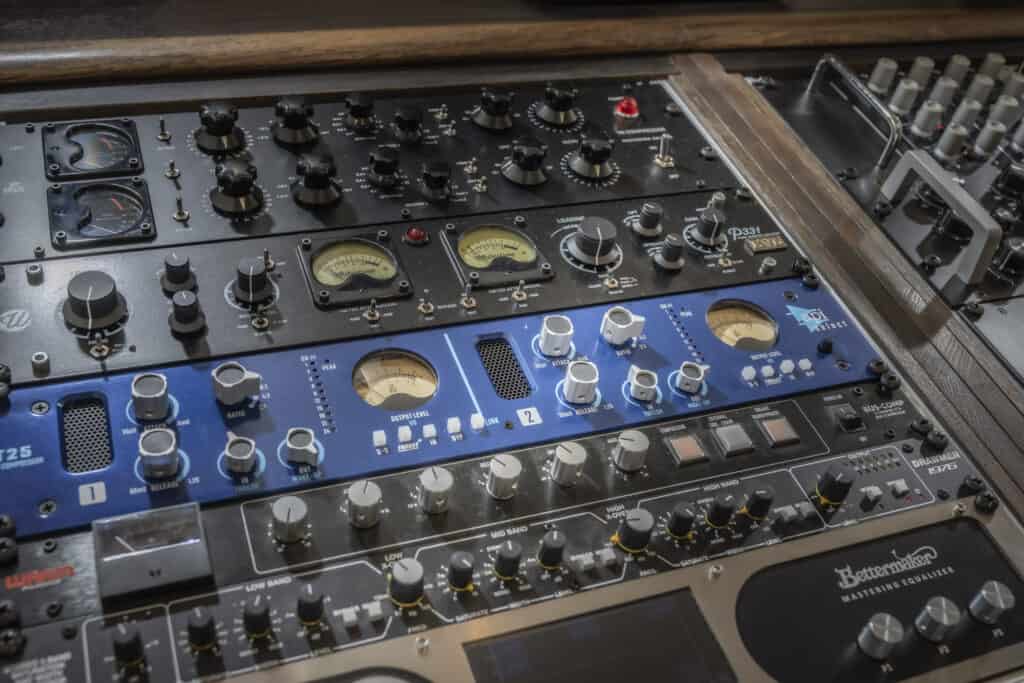
It doesn't apply in every case, but every now and then it isanalog sound im mixing or masteringstillfar ahead of audio plugins.
The funny thing is that there are indeed scientific tables and facts that put analog mixing and mastering far ahead of audio plugins. So this is not about magic or just gut feeling, the facts speak volumes.
But that doesn't mean that you have oneNumber one hitcan only produce analogously. There are many great songs that can also be produced digitally, purely in-the-box (in the box) have arisen. But if a reallydeep and rich soundis to be generated analogously is still the best way.
One more thing to say before we delve deeper. As is so often the case, the devil is in the details, and these are all too often hidden in the darkest corners of signal processing mathematics. That's why we try not to use too much technical jargon here and to explain it in a very easy way.
SAMPLERATE – ACCURACY AND TIME RESOLUTION
All audio systems (DAWs) have their limitations. But it happens that analog circuits are not always limited to 22 kHz or 48 kHz ( how it works digitally at 44,1 kHz or 96 kHzsampling rateis working ), and even if the combined in-to-out bandwidth is only 20 kHz, the individual branches of the same circuit canHave bandwidths in the megahertz range or higher.
But why is this necessary? Humans only hear up to 20 kHz and only at a young age or if your father is a dog 🙂
Jokes aside, during the processing itself, especially if any quick onestiming constantsintodynamics processingare involved (e.g. inaudio compressor1176…), the byproducts of the synthesis of the control signals, or even the control signal itself, can occur and have a much wider bandwidth than the human ear can perceive.
Compared to basic digital processing algorithms, this allows analog circuits to “inter-sample peaks“ and generate control signals from frequency content that exceeds the human hearing range or theNyquist frequency limitof a digital system significantly exceed.
A higher bandwidth audio circuit, if not really carefully designed, can be more susceptible to oscillations at frequencies well above our hearing range. This phenomenon canreducedheadroom , weird distortions and intermodulation in our song, none of which sounds really pleasant. Nevertheless, it is not to be despised that with the correct circuit design of the "built-in"True peak processingduring the walk into the AD-converter(Conversion from analog to digital) can save a few dB of headroom.
NONLINEARITIES – DIFFERENT EQUAL BETTER?
Analog devices in music also don't need to somehow stitch various mathematical curves together in order tosaturation, distortionand simulating other non-linearities - things inherent in digital sound processinghardest fallto do right. Instead cananalog equipmentexactly the same effect withfar superior accuracyachieve, so you can achieve perfect, imperfect results in mixing or mastering. It is not necessaryOversamplingto use. It will continue to work even if you have updated your DAW or the plugins.
OVERSAMPLING IN AUDIO EDITING
Oversampling* or oversampling occurs when a signal with ahigher sample rateis processed than is actually required for displaying the signal bandwidth. An oversamplingmay have advantages in some applications.
*The correct terms for this process when done digitally/ITB would be upsampling, processing and downsampling, but since the effect of increased bandwidth is the same as if the signal was originally oversampled when converted to digital, most use plugins -Manufacturers use the term oversampling as an explanation.
This process requires very good filters in the plugins to avoid generating frequency content that was not present in the original audio, thus preventing a distorted sound.Mixor to obtain a master's degree.
Many good-sounding digital dynamics processors (VST plugins) have built-in oversampling to provide a more accurate,natural gain reduction responseto deliver.
But even oversampling cannot be compared to thatAccuracy of a well designed analog circuit. This is particularly important for all time-dependent processing. The difference is therefore much more noticeable in dynamics processors (such as compressors, limiters, gates, etc.) where the accuracy of theAttack and release timing curvesdecisively influences the tonal character of the compression, limitation, expansion or gating. Plugins must at least oversample both audio and timing circuits to have any chance of comparison.
BANDWIDTH OF ANALOG DEVICES AND PLUGINS
The topic of bandwidth of analog devices and plugins has already been touched on in the text above, but we want to go into more depth here.
Whenever the audio signalnonlinearrunning, that creates oneadditional frequency content. So if a peak is cut off, everything above the cut has to go somewhere, because it's very unlikely that it will fizzle out in the air...
With analogue devices, these higher frequencies either disappear in the circuit or they reach the A/D converter and are lost there.
Things can get complicated with audio plugins. To stay true to the sampling theorem, a digital algorithm must combine this energy redistribution with amuch more limited setof available frequencies.
How does this affect the audio signal?
So, to hear pleasant 2nd and 3rd harmonic overtones in your song when saturation occurs at a 14 kHz component of an "S" sound at a 48 kHz sampling rate, you have to resort to more drastic measures. 28 kHz and 42 kHz frequencies simply do not "exist" at 48 kHz sampling rates because the way physics works puts them above the Nyquist frequency limit.
If you're not careful, these higher harmonics will appear incorrectly at 20kHz and 6kHz. If that occurs, it's totally bad, this phenomenon is calledAliasing. Here you can hear a strange sound during processingmetallic or plastic quality. Finding a good solution to this plugin problem is not always easy and always requiresTradeoffs in filter design and CPU usage.
ANALOG MODELING FOR PLUGINS
You want to make a true-to-life analogue replica? Then buckle up because this isn't going to be easy.
We're trying to shed some light on the technology swamp and give a basic overview without technical jargon.
Modeling an analog circuit means that we need to figure out how the circuits perform in relation to the differentinput signal levelandfrequency contentbehave so that we know what comes out at the other end for any given input. It's not enough to try out the emulation with a test signal and then do it exactly the same for all sounds. You have to make it doable with different sounds and it becomes oneBalancing act when coding plugins.
To do it carefully and correctly, we need to know the electrical components of this circuit (Resistors, capacitors, transistors, tubes, inductorsetc.) and the more accurate the model is supposed to be, the better we have to describe these elements. Sure, a resistor is just a wire that doesn't like lots of electrons being pushed across it, but does it do that equally for all types of audio signals? What if this resistance is near a bulky inductor or an overheated tube?
Each time we create a better, more complete description for each element to achieve greater accuracy, the extrapolation within the VST or AU plugins becomes more complicated. It can become so complex that it is either nearly impossible to navigate or too difficult to calculate in real time.
It goes without saying that there is a lotmore development timeand therefore needs money to make this extrapolation work really well. That's whymany plugins have a simplified version. And although it works in real time, it has to be said that even if you look at it from a distance, itonly resembles what a real circuit can do, because the essential details are missing.
Something is missing in the audio algorithms and you can hear that too. If half measures are acceptable to you on your tracks then that's cool, but I'm guessing most of you need more.
MORE DEPTH IN AUDIO EDITING
Let's take a look at thesidechain circuitsdynamic processors likeaudio compressors or Limiting-Plugins. They use diodes (among many other elements) to create the control voltage from an audio signal. A diode is aone-way valve' for electric current, and each time this valve opens or closes, it does so very quickly and consequently produces a shorthigh frequency noise, similar to a "click" that produces a missing or bad sample in the digital recording of audio. That isno problem for an analog circuitwith a naturally limited bandwidth that just filters out that noise, but in digital plugins you have to be careful with stuff like this or it's more work than it's worth.
And then there's thenon-linearityin every third component and differently for every single transistor, tube, transformer and many other elements.
Conclusion: Analog devices don't bother with mathematical equations, they just do their thing with smooth transitions, complex curves or weird cut-offs, and without latency. Simply unbeatable.
Nonlinearities in digital processing are usually handled with more or less complex polynomial transfer functions - curves that tell you what level an output sample should be for a given input sample. Sometimes different ones need to be put together to get different saturations for different levels or different polarities if it's aasymmetric saturationacts. These equations and their curves are usually approximations of what a single transistor, tube, transformer, or entire electrical circuit could do, but they're only approximations.
MORE DEPTH FOR YOUR SONG, TOO?
Test our analog mixing and/or mastering now, whether for CD or streaming services! Benefit from over 20 years of experience and the non-linearity of the finest hardware!
COMPLEXITY OF ANALOG AUDIO HARDWARE
The more accurate these approximations have to be, the longer and larger the equations are, which means more complex mathematics, longer calculation times and a higher error rate. So in most cases it is a trade-off between accuracy, CPU usage and the sanity of the DSP engineer to develop a good audio plugin. These are the missing "last few percent".
So let's go deeper. Let's build a real electrical model of the circuit we love for the warm tone and depth.
Don't worry, you don't have to have studied electrical engineering for three semesters to keep up, and you don't have to understand everything. It's just meant to illustrate the complexities of true analog modeling in plugins, so you can appreciate the great sounding plugins even more and get an idea of why there are still so many weaknesses.
We'll start with Kirchhoff's equations, which are used to calculate the currents and voltages in electrical circuits, and get to work! After days of running simulations and running 20 cm long equations across several sheets of paper, we finally get a transfer function. 7th order (because a fairly small audio circuiteasily 7 capacitorsmay have). Made?!
Unfortunately, it's not going to happen anytime soon. Every capacitor is also a tiny inductor and has some leakage current (parallel resistance) and some series resistance (ESR). This practically doubles the number of reactive parts in the circuit and doubles the order of the transfer function.
Oops, I forgot to mention that there are different onesOp amps have different slew rateshave that in onelevel-dependent high-cut behaviorknock down. But you don't have op amps, only transistors or tubes? Parasitic capacitances, non-linear transfer functions, bleeder resistances between the N and P layers, .... The math seems to explode with every right model you want to integrate. You tried so hard, what happened?
induction coils
Is it possible that I saw an input, interstage and output transformer in this beautiful Neve 33609? Ooooh, one even has a tertiary winding - oh great!
Don't give up now!
Before you even think about it, just thattransmission ratioand somethingsaturationto apply...there is also a parasitic capacitance between the windings which forms a resonant loop with the inductance of the winding, the series resistance of each winding and probably a little less than ten other electrical parasiticsidekick disorders, which you must consider when you set out on your journey to create a perfect transformer model.
The debate is old, the practice pragmatic — how analog and digital are combined in modern mastering is described by theMastering Guide.
The saturation and hysteresis properties of the core depend on its alloy, production process, shape, construction process and possible physical imperfections such as B. oneunintentional air gap in a core, which is not perfectly assembled.
Some transformers and inductors even start making noise physically because themagnetic forcesmove them far enough that you can hear them. This is anothernonlinear energy loss, which you need to consider for a perfect template. Incidentally, the above text refers to inductors that are used in manyvintage EQdesigns are used (e.g. Pultec EQP-1A), to some extent for magnetic tape and in many respects for tape heads.
THE SOBER CONCLUSION
Now that all of the above points have been covered from all angles, how about properly modeling a Class A discrete, vintage, transformer-balanced tape machine?
Do I hear from you now that I'd rather shoot myself in the leg?
Well, that's probably the only correct answer.
And I'll tell you why...
As you can see, havedigital audio toolsmost problems when it comes to the sound straightdon't sound perfectallow. Because as luck would have it, we kind of love that imperfection because we feel like they're the recordingsfuller, smoother, more euphoniouslet it sound - and thus, of course, subjectively better in many respects.
We have internalized this sound in body and soul, the specific sound impression of the analog devices that are used in our favorite songs. That's because we love the songs and the sounds that the engineers and producers chose, they've become part of a combined aesthetic. When creating a track, these sounds are the reference you want to achieve and surpass.
Knowing this, it is no coincidence that many audio engineers using hybrid setups have moved to a workflow that goes something like “digital for surgery and correction, analog for color“. It takes the best of both worlds and uses different technologies for tasks that they do best.
Analog vs. Digital: Direct comparison at a glance
| Criterion | Analog | Digital (ITB) |
|---|---|---|
| sound character | Continuous signal, natural saturation and warmth through nonlinearities | Discrete signal; with correct gain staging, it sounds neutral and transparent. |
| Dynamics & Headroom | Soft clipping, overdrive sounds musical | Hard clipping at 0 dBFS, precise headroom planning possible |
| static noise | Thermal noise and band noise are present (characteristic) | Quantization noise (at 24 bits < -144 dBFS, practically inaudible) |
| Workflow | Hardware, patchbay, recall are complex; each device is unique. | Fully recallable, versioning, remote work possible |
| Costs | High-quality hardware is expensive to purchase and maintain. | Scalable; entry possible with a small budget |
Does analog really sound better than digital?
Not generally. Analog equipment, due to its non-linearities, generates a natural warmth and saturation that many musicians find appealing. Whether thatTogetherIt depends on the style and goal. Digital often delivers even more precise, neutral-transparent results. In professional settings...masteringStudios often combine both worlds.
What is the main difference between analog and digital audio?
Analog audio is a continuous electrical signal. Digital audio is a discrete sequence of numbers (samples) that is converted back into an analog signal during playback. The crucial difference lies in the signal processing: Analog processing uses real physical phenomena (transistors, capacitors, transformers), while digital processing uses mathematics.
Can plugins replace analog hardware 1:1?
No, not completely. Plugins mathematically model the behavior of analog circuits—the more accurate the model, the higher the CPU load. The finest nonlinearities (such as those found in fast transients or overdrive) are difficult to replicate. However, high-quality emulations come very close.
For which music productions is analog mastering worthwhile?
Analog processing is particularly worthwhile for music that benefits from a warm sound character and natural saturation: rock, jazz, singer/songwriter, vinyl productions. For EDM or very transparent pop mixes, digital processing is preferable.masteringoften more precise. Many studios, like Peak-Studios, use a hybrid approach.