
 RMS level in audio technology: meaning and delimitation
RMS (Root Mean Square) measures the average energy content of an audio signal and thus shows how loud a mix is actually perceived—regardless of short peaks.mixingIn mastering, the RMS value is the central benchmark for assessing dynamics, compressor settings, and comparing volume levels.
Table of Contents
What is RMS (Root Mean Square) in audio technology?
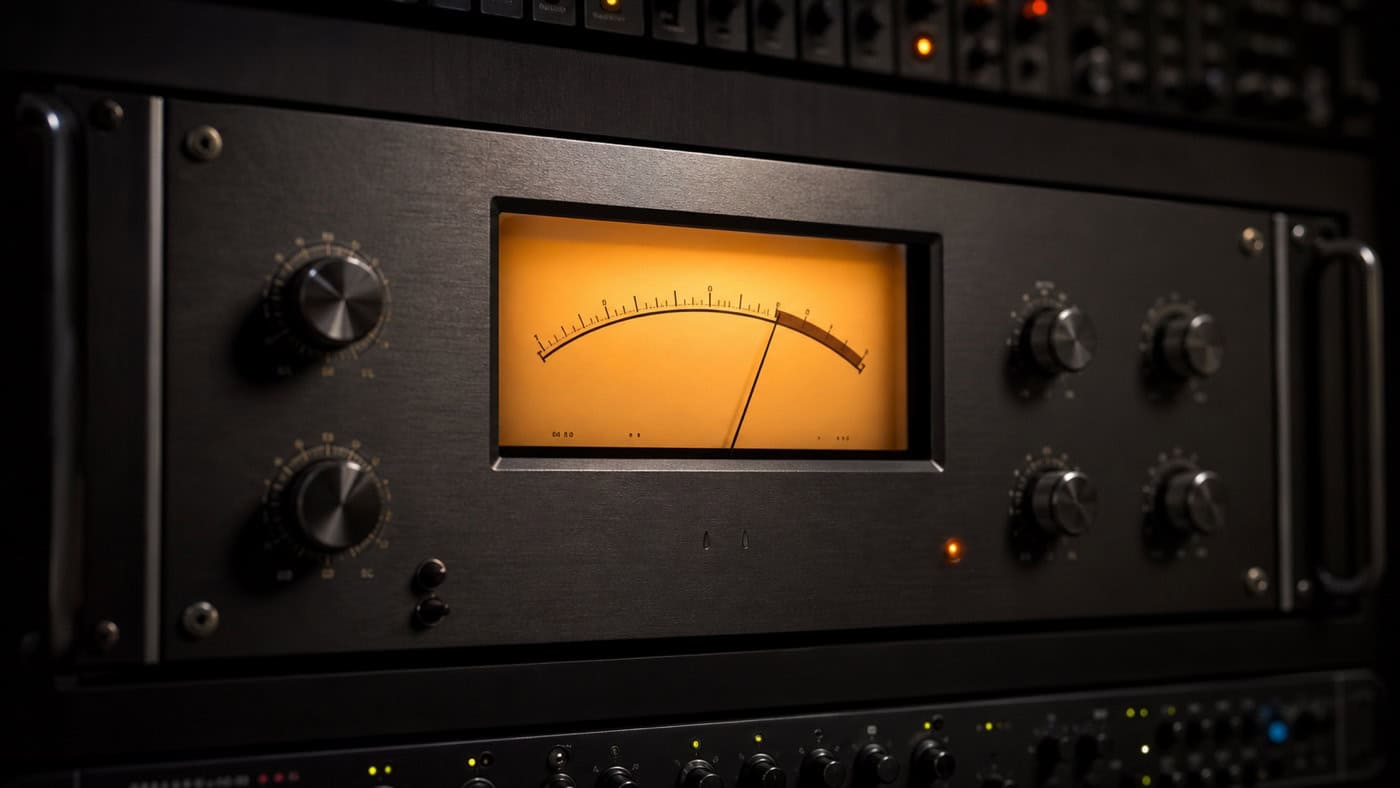 RMS (Root Mean Square) RMS describes the effective average level of an audio signal. In audio engineering, RMS helps to assess the energy and dynamics of a signal; however, RMS is not the same asLUFS or True PeakFor mixing and mastering, RMS is therefore a useful measurement, but always only one part of the overall level and loudness assessment.
 Definition and calculation of RMS
RMS stands forroot mean square, or "root mean square." Mathematically, RMS is calculated as follows:
- EachAmplitudeThe value of a signal is squared.
- The mean is calculated from all squared values.
- The square root is taken from this mean.
For example:A sine wave signal with an amplitude of 1 V has an RMS value of approximately 0,707 V. This value represents the "effective" voltage or energy.
RMS is particularlyAC signals andnon-linear audio signalsrelevant because it describes actual performance better than simple averages.
RMS in audio production
In the audio world, the RMS value measures theaverage energy contentof an audio signal – regardless of short peaks. It is typically used to:
- credentials for dynamicsa mixto assess, RMS measures the average energy of your song — like the one with LUFS and theCrest Factorplaying together, the collectsMastering Guide.
- theheadroom estimate the difference compared to the maximum level (e.g. 0 dBFS),
- Mixing decisionsto meet, for example when usingcompression.
| RMS value | Significance |
|---|---|
| Low | Quiet signal, great dynamics, lots of headroom |
| High | Loud signal, low dynamics, little headroom |
Tip:Combine RMS analysis with the display ofPeak levelsandLUFSto get a complete impression of the loudness structure of your mix.
Difference between RMS and LUFS
RMS and LUFS both help in assessing level and loudness, but measure from different perspectives:
| Criterion |
RMS |
LUFS |
|---|---|---|
| Basis of calculation |
Mathematical effective value |
Perceptually weighted loudness |
| Objective |
Assessing energy and dynamics |
Assess loudness for streaming, broadcast, and comparability |
| Application |
Level control, dynamic range assessment, mixing and mastering |
Loudness metering, streaming normalization and mastering control |
For a proper assessment, RMS,LUFS, peak andTrue Peakconsidered together.
Applications of RMS outside the audio world
RMS is used in many areas:
- Electrical engineering:Calculating power in alternating current circuits.
- Signal processing:Assessment of noise levels and energy distributions.
- Acoustic technology:Evaluation of loudspeaker performance or sound pressure levels.
Further:Also read the article aboutdBFSto better understand the scaling of digital RMS values.
RMS power of loudspeakers and amplifiers
In the context of loudspeakers and amplifiers, the term refers to...RMS performanceThe continuous power (rated power) that a device can handle continuously without damage – as opposed to the short-term peak power (often 2–4 times higher). It is calculated from the effective voltage and impedance:
P = URMS² ÷ R– Example: 20 V RMS at 8 ohms results in 20² ÷ 8 =50 wattsRMS
Note:RMS stands forroot mean square(square mean) – not to be confused withRoot Sum Square(RSS), another computational variable.
Conclusion & Tip
The RMS value provides a helpful assessment of the energy and dynamics of your audio signal. Especially inmixing and masteringIt helps to better assess tonal balance, compression, and dynamic range. However, for a precise loudness evaluation, RMS should always be considered in conjunction with LUFS, True Peak, dBFS, and the listening experience.online masteringRMS, along with LUFS and peak values, serves as a reference point to bring a track to a consistent, release-ready loudness level.
If you're unsure whether your mix is balanced and ready for mastering, amix analysis help to evaluate RMS, dynamics and loudness in a musical context.
Tip: For streaming, LUFS loudness is what matters, not RMS loudness –measure them for free in your browserwith our loudness meter.
FAQ on RMS (Root Mean Square)
What does RMS mean in music?
RMS stands for "Root Mean Square" and describes the time-averaged level of an audio signal – not the short peaks, but the average energy over a period of time. This is precisely why the RMS value correlates much better with perceived loudness than the pure peak level. In music, RMS is therefore used to estimate how loud a track actually sounds to the ear.
Why is RMS important in mastering?
In mastering, the RMS value helps to keep the perceived loudness constant across an entire song or album – preventing the level from fluctuating from track to track. It serves as a rough guideline for the density and loudness of the master. However, for the final loudness measurement, modern studios usually work with...LUFS, as this measure is closer to human hearing perception.
Is RMS synonymous with loudness?
No. RMS is a purely mathematical average level and weights all frequencies equally. However, perceived loudness depends heavily on how sensitive our hearing is in different frequency ranges – this is only taken into account by the K-weighted LUFS measurement. Therefore, RMS provides a good technical approximation, but it is not the same as loudness.
How do I measure the RMS value of my track?
Most DAW level meters and specialized loudness plugins display the RMS value. Our free [tool/app/etc.] is also handy.Loudness MeterThis tool lets you measure the RMS, True Peak, and loudness of your track directly in your browser – no installation required. When measuring, make sure to capture the loudest, most representative section of the song.
What is a good RMS value for mastering?
This depends heavily on the genre – there's no universally "correct" value, and the figures can vary depending on the measurement window and plugin. As a rough guide, many modern masters operate between -14 and -9 dBFS RMS; high-energy genres like EDM or metal are often louder, while dynamic music like jazz or classical is intentionally quieter. Since streaming services normalize loudness depending on the platform, maximizing RMS at all costs is less worthwhile these days – sound quality and dynamics are more important.