How loud should we master metal music?
When mastering metal music, sooner or later you have to decide how loud the finished song should be. As a reminder: the consumer makes the volume settings on his end device, while loudness describes how loud the recording in the audio file appears to the listener and can be played back. You can find out more about this in ourArticle on the topic of LUFS
– the method of measuring loudness.
To get closer to the question of how loud a metal mastering should be, we can look at the LUFS currently being used by the major streaming services. Andreas Brede took a closer look at this at the Triagon Academy as part of his thesis on "Digitization in the Music Industry and its Impact on Mastering for Streaming Platforms." Peak-Studios brought us on board for an expert interview for the research, thanks to our mastering expertise.
For the analysis, the original audio files of well-knownMetal mastering productionsevaluated. The graph below shows the average loudness that was measured.
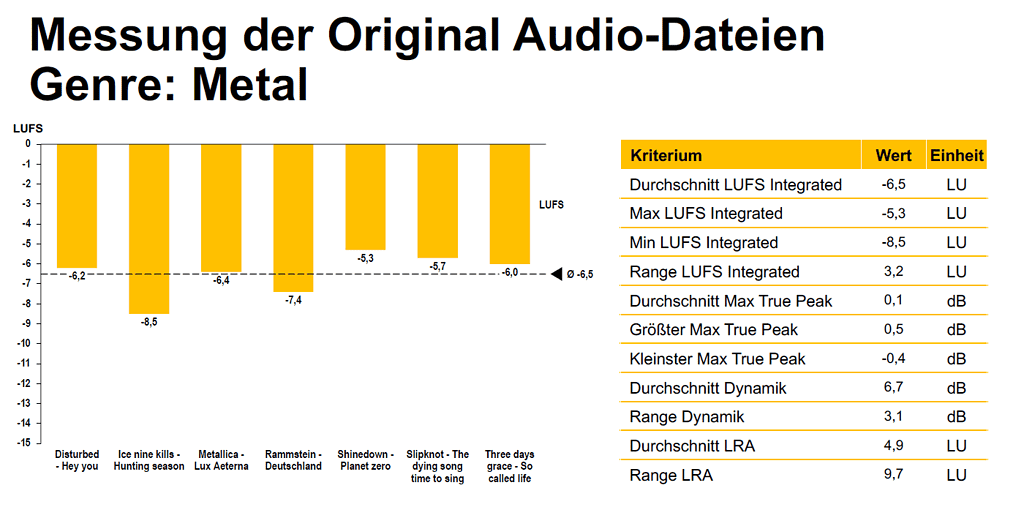 LUFS measurement genre of the original audio of metal music
 Metal likes to be heard very loud - so the relevance of loudness is obvious in this genre. In music production, people like to help out here: Basically, metal music is very densely produced pieces of music with comparatively low dynamic values. Targeted distortion and clipping are used tometal masteringto increase its loudness.
You want the best possible, distortion-free playback of your song on all platforms?
Ultimately, however, the loudness of your metal mastering should primarily come from one be dependent on good soundThe graphic shown above should only serve as a guide for similarly arranged and instrumental titles in the metal music genre, and should not be viewed as a "must" for your metal music mastering. Nevertheless, the study offers a very good orientation as to how other successful projects have positioned themselves in the market and gives you a good idea of what you should measure yourself against if you want to be noticed in a direct comparison.
Metal has its own loudness conventions — how these fit into the general mastering loudness system is shown by theMastering Guide.
The target group is and remains central to the loudness settings: Depending on which streaming service your song is to be published with, there are also other specifications regarding LUFS. How the streaming services treat your metal song, we have in ourUpload Streaming Services Article summarized for you.
If you have any further questions about metal mastering, LUFS or audio editing for streaming services, please let us know! We are also there for you if you need professional help with your music project!
Your contact to Peak-Studios

-
Personal point of contact
-
Over 20 years of experience
-
Highest quality standards
Other useful information:
48 khz sample rate - why 44,1 khz will soon be out:
https://www.peak-studios.de/48-khz-der-neue-standard/
Intersample Peaks - Why 2dbTP headroom is better
https://www.peak-studios.de/intersample-peaks/
Streaming mastering from Peak-Studios:
https://www.peak-studios.de/mastering/
Tip:Measure the LUFS loudness of your Metal Master– free in your browser with our Loudness Meter.