Vinyl mastering myths: What really matters before the pressing plant
Vinyl MasteringIt is surrounded by many myths. Some rules contain a kernel of truth, others are passed on too generally. This often leads to incorrect decisions at the pressing plant.
The reason is simple: A vinyl record doesn't work like streaming or a CD. Music is mechanically transferred into a groove and later read by a stylus. Therefore, bass response, phase, sibilance, dynamics, side length, and cutting level play a particularly important role.
In this article, we debunk the biggest myths about vinyl mastering. You'll learn which statements are true, which are only partially true, and what really matters when your mix or master is to be released on vinyl.
Table of Contents
- Advantages and limitations of vinyl
- Why there are so many vinyl mastering myths
- The history of the vinyl record
- In short: What makes vinyl mastering different
- Myth 1: Vinyl is just another output format
- Myth 2: The DMM process is always better than lacquer cutting.
- Myth 3: High frequencies and sibilant sounds must always be heavily attenuated.
- Myth 4: Everything below 300 Hz must be mono
- Myth 5: Transients sound worse on vinyl
- Myth 6: The warm vinyl sound is only created by fewer treble frequencies.
- Myth 7: Black records sound better than colored ones.
- Myth 8: Vinyl sounds the same on all turntables
- Myth 9: My song is just as loud on vinyl as my digital master.
- Myth 10: Loudness has no influence on the position on the record.
- Myth 11: You don't need a mastering engineer for good vinyl mastering.
- Myth 12: The vinyl cutter automatically handles the mastering.
- Myth 13: A test pressing sounds exactly like the final edition.
- Myth 14: The order of the songs doesn't matter.
- Checklist: What's important before the press shop
- How much does it cost to press a record?
- How long does it take to press a record?
- Conclusion on vinyl mastering myths
- Sources
Advantages and limitations of vinyl
-
Own sound aesthetic
-
Format-related “restrictions” such as distortions can be used creatively
-
Haptics and visual appeal
-
Special feature for fans
Technical limitations of vinyl
-
Physical sound carrier that is subject to or exposed to corresponding restrictions and influences
-
Production and distribution are more expensive compared to purely digital production and distribution
Why there are so many vinyl mastering myths
According to statista.de, 41,3 million EPs and LPs were sold in the US alone in 2022. Vinyl is therefore no longer a niche format, but relevant again for many artists, labels, and fans.
With the vinyl record's comeback, many rules and half-truths have also returned. Some of these are helpful in preparation. Others are applied too generally and lead to incorrect decisions regarding mixing, mastering, lacquer cutting, or pressing.
According to the Recording Industry Association of America's (RIAA) 2023 mid-year report, vinyl accounted for 72 percent of sales of physical formats. The market share of vinyl records has also grown in Germany, according to the BVMI (German Music Industry Association). This makes it all the more worthwhile to address the most common myths surrounding vinyl records in a professional and accurate manner.
Podcast and expert context
Chris Jones
CEO – mixing and mastering engineer. Has been running Peak-Studios since 2006 and is the first online service provider for audio services.More about Chris

Helmut Erler
Helmut's work as a disc mastering engineer (cutter) and sound engineer has brought the well-known sound of internationally successful artists to vinyl and calibrates record cutting machines.More about Helmut

Fabien Schivre
Fabien is the mastermind behind Tokyo Dawn Labs and has been developing high-quality audio plugins such as the well-known TDR Nova for many years.More about Fabien
The history of the vinyl record
Before we tackle the myths of vinyl production, let's take a quick look at themHistorythrow the record:
The record was released towards the end of the19. centurydeveloped. The vinyl record as we know it today has been around since 1930. Before the use ofPolyvinyl chloride (PVC) aka vinylShellac was mainly used. However, this became scarce during the Second World War, forcing manufacturers to find an alternative.
The new, more robust and cheaper to produce plate displaced its predecessor from Western Europe and North America by 1960. This would certainly be the case toostereophonycontributed, which became established from 1958 onwards. As the disc's popularity increased among consumers, the format continued to be refined. Quadraphonic records were produced between 1971 and 1978. The surround format was technically demanding because a record can only contain two channels. Accordingly, the four channels had to be folded down to two and restored to the consumer. Due to various playback systems that were not compatible with one another, the quadrophonic playback method could not become established.
TheGolden timeAccording to Statista, the price of vinyl records was between 1970 and 1990. With theIntroduction of CD and digital technologyVinyl records were often written off. However, they have since re-established themselves in the market and now account for approximately three-quarters of physical music sales in the USA.
Do you want your mix released on vinyl?
In short: What makes vinyl mastering different
Vinyl mastering prepares a mix or master for the technical requirements of a vinyl record. Unlike streaming or CDs, music is mechanically transferred into a groove during lacquer cutting or DMM (digital mastering).Cutting StylusThe groove deflection and the subsequent scanning by the needle set clear limits.
Therefore, bass response, phase, sibilance, dynamics, side length, and average level are particularly important. Many vinyl rules are useful guidelines, but they don't replace examining the specific song.
There are a few terms you should know about vinyl records. The most important terms are summarized in the following glossary:
RPM:The revolutions per minute (RPM) indicate the playback speed of a record.
LP:A long-playing record usually has a diameter of 30 cm and is generally played at 33,33 RPM.
Single:A single record usually has a diameter of 17,5 cm and is often played at 45 RPM.
Maxi single:A maxi-single often uses 45 RPM, thus offering a higher cutting level but less playing time.
Lacquer cut:In lacquer cutting, the audio material is cut into a lacquer foil. This foil is later used to create the tools for pressing.
DMM:In Direct Metal Mastering, the audio material is cut directly into a copper-coated metal plate.
Pressing plant:The pressing plant produces test pressings and the final print run.
Myth 1: Vinyl is just another output format
In short:No. Vinyl is not just another output format like WAV, CD, or streaming. A record is a physical medium with its own technical limitations.
What really matters:The music is cut into a groove and later mechanically played back. Bass range, phase, dynamics, sibilance, cutting level, and side length all influence whether a record can be cut cleanly and played back reliably.
Practical tip:Don't wait until you have the finished streaming master to plan your vinyl release. Check early on whether your mix or master is suitable for vinyl.

Myth 2: The DMM process is always better than lacquer cutting.
In short:No. DMM and lacquer cutting have different advantages and limitations.
What really matters:In direct metal mastering, the audio material is cut directly into a copper-plated metal plate. This can be very precise and saves processing steps. In lacquer cutting, the material is cut into a lacquer foil. This method can be more suitable for certain dynamic ranges, desired sound, or production workflows.
Both methods are particularly problematic due to large groove excursions, low frequencies, high levels, and unfavorable phase relationships. Therefore, the quality is not solely determined by the method, but also by the audio material and its preparation.
Practical tip:Consult with a mastering engineer, cutter, or pressing plant to determine which process best suits your project. Don't base your decision solely on the terms DMM or lacquer cutting.
Direct Metal Mastering (DMM)
In 1981, the Teldec company (Telefunken-Decca) developed the DMM process in collaboration with Georg Neumann. While in the lacquer cutting process two galvanic baths have to be carried out to create a father (negative image) and a mother (positive image) after the sound has been transferred to a lacquer film, with DMM the mother is created directly.
“The Mother” describes a stainless steel plate that is coated in a galvanic bath. The sound material is transferred to them using a cutting graver. The sons are in turn made from this, which then serve as the actual pressing template or stamp.
The DMM process has a number of advantages over lacquer cutting: On the one hand, the absence of certain work steps saves time and minimizes sources of error. On the other hand, there are fewer distortions. The disadvantage is that the plates have a shorter lifespan because the grooves are less deep.
Myth 3: High frequencies and sibilant sounds must always be heavily attenuated.
In short:No. High frequencies and sibilance sounds need to be controlled, but a blanket high-cut is rarely the best solution.
What really matters:Overly sharp sibilance, harsh hi-hats, or very bright synth sounds can distort during cutting and playback. However, this doesn't mean that every vinyl master automatically needs to be heavily darkened. The specific signal is what matters.
Practical tip:Use targeted processing tools like de-essers, dynamic EQ, or automation. Don't indiscriminately remove high frequencies if they are musically important.
Myth 4: Everything below 300 Hz must be mono
In short:No. The bass range should be controlled, but a rigid limit at 300 Hz is too general.
What really matters:Very wide or out-of-phase low frequencies can cause significant groove deflection. This can complicate the cutting process and make playback unreliable. A simulation or test cut provides the most reliable assessment. The critical range depends on the song. Important factors include dynamics, stereo width, side length, and...phase positionin the bass range.
Practical tip:Check theMono compatibility in the bass range. If necessary, place low frequencies more towards the center, but decide according to the material and not according to a rigid rule.
Unsure if your mix is suitable for vinyl?
If you have technical uncertainties regarding bass response, phase, sibilance, or dynamics, a mix analysis can help. It doesn't replace a pressing plant, but it gives you a professional assessment before vinyl mastering.
You can reach us by phone from Monday to Friday from 9 a.m. to 8 p.m.

Direct Support

Multiple award-winning

Over 20 years of experience

Highest quality standards
Myth 5: Transients sound worse on vinyl
In short:Not necessarily. Transients are reproduced differently on vinyl than in digital formats.
What really matters:Vinyl can convey punch and vibrancy very well. Extreme peaks, hardClippingHowever, uncontrolled dynamics can become problematic. The mix and mastering determine how cleanly the attack and punch are preserved.
Practical tip:Pay attention to clean transients during the mix. Avoid hard clipping on drums or the master bus if a vinyl pressing is planned.
RIAA equalization
The deflection of the cutting stylus has a major impact on the volume and available space of a record. The greater the deflection, the louder and/or lower-frequency the signal. But also the greater the space consumption. At high levels, so-called “self erase” can also occur. The rear part of the cutting graver directly erases the part cut by the front, which leads to distortion.
In order to achieve the best possible result and preserve the original frequency response of a track, theRIAA equalizationdeveloped. It describes a cutting characteristic curve that divides the frequency spectrum into four sections based on the three transition frequencies at 50,05 Hz, 500,5 Hz and 2122 Hz. To put it simply, filters are used to lower the lows and low-mids and raise the mids and highs, which ensure an even deflection. This process is called encoding.
Every turntable is equipped with a decoder in the preamp, which compensates for the RIAA equalization and thus restores the original sound spectrum.
Myth 6: The warm vinyl sound is only created by fewer treble frequencies.
In short:Only partially. The warm impression of vinyl is not solely due to lower treble.
What really matters:Frequency response, dynamics, distortion, RIAA equalization, cutting, pressing, and playback system all affect the sound. Excessively harsh highs and sibilance need to be controlled. However, a good vinyl master shouldn't sound generally muffled or dull.
Practical tip:Address problematic sharpness selectively. A good vinyl master remains open, controlled, and musical.
Myth 7: Black records sound better than colored ones.
In short:Not necessarily. Manufacturing quality is more important than color.
What really matters:Material quality, pressing plant, cutting, mastering, and quality control have a greater impact on the sound than the color itself. Colored vinyl records can sound very good if they are produced well.
Practical tip:Choose a color or special format for design reasons. Clarify any technical details with the pressing plant beforehand.
If your release is to be released on vinyl
Myth 8: Vinyl sounds the same on all turntables
In short:No. The playback system has a major influence on the sound.
What really matters:Cartridge, stylus, preamplifier, turntable, speakers, and room acoustics can significantly alter the sound. Therefore, a record can sound different on different systems.
Practical tip:Listen to test pressings on more than one system. Pay particular attention to distortion, stylus skips, noise, sibilance, and noticeable differences between the center and outer edges of the record.
What is WOW?
WOW and Flutter both describe pitch fluctuations that can be heard when playing a record. However, they express themselves differently and arise from different causes:
WOWis a slow variation that can be traced back to the vinyl record. Reasons for this include a center hole that does not fit precisely, a plate that is too light or a plate that is warped. In the pressing plant, WOW is usually measured as part of quality control, so that a minimum deviation of around 0,2 percent is not exceeded.
Flutteron the other hand, there is a rapid variation that can be attributed to the playback device. A bent turntable or a turntable motor that no longer runs smoothly can be the reasons for this.
Myth 9: My song is just as loud on vinyl as my digital master.
In short:Mostly not. Vinyl has different limitations than streaming or CD.
What really matters:The loudness of a digital master has no direct correlation with the loudness of the final vinyl record. The cutting level depends on dynamics, frequency distribution, side length, and the risk of distortion. Very loud or heavily limited masters may necessitate cutting the record at a lower volume.
A streaming master can work in some cases. However, it should be checked before pressing to ensure that clipping, sibilance, bass response, and phase are suitable for vinyl.
Practical tip:Don't treat loudness on vinyl like a streaming value. The goal is a cleanly playable record, not the highest LUFS value.
Myth 10: Loudness has no influence on the position on the record.
In short:Yes. Loudness, waveform, and space requirements are related.
What really matters:The space required on a record depends heavily on the waveform. Clipped signals are particularly problematic. A clipped signal is more like a square wave, distorts more easily, is harder to cut cleanly, and requires more space in the groove.
Practical tip:Avoid harsh clipping and excessive limiting. A controlled, dynamic master can often be edited more safely and musically.
Myth 11: You don't need a mastering engineer for good vinyl mastering.
In short:Sometimes experienced work is sufficient. However, without suitable experience and a secure listening environment, it is risky.
What really matters:A vinyl mastering engineer checks frequency balance, bass response, phase, sibilance, dynamics, stereo width, cut level, and side length. These aspects are difficult to accurately assess on standard consumer systems.
Practical tip:If print run, budget and pressing quality are important, a professional inspection before the pressing plant is worthwhile.
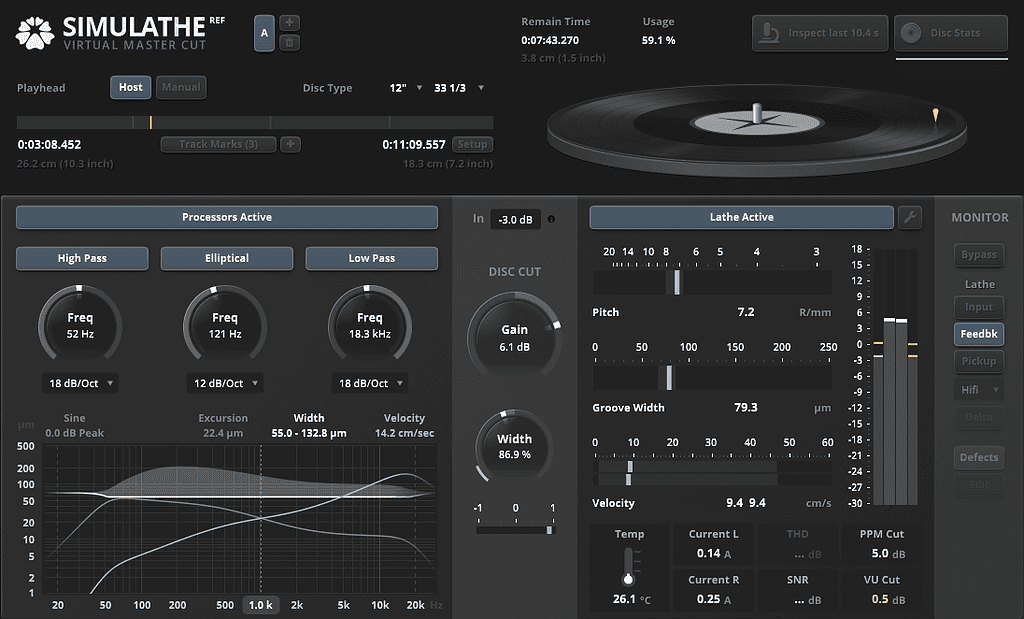
If you are experienced and have good monitoring equipment, you can prepare your tracks yourself. Specialized software can help identify critical points. One example is Simulathe from Tokyo Dawn Labs. Such tools show, among other things, excursion, stereo width, speed, cutting stylus temperature, and space requirements. Nevertheless, a simulation does not replace any professional review.
Professional inspection before paint cutting or DMM
Myth 12: The vinyl cutter automatically handles the mastering.
In short:Not automatically. Vinyl mastering and cutting are different work steps.
What really matters:The mastering engineer prepares the audio material both sonically and technically. The editor or disc mastering engineer then transfers the prepared material into the editing process. Some providers combine both tasks. Nevertheless, it should be clear beforehand whether your material will only be edited or also fully mastered.
Practical tip:Before handing over the project to the pressing plant or cutting studio, ask what services are included and what files are expected.
Myth 13: A test pressing sounds exactly like the final edition.
In short:No. Vinyl remains a physical product with minor manufacturing differences.
What really matters:Temperature, pressing pressure, material, storage, and manufacturing variations can cause minor differences. A test pressing is still important because it reveals major problems before the main production run.
Practical tip:Carefully check the test pressing. Clearly document any distortion, skips, noise, or level problems for the pressing plant.
Myth 14: The order of the songs doesn't matter.
In short:No. The track order can affect sound and playability.
What really matters:Playing the record is more difficult at the end of a side. Distortion can be more noticeable there, especially with loud, bright, or very dense songs. Quieter or less critical songs often perform better in the center.
Practical tip:Plan the A and B sides early. Don't automatically put particularly important or technically challenging songs at the end of a side.
Diameter loss
The closer the needle gets to the end, i.e. the inside, of a record, the lower the sound quality. The resulting loss of cross-section (diameter loss) is responsible for this. You can think of it like this: the needle is a car that makes its laps on the plate. The closer it gets to the target, the inside of the plate, the shorter and narrower the routes become. But the car remains the same size: it becomes increasingly difficult to maneuver it safely, so you have to drive more slowly.
And the same is true with the needle and the groove to be scanned. The needle stays the same size, but the grooves become narrower/squished. On a 12-inch LP, the speed on the outside is about three times faster than on the inside. On a 7-inch single, the ratio of outside to inside speed is about 2:1.
Accordingly, important songs or hits should be placed at the beginning, i.e. on the outside. However, the slower sampling speed, which involves loss of treble and distortion, can be used for creative purposes.
Checklist: What's important before the press shop
Let's briefly summarize what you should check before producing your record:
-
Think about which format (LP, single, ...) you want to release.
-
Be aware of the physical limitations of a vinyl record; check problematic frequency ranges and do not compress too much. Appropriate software, mastering engineers and disc mastering engineers will support you if necessary.
-
Determine track order and pause lengths, taking playback speed into account.
-
Deliver all production-relevant data to the pressing plant. This includes the size of the print run, the choice of editing method and the distribution of your songs on the record.
-
Have a test pressing in your hand about three weeks after placing the order and your own final record about five weeks after that.
How much does it cost to press a record?
The cost of a vinyl pressing depends on a few factors, such as:Format (single, LP, etc.), the circulation and the transport. The podcast gives an example calculation based on the following specifications:
-
400 * 12“ vinyl, black (edition, format)
-
Metal works, stampers (galvanics, stampers)
-
2 x labels, CMYK 4+0 or 1+0
-
Jacket KV01 (GC1 300gsm, 3,5 mm spine) CMYK 4+0, glossy/matt lamination (case)
-
Black inner sleeve
-
assembly
-
Plastic protective over bag
-
assembly
Of course, the costs always depend on the wishes of the customer. Roughly speaking, it can be said that based on the specifications mentioned, a record4 to 4,50 Eurocosts. The edition of400 pccosts a total of aroundEUR 1600. Add to this if necessaryTest pressings (25 euros/piece), the production of covers, paper inner sleeves and vinyl labels as well as transport costs.
As a reminder!
This invoice is based on a master lacquer delivered ready for pressing. If a mastering engineer is required, corresponding costs will be added. And of course the work of an editor also needs to be paid. In the podcast, Helmut Erler calculates around 75 euros per page for the work of a disc mastering engineer, which includes the verification of a delivered master, preparation and test cuts. There are additional costs for the actual editing, which depend on the playing time. Cutting a single costs around 90 euros per side, and an LP costs 150 euros.
How long does it take to press a record?
It takes approximately 10 minutes from the delivery of all the necessary files to the pressing plant to the receipt of the finished recordtwo months: Three weeksare estimated for test pressings andfive weeksfor main production.
If you deliver a finished paint or DMM master to the press shop instead of a digital file, this is what comesProduction timeadded. You can have this done at a specialized cutting studio, which also allows more influence on the cut than a pressing plant.
Conclusion on vinyl mastering myths
Many myths surrounding vinyl mastering contain a kernel of truth. They become problematic when interpreted as rigid rules. Bass response, phase, sibilance, dynamics, side length, and track order must always be evaluated in the context of the specific song.
This article aims to help you identify common misconceptions and better assess your material for vinyl. If you're unsure whether your mix or master is suitable for vinyl, a professional review before sending it to the pressing plant can be beneficial. Those who want to prepare their release for pressing can use Peak-Studios' services.professional vinyl masteringon request.
Is your mix suitable for vinyl?
A mix analysis can help with technical uncertainties. You'll receive an assessment of the bass response, phase, dynamics, sibilance, and potential risks before vinyl mastering.
Sources
- Video sources are included in the transcripts
- Questions from Podcast
- Half-year report BVMI:https://www.musikindustrie.de/presse/presseinformationen/halbjahreszahlen-2023
- Half-year report RIIA (USA):https://www.riaa.com/wp-content/uploads/2023/09/RIAA-Mid-Year-2023-Revenue-Report.pdf
- https://www.statista.com/chart/7699/lp-sales-in-the-united-states/
- https://hofa-media.de/vinyl-fakten/
- https://www.planet-wissen.de/kultur/musik/geschichte_der_tontraeger/pwiedieschallplatte100.html
- https://my45.de/wp-content/uploads/MY45_Audio-Spezifikationen.pdf
- https://onlinevinylmastering.com/wp-content/uploads/2018/03/18_03_OVM_Guidelines_How-It-Works_.pdf
- https://www.vinylherstellung.de/glossar/#d
- https://www.railroad-tracks.de/dmm-vs-lackschnitt
- https://www.dj-lab.de/die-vinylkrise-eine-blase-implodiert-reportage-teil-2/
- https://de.wikipedia.org/wiki/Schneidkennlinie
- https://www.schule-bw.de/faecher-und-schularten/mathematisch-naturwissenschaftliche-faecher/physik/unterrichtsmaterialien/mechanik_2/kreis/medien/schallplatte.htm