What does an audio engineer really earn? Reality instead of illusion.
Revenue vs. Income: The Business Reality in the Recording Studio
In the world of music production, people often talk about revenue – but rarely about what actually remains after taxes. The question "How much does an audio engineer earn?" is often confused with gross revenue. €10.000 a month sounds like financial success. But anyone who works as a freelance audio engineer knows: revenue is not the same as income.
This article uses a realistic practical calculation to show how €10.000 in monthly revenue can be transformed into actual disposable income – and why entrepreneurial thinking is crucial in the music business.
In the following video, I will work through the calculations step by step.
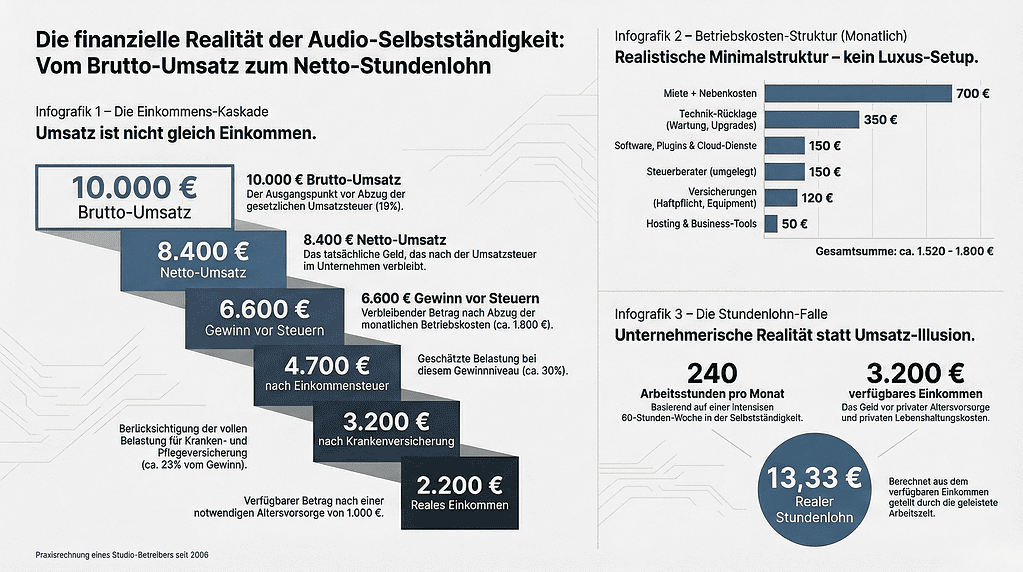
From €10.000 in revenue to real income
Step 1: Sales tax – money that never belongs to you
A gross revenue of €10.000 is subject to 19% VAT. This equates to approximately €1.600.
Remaining net revenue: approx. €8.400
Value-added tax (VAT) is not profit, but a pass-through item. Those who do not immediately set this sum aside risk liquidity problems with their next VAT return.
The realistic operating costs of a small recording studio
We are not looking at a high-end luxury studio, but a functional, professional setup.
Studio & additional costs
-
Rent: €500
-
Electricity, heating, internet: €200
Total: €700
Software & Infrastructure
-
DAW and plugin subscriptions: €150
-
Hosting, backups, cloud tools: €50
Total: €200
Technical reserves
Hardware ages, computers are replaced, monitors need maintenance.
-
Reserve for technical equipment: €300–400
Administration & Security
-
Insurance: €120–150
-
Tax advisor (applied for): €150
Monthly operating costs (conservative calculation)
| Cost block | amount |
|---|---|
| Rent & additional costs | 700 € |
| Software & Tools | 200 € |
| Technical reserve | 350 € |
| Insurance & Tax Advisors | 300 € |
| Total | approx. 1.550–1.800 € |
Let's conservatively estimate €1.800.
Profit before taxes: €8.400 – €1.800 = €6.600
Taxes and health insurance
income tax
With an annual profit of approximately €80.000, the income tax burden is around 29%.
→ approx. €1.900–2.000 per month
trade tax
Partially credited, but in reality, an additional burden of approximately €50 often remains.
Healthcare
As a self-employed person, you pay both employee and employer contributions.
→ approx. 23% of the profit
→ approx. €1.000–1.100 per month
What really remains?
From the winnings of €6.600:
-
Income tax: ~€2.000
-
Health insurance: ~€1.050
-
Remaining trade tax: ~€50
Available income: approx. €3.500
From an original turnover of €10.000.
Retirement planning: The often-ignored factor
Self-employed audio engineers usually do not accumulate any significant statutory pension entitlements.
To avoid relying on basic income support in old age, private pension savings of approximately €1.000 per month are realistic.
After deducting these provisions, the following remain:
Approximately €2.500 for living expenses.
This money must cover private rent, living expenses, mobility, holidays and savings.
Working hours vs. actual hourly wage
With a 60-hour work week:
-
240 hours per month
-
€2.500 available income
Actual net hourly wage: approx. €10–13
Depending on retirement savings and tax burden.
This puts the pay at the minimum wage level – despite a turnover of €10.000.
Professional mixing means not only creative work, but also entrepreneurial responsibility.
The same applies to professional mastering – quality takes time and calculation.
Location and setup differences
Studio rental costs of €500 are realistic in rural areas. In metropolitan regions like Berlin or Munich, such figures are hardly achievable. At the same time, costs are shifting for purely "in-the-box" producers: less hardware, but often higher software subscriptions.
However, the basic logic remains the same: fixed costs + taxes + pensions determine real income.
Why dumping prices don't work
Offers like "€100 per mix" or "€20 mastering" seem attractive – but are not economically viable.
Example: €100 per mix → 100 songs per month for €10.000 in revenue.
This means:
-
25 songs per week
-
including audits, communication, administration
Realistic mixing and mastering prices depend on fixed costs, experience, and positioning – not on cut-rate pricing.
Quality and sustainability inevitably suffer.
Dumping prices are not a competitive advantage, but usually a miscalculation.
Sound pricing in a recording studio requires a sound business calculation – not gut feeling or competitive pressure.
The risk of advance tax payments
After a good first year, the tax office often demands:
-
Back payment for the previous year
-
Advance payment for the current year
This double burden has already led to liquidity problems for many studios. Without reserves, even a successful year can become a threat to their existence.
Conclusion: Think entrepreneurially
A turnover of €10.000 is not a fortune.
They are the foundation for a solid self-employment – nothing more.
Those who want to be successful in the long term must:
-
Separate taxes immediately
-
Know fixed costs exactly
-
Prioritizing retirement savings
-
Calculate your own hourly rate realistically
If you want to calculate your realistic hourly rate as an audio engineer, use our free pricing calculator for recording studios.
👉 Pricing calculator for recording studios
Revenue is not income.
And income is not the same as wealth accumulation.
You can find more about the structural and mental challenges in my series "Self-Employed as an Audio Engineer", in which I openly shed light on the reality of the industry.
FAQ – Frequently Asked Questions about Income as an Audio Engineer
What is the average salary for an audio engineer?
Employees often earn between €2.500 and €4.500 gross. Self-employed incomes depend heavily on pricing, fixed costs, and market positioning.
How much revenue does a self-employed audio engineer need?
To have about €2.500 left over for living expenses after taxes and retirement provisions, a monthly turnover of around €10.000 is realistic.
How do you calculate the hourly rate correctly?
Private expenses + fixed costs + taxes + retirement savings divided by billable hours. Only billable hours count – not every hour worked.
Is self-employment as an audio engineer worthwhile?
Yes – if business acumen is taken into account. Talent alone is not enough. Economic understanding is crucial.
The figures are based on a realistic practical calculation by a studio operator with over 20 years of industry experience.