
VoiceOver in audio production
In voiceover, a speaker delivers a commentary or explanatory text that is overlaid on existing visual or audio material—without appearing on screen themselves. This technique is used in documentaries, explainer videos, commercials, and e-learning formats, and places high demands on recording quality, speaker timing, and audiophile post-production.
VoiceOver is an important part of the soundtrack of films, documentaries, series and other video formats. We would like to explain to you what VoiceOver is
What is VoiceOver in Audio Production?
In audio production, the term VoiceOver refers to a recording of spoken text, usually is placed over a video element. Voiceovers are often used for commentary, explanations, instructions, or narration in films, commercials, radio commercials, podcasts, documentaries, and other media. They can be spoken by professional speakers or actors and are an important means of conveying information or reinforcing the mood and atmosphere of a project. In audio production, VoiceOver is often used in combination with music, sound effects, and other audio elements to create a coherent and engaging listening experience.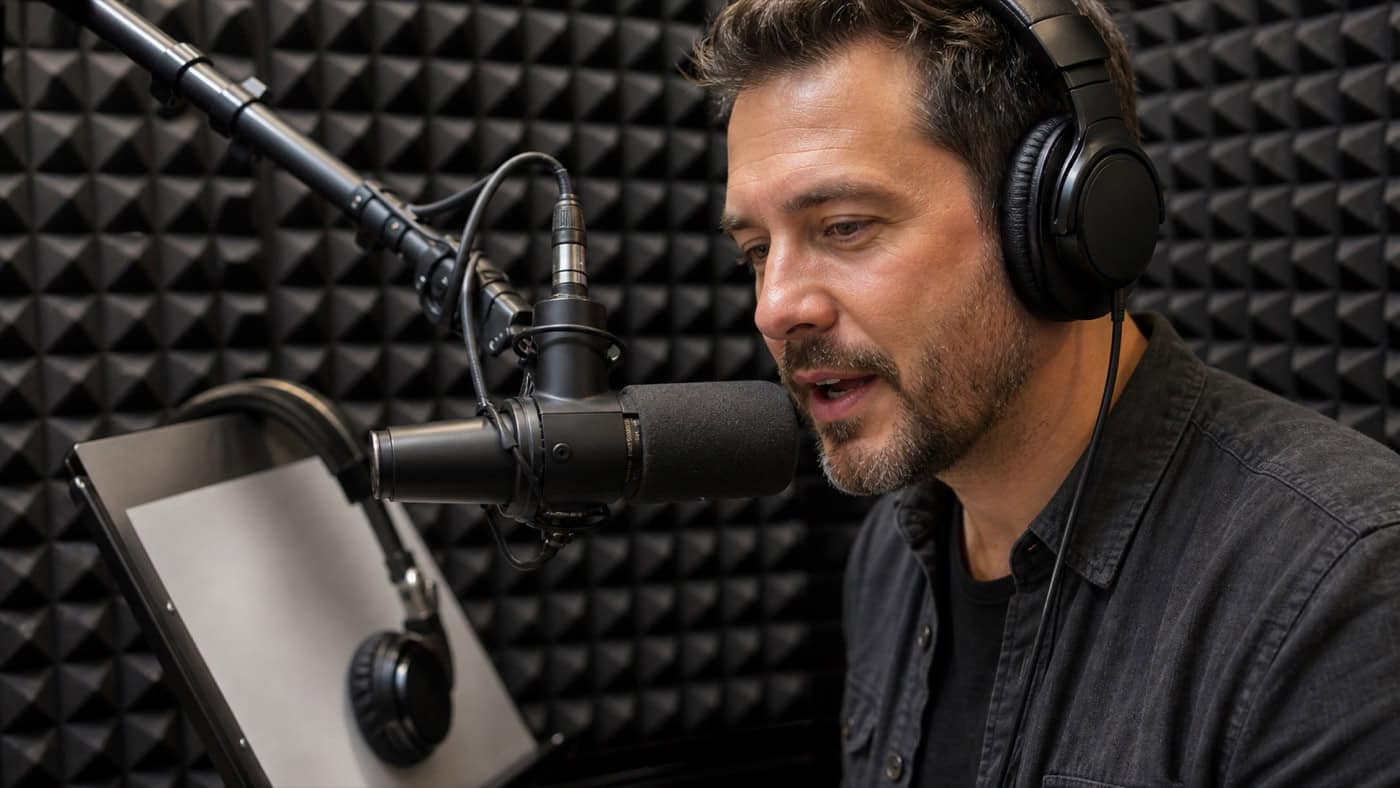
We also ensure the ideal sound for your voiceover!
What should you consider when using VoiceOver in audio production?
In audio or post-production, there are some points to consider when creating and editing voice-overs:
recording quality: Make sure the recording session is of high quality and contains no background noise, distortion or other interference.
Selection of the speaker: Choose a speaker with a pleasant voice and a tone that matches the content of the voiceover.
Skript: A well-written script is very important. It should be clear, concise and easy to understand. Also consider the length of the script and the time needed for voiceover.
Timing and synchronization: Make sure the voiceover is well synchronized with the other elements of the production, such as: B. with music, sound effects or visual elements.
Emotion and expression: The speaker should be able to convey the right emotion and expression to create the desired mood and atmosphere.
Technical aspects: Pay attention to the correct microphone position, microphone type and room acoustics to achieve the best possible recording quality.
post processing: If necessary, do one Post-production of her voiceover to optimize the recording, e.g. B. Removing noise, adjusting volume or adding effects.
Emphasis: The speaker must use proper intonation to emphasize important points and capture the audience's attention.
Aussprache: Correct pronunciation of words and names is crucial to the clarity and understandability of the voiceover.
Pacing: Pay attention to the correct speaking pace. It should be neither too fast nor too slow so that the listeners can grasp the content well.
consistency: Make sure the voiceover is consistent with the style, tone and delivery of the rest of the production.
target audience: Consider the target audience of your production and tailor the voiceover to their needs and preferences.
What is VoiceOver in Audio Production?
In audio production, the term VoiceOver refers to a recording of spoken text, usually is placed over a video element. Voiceovers are often used for commentary, explanations, instructions, or narration in films, commercials, radio commercials, podcasts, documentaries, and other media. They can be spoken by professional speakers or actors and are an important means of conveying information or reinforcing the mood and atmosphere of a project. In audio production, VoiceOver is often used in combination with music, sound effects, and other audio elements to create a coherent and engaging listening experience.
What should you consider when using VoiceOver in audio production?
In audio or post-production, there are some points to consider when creating and editing voice-overs:
recording quality: Make sure the recording session is of high quality and contains no background noise, distortion or other interference.
Selection of the speaker: Choose a speaker with a pleasant voice and a tone that matches the content of the voiceover.
Skript: A well-written script is very important. It should be clear, concise and easy to understand. Also consider the length of the script and the time needed for voiceover.
Timing and synchronization: Make sure the voiceover is well synchronized with the other elements of the production, such as: B. with music, sound effects or visual elements.
Emotion and expression: The speaker should be able to convey the right emotion and expression to create the desired mood and atmosphere.
Technical aspects: Pay attention to the correct microphone position, microphone type and room acoustics to achieve the best possible recording quality.
post processing: If necessary, do one Post-production of her voiceover to optimize the recording, e.g. B. Removing noise, adjusting volume or adding effects.
Emphasis: The speaker must use proper intonation to emphasize important points and capture the audience's attention.
Aussprache: Correct pronunciation of words and names is crucial to the clarity and understandability of the voiceover.
Pacing: Pay attention to the correct speaking pace. It should be neither too fast nor too slow so that the listeners can grasp the content well.
consistency: Make sure the voiceover is consistent with the style, tone and delivery of the rest of the production.
target audience: Consider the target audience of your production and tailor the voiceover to their needs and preferences.
What is the difference between voiceover, dubbing, and audiobook?
In voiceover, a narrator's or commentator's voice is added to the existing material without needing to perfectly match the lip movements – the original often remains audible at a lower volume in the background. In dubbing, the new voice replaces the original dialogue and is synchronized as closely as possible with the speakers on screen. An audiobook, on the other hand, is a continuous, purely auditory production without any visual component, in which a narrator reads the entire text aloud. What all these methods have in common is that recording quality and careful audio editing are crucial for a professional effect.
How do you record a voiceover professionally?
For a clean voiceover, a quiet, preferably dry room without distracting reflections and background noise is essential. Speak into the microphone at a consistent distance (usually about 15–25 cm) and use a pop filter to suppress plosive sounds. Adjust the recording level so that the loudest parts remain well below 0 dB, and record multiple takes if necessary. A technically sound voiceover recording session This is the foundation; we then take care of the fine-tuning – removing unwanted noise, EQ, compression and loudness.
Which microphone is suitable for a voiceover?
For voice recordings, a large-diaphragm condenser microphone with a cardioid polar pattern has proven effective because it captures voices with rich detail and reduces sound from the sides and rear. In acoustically untreated rooms, a dynamic microphone can also be a good choice, as it picks up less room reflections. More important than the specific model, however, are a consistent microphone position, a pop filter, and a quiet room. Which microphone is best in any given situation depends on the voice, the room, and the intended use.