
Cutting gravers in vinyl production

The cutting stylus is a heated sapphire or diamond stylus that, during vinyl mastering, mechanically engraves the audio signals as a groove into a rotating lacquer foil. This master foil is then electroformed to create the pressing die, from which all vinyl records in a pressing run are produced.

What is the cutting graver in vinyl production?

In vinyl manufacturing, a cutting graver is used as part of a cutting process to create master plates or dies for vinyl pressing. This special cutting graver is also known as a cutting needle or cutting pen.

The quality and precision of the cutting graver is crucial for the sound quality of the record. An experienced sound engineer uses special techniques to ensure that the grooves accurately reproduce the audio signals and that the record does not have any unwanted noise or distortion. Therefore, the master cutter plays an important role in the production of records.
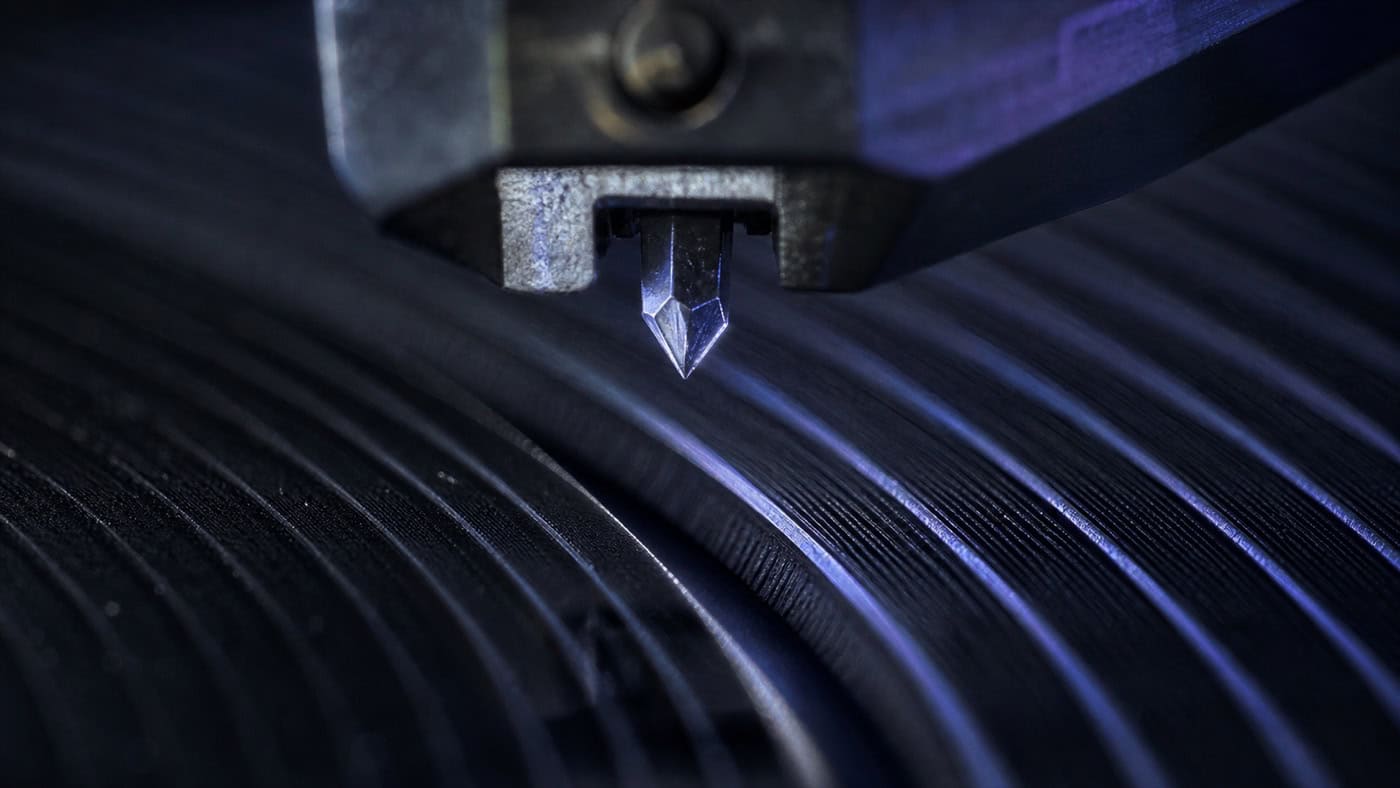
Extreme macro shot of a diamond cutting stylus over a freshly cut vinyl groove with blue-violet light reflection.

We will be happy to advise you on the manufacturing process, space requirements, track arrangement and, if desired, create a digital vinyl preview for you!

What is the process in which the cutting graver is used?

Sound recording: First, the audio that will be pressed onto the record is prepared in analog form. This can begin with a recording in a studio. In most cases, vinyl mastering follows. The audio material is prepared specifically for the later production steps. Vinyl mastering (or disc mastering) differs fundamentally from mastering for CD or streaming because the physical requirements of vinyl must be considered to achieve the best possible sound result.

Converting sound into an electrical signal: The recorded audio signal is converted into an electrical signal.

The cutting stylus is the physical lens of vinyl mastering — the vinyl workflow as a whole is shown by the Mastering Guide.

Cutting the master plate: The electrical signal is transmitted to a cutting needle that strikes a rotating aluminum or acetate foil coated with paint. This cutting needle writes the audio signal into the surface of the film in the form of grooves.

Electroforming: After the master plate is produced, it is used for electroforming. The master is coated with metal, usually nickel, to create a stronger and more durable stamper.

Pressing: The finished metal stamper is inserted into a pressing machine, where vinyl granulate is pressed into the final record shape under heat and pressure.

Cutting styli are usually made of sapphire or industrial diamond. These extremely hard materials retain their precisely ground cutting edge even when engraving lacquer foil over extended periods. Diamond is more wear-resistant and produces more consistent grooves across numerous cuts, while sapphire is less expensive but wears down faster and requires more frequent resharpening or replacement.

The stylus is heated by a small heating wire so that it cuts the lacquer layer more smoothly and cleanly, instead of tearing it. The heat slightly liquefies the material at the cutting edge, resulting in smoother groove walls and less surface noise. A correctly set stylus temperature is therefore crucial for a quiet, undistorted sound on the finished record.

In stereo, the stylus cuts the two channels into the two groove walls using the 45/45 method. The left channel modulates one wall, the right the other, each at a 45-degree angle to the record surface. The stylus moves simultaneously horizontally and vertically. Mono signals produce a purely lateral deflection, which ensures compatibility with older mono playback systems.

Strong, out-of-phase bass and harsh, sibilant treble are problematic. Low out-of-phase signals produce large vertical excursions that the stylus can barely engrave cleanly without the needle skipping later. Aggressive sibilance overtaxes the cutting edge and leads to distortion. Therefore, bass frequencies are often monoblocked and treble frequencies controlled before the signal reaches the stylus.

Both touch the groove, but perform opposing functions. The cutting stylus is a sharp-edged tool that actively re-engraves the groove into the lacquer foil, removing material in the process. The stylus, on the other hand, is rounded and passively reads the finished, pressed groove by converting its deflection back into an electrical signal. Cutting creates, stylus reproduces.