"Quality first" – have a song mixed and still expect express delivery?
There's a moment in the daily studio routine that always makes me smile. A customer wants to... Have a song mixed, fills out our order form, gets to the "Priority" field – and deliberately ticks the box "Quality first" No time pressure, thank you. Quality above all. Great, I think. That's exactly what we deliver.
Three days later, a message landed in my inbox: could a remote session be arranged? Even today. And whether the studio might not be fully booked right now, since he'd already waited three days. I opened the form again. There it was, in black and white: Quality first. His own checkmark.
This isn't uncommon. It happens more often than you think – and it's usually not due to impatience, but rather a genuine misunderstanding. That's why we're clarifying here what it means to... To have a song mixed with "quality first". – and why time in mixing is not wasting time, but a tool of the trade.
Contents of this article
Why a good mix takes time – and why that's no excuse
A mix doesn't sound better just because I spend more time on it. But it sounds significantly worse if I rush it through under time pressure – without breaks, without cross-checking. Because behind "takes time" lie concrete, technical mechanisms.
Fresh ears are not a luxury, but a method. The human hearing I get used to sound extremely quickly. After 45 minutes of intensive work, I hear the same mix differently than at the beginning – often worse, because my hearing compensates for certain frequencies. I also need distance to hear neutrally again: a break, a nap, sometimes even a whole day. This distance isn't procrastination. It's the moment when I find flaws I simply couldn't hear before.
Testing multiple systems: why it's worthwhile
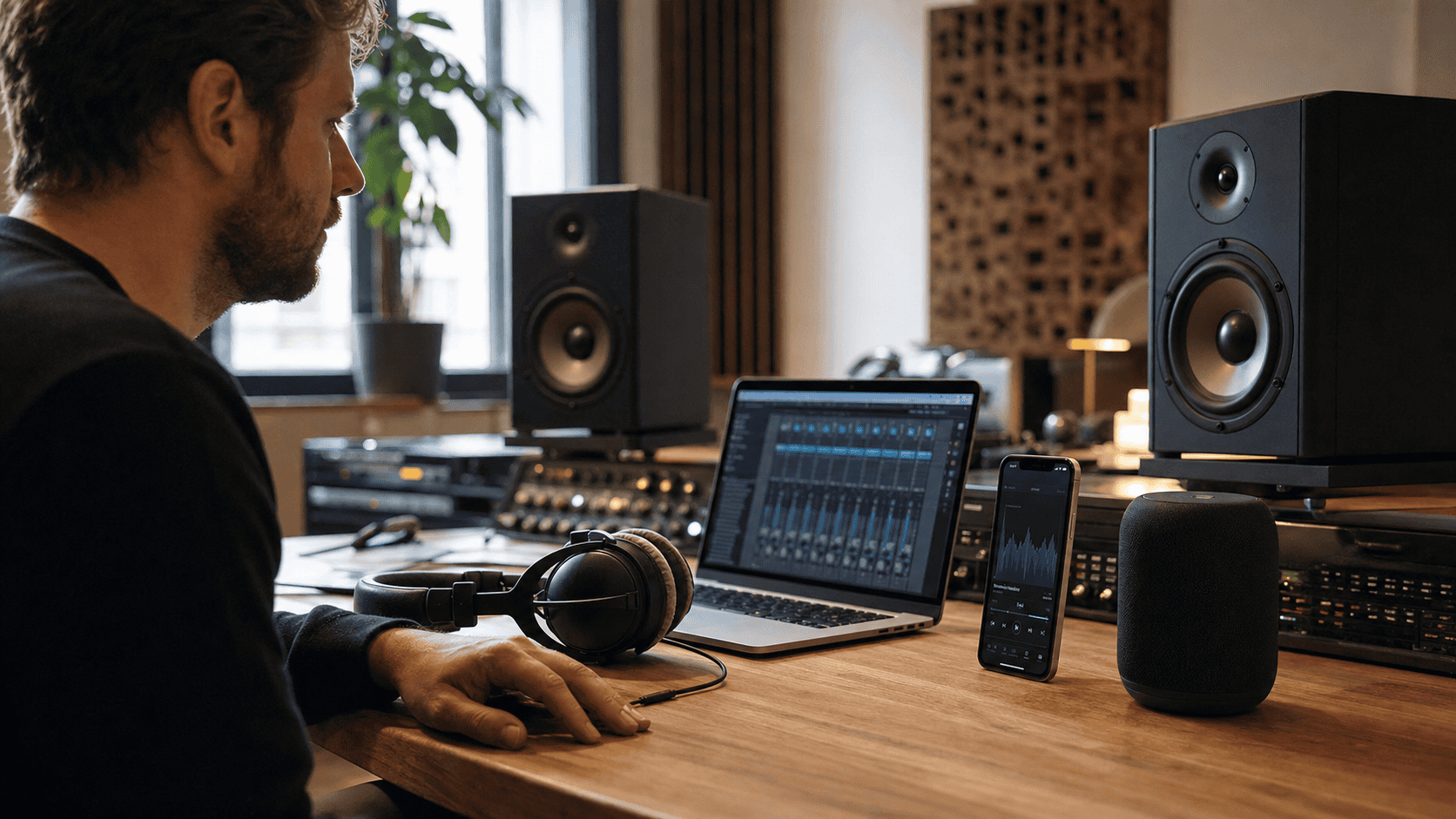
Cross-checks on multiple listening systems. A professional mix isn't just listened to on studio monitors, but also on headphones, small laptop speakers, in the car, and on mobile phone speakers. That's because your song will be played on all these systems on streaming platforms – and a mix that only sounds good on studio monitors often sounds tinny or muddy on AirPods. This circuit of systems takes time. But it's precisely the difference that makes a professional mix stand out. Mixing accounts.
Revision loops are part of the process – not an obstacle. Professional online mixing works in cycles: initial draft, feedback, adjustments, repeated listening, and final listening after a break. Anyone who has their song mixed professionally and tries to shorten this process will end up with an "almost finished" mix – which will then be unpleasantly obvious on release day. So patience is doubly worthwhile.
The brain that wants to confirm. There's another psychological effect at play: when you're close to finishing, you want to be done. The urge to mark the mix as complete overrides critical listening. A forced break—at least one night—breaks this tunnel vision. Nevertheless, this waiting period often feels like stagnation to the client. But it isn't.
If you want to have your song mixed: Quality first or Express?
In our workflow, there's a real difference between the two options – and it's not just about speed. Those who... Get the song mixed Anyone who wants to should know the difference before booking.
Quality first This means the mix moves into the regular production queue. It gets the time it needs – breaks to listen carefully, complete cross-checks, and a clearly structured revision cycle. Every edit is perfect: the vocals come cleanly to the forefront, the stereo image is deliberately built up, and in the end, the mix is perfectly rounded off. mastering The final sum is deducted. The result is exactly what you booked for: a mix that delivers on every system and meets the quality standards of a release.
Express This means the mix is prioritized and delivered within a shortened timeframe. For this, I pay a premium on our end with a more condensed work phase, and you – quite rightly – pay a higher price. The result is still professional, but there are compromises: fewer system checks, shorter intervals, and a tighter revision cycle.
Neither approach is wrong. But you can't book "quality first" and then deliver at express speed – because that would mean someone is lying. Either the Terms & Conditions or the expectation. Therefore, choosing between the two options is a real decision, not a formality.
"Surely something should be finished after three days?"
This thought is understandable. Three days sounds like a lot. In Studio life Sometimes they aren't – and sometimes it's not due to a single project, but rather the queue. A professional studio typically has several projects in production simultaneously. "Fully booked" is therefore not a euphemism for "currently chilling" – it means that other projects are currently being given their allocated time slot.

If you want planning certainty – that is, if you want to know when your mix will be ready – the right answer is not to look for a Remote session to ask. The correct answer is: When booking, please communicate your desired delivery date. Then we can determine whether express delivery is necessary or whether the Quality-first slot is available in time. This isn't a counter-demand – it's professional order clarification.
A mix analysis An initial consultation is also a sensible first step: She clarifies the current state of your project, identifies the problems that need solving, and gives us both a realistic assessment of the effort involved – before the clock starts ticking. She also alleviates any uncertainty you may have about whether "quality first" is even the right approach for your project.

How to realistically plan expectations and timing as a customer
To ensure you're on the right track the next time you book and want to have your song mixed, here are three simple rules:
1. Make your decision before submitting. Choosing "Quality first" or "Express" is a real decision – not just a form field to be skimmed. If you have a specific target date (release date, submission deadline, pitch), write it in the project notes. Then we can plan the right slot from the start.
2. Deadlines belong in the briefing, not in follow-up messages. "I need this by Friday" is information that guides your order – but only if we know it. Three days after upload is too late for deadline planning; for booking, it's perfect.
3. Trust the process – or book Express. If you're unsure whether "quality first" is right for your project, just ask. No problem. But if you book quality and then expect express delivery, you'll get neither.
Our offer in this regard: transparent mixing and mastering pricing – including express option – so you know from the outset what you are booking and what it costs.
Do you have a deadline? Send us your song – when booking, we'll clarify whether it's "Quality first" or "Express" and schedule a suitable slot.
Conclusion: Finish your song – with the right priority
"Quality first" and express delivery are both honest approaches – they're simply mutually exclusive. Consciously choose the priority that suits your project and specify your deadline when booking. A good mix takes time, and while time can be planned, it can't be shortened retroactively without compromising quality.
This is especially true because mastering usually follows mixing: First, each track is meticulously processed, then the finished stereo mix is transferred to the master. Allocating time for this step results in a more powerful and clear final product. Nevertheless, it's always better to ask too many questions than too few. Clear communication from the outset ensures you get exactly the result you booked. So let's plan together – instead of improvising three days later.
YOUR CONTACT TO PEAK-STUDIOS
Send us a message - we usually reply within 3 hours on working days.
- Personal point of contact
- Over 20 years of experience
- Highest quality standards
You can reach us by phone from Monday to Friday from 9 a.m. to 8 p.m.
Frequently asked questions about Quality First, Express, and mixing times
Can I switch to Express after booking?
Yes, generally – as long as the mix hasn't been produced yet. Communicating early is worthwhile: If you have a deadline, mention it when booking, not three days after uploading.
How will I know when my mix is finished?
A mix is finished when it sounds consistently good on all systems – monitors, headphones, laptop, mobile phone – and no weaknesses are noticeable after a break to let your ears freshen up. If you're unsure, then use our Mix feedback and secure valuable tips and clear expertise.
Why does a good mix need breaks in between?
The ear quickly adapts to a sound and no longer reliably detects flaws. Fresh ears – after a break or a night's sleep – hear more neutrally. This isn't laziness, but a technical necessity. That's why a careful mix takes several days, even though the actual working time is shorter.