
Phono preamplifier – Significance, Function & Tips
A phono preamplifier takes the very weak signal from a turntable cartridge and amplifies it to line level – strong enough for a regular amplifier or receiver. At the same time, it corrects the sound signature through the... RIAA equalization, which compensates for the frequency curve that was deliberately introduced during record production.
What is a phono preamplifier?
A phono preamplifier amplifies the weak electrical signal from a turntable. This improves the signal before sending it to an audio amplifier or receiver.
The signal is generated by the vibrations of the record needle. Since records have a weaker signal compared to modern audio sources such as CDs or digital music files, a phono preamplifier is necessary to bring the signal to a level that the amplifier can process correctly. The phono preamplifier also compensates for specific sound characteristics of the records that were taken into account during recording.
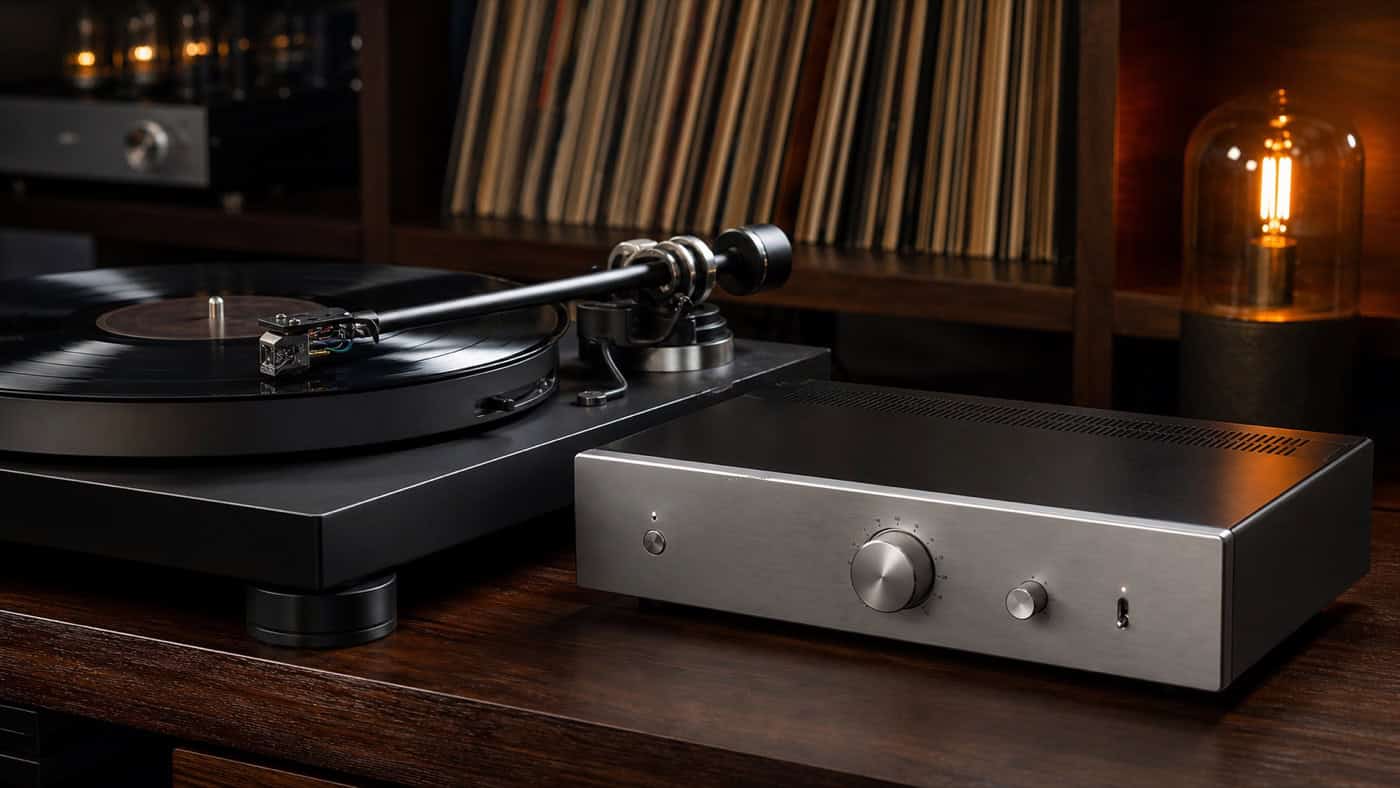
Important criteria for a phono preamplifier
Pickup selection: Make sure the preamp is compatible with the type of cartridge used on your turntable. There are different technologies such as magnetic or moving magnet (MM) and moving coil (MC).
Gain: Make sure the phono preamplifier provides enough gain to amplify your cartridge's signal. The gain factor required depends on the output voltage of your pickup.
Noise and interference: Clear audio reproduction depends on low noise levels. Therefore, when buying a phono preamplifier, you should pay attention to low noise levels.
The preamplifier should also offer switchable equalization (RIAA correction), as most records require this function. Some models also allow you to deactivate equalization, which can be helpful when playing old records with different equalization.
Connection options: Please check whether the phono preamplifier fits your audio system. Some models also have USB ports for connecting to computers.
Build quality: Solid construction and high-quality components can improve audio performance and extend the life of the device.
Do you want your songs to also sound good on vinyl?
Moving magnet (MM) vs. moving coil
Magnetic pickups (MM):
Construction: MM pickups have a magnet connected to a needle. The movement of the magnet within a fixed coil system creates an electrical signal.
Output voltage: Compared to MC cartridges, MM cartridges generally produce a higher output voltage. This makes them more compatible with most phono preamplifiers.
Price: MM pickups are often less expensive than MC pickups.
This makes them more compatible with most phono preamplifiers.
Price: MM pickups are often less expensive than MC pickups. For this reason, they can be a good option for beginners.
Moving coil (MC):
Construction: MC pickups have a coil that moves and thereby generates the electrical signal in the magnetic field. The coil is lighter than the magnet in the MM pickup.
Output voltage: MC cartridges typically produce a lower output voltage than MM cartridges. Therefore, you need a phono preamplifier with a higher gain.
Sound: MC cartridges are known for their precise reproduction, which makes them particularly popular among music lovers. Price: MC cartridges are typically more expensive than MM cartridges and are therefore preferred by advanced audiophiles.
When choosing, it is important to ensure that the phono preamplifier is compatible with the type chosen. Some preamps have switches or settings that allow you to switch between MM and MC modes. This offers flexibility when choosing the pickup.
Switchable equalization (RIAA correction)
Switchable equalization or RIAA correction refers to a special equalizer built into phono preamplifiers. This feature is important to balance the original sound profile of records.
Why is an equalizer necessary?
When recording records, the sound signal is passed through a Equalizer distorted to compensate for the physical limitations and the way records are made.
The RIAA (Recording Industry Association of America) has established a standard for this equalization that ensures that recorded records have an optimized sound profile.
Phono preamplifiers complete the vinyl signal chain — the context for mastering decisions is provided by the Mastering Guide.
RIAA correction in the phono preamplifier:
The phono preamplifier contains an RIAA correction circuit that restores the signal that was distorted during recording to its original form. Without this correction, the played signal would sound thin and unbalanced.
Equalization can be switched off:
Some phono preamplifiers offer the option to turn off RIAA correction. This can be useful when playing records recorded with a different equalization. For example, older records recorded before the RIAA standard was introduced may require different equalization.
Flexibility for music lovers:
Audiophiles might benefit from this feature if they own or want to experiment with records with alternative equalization curves.
The ability to bypass RIAA correction provides more flexibility in tailoring the sound profile to personal taste. Overall, the switchable equalization allows audiophiles to adapt to different recording practices and sound preferences while ensuring playback of standard RIAA records.
Frequently asked questions about the phono preamplifier
Do I need an external phono preamplifier if my turntable or receiver already has one?
No, if your turntable has a built-in phono preamp or your receiver has a phono input, no additional device is needed. Look for a phono/line switch on the turntable or an input labeled "Phono." If your amplifier only has line inputs and the turntable doesn't have a built-in phono stage, you'll need an external phono preamp.
What happens if I connect a turntable without a phono preamp directly to a line input?
The signal sounds very quiet, thin, and treble-heavy. Without amplification, the weak cartridge signal doesn't reach a usable line level, and without RIAA equalization, the bass, which was attenuated during pressing, remains too weak and the boosted treble too prominent. So you hear music, but it's unbalanced and difficult to get loud. Only a phono preamplifier restores both frequencies correctly.
What does the RIAA curve mean technically, and why is vinyl recorded with equalization at all?
During pressing, low frequencies are attenuated and high frequencies are boosted. This saves groove space, because strong bass would otherwise produce wide excursions, and it improves the signal-to-noise ratio in the high frequencies. The phono preamplifier precisely reverses this standardized curve during playback: bass frequencies are boosted again, and treble frequencies are attenuated. This results in a frequency-linear, balanced sound.
How much gain do I need for my pickup?
This depends on the output voltage of your cartridge. Moving magnet (MM) cartridges typically deliver a few millivolts and require around 40 dB of gain. Low-level moving coil (MC) cartridges deliver significantly less and often require 60 dB or more. Check your cartridge's specifications and choose a preamp with a gain range that matches it; otherwise, the sound will be too quiet or distorted.
What causes hum or noise in the phono preamplifier and how can it be avoided?
Hum is usually caused by a missing or poor ground connection: Connect the turntable's ground wire to the preamplifier's ground terminal. Noise comes from the high gain itself, so a low self-noise level is a sign of quality. Also, keep the turntable away from power supplies and wireless sources, and use short, shielded RCA cables to reduce interference.