
PGM film sound in post-production
PGM (Progressive Master Audio) refers to the finished overall sound mix of a broadcast or film production – the main program that is actually aired. It combines dialogue, voice over, atmosphere, soundbite, Foley, Sound effects and music in a single mix that is handed over to the broadcasting system.
PGM is an important term in the Film sound mixing or audio post-production. In this article, we want to explain what it's all about.
What is the PGM in film sound?
"PGM" means "program". In radio and television studios, this term is used to refer to the main program or show currently being broadcast. The term is often used to distinguish the actual content being broadcast from other elements such as advertisements, trailers or announcements. PGM sound therefore includes the entire sound mix. This includes the actual dialogue, voiceover, FX or SFX, atmosphere, original sound, Foley and music.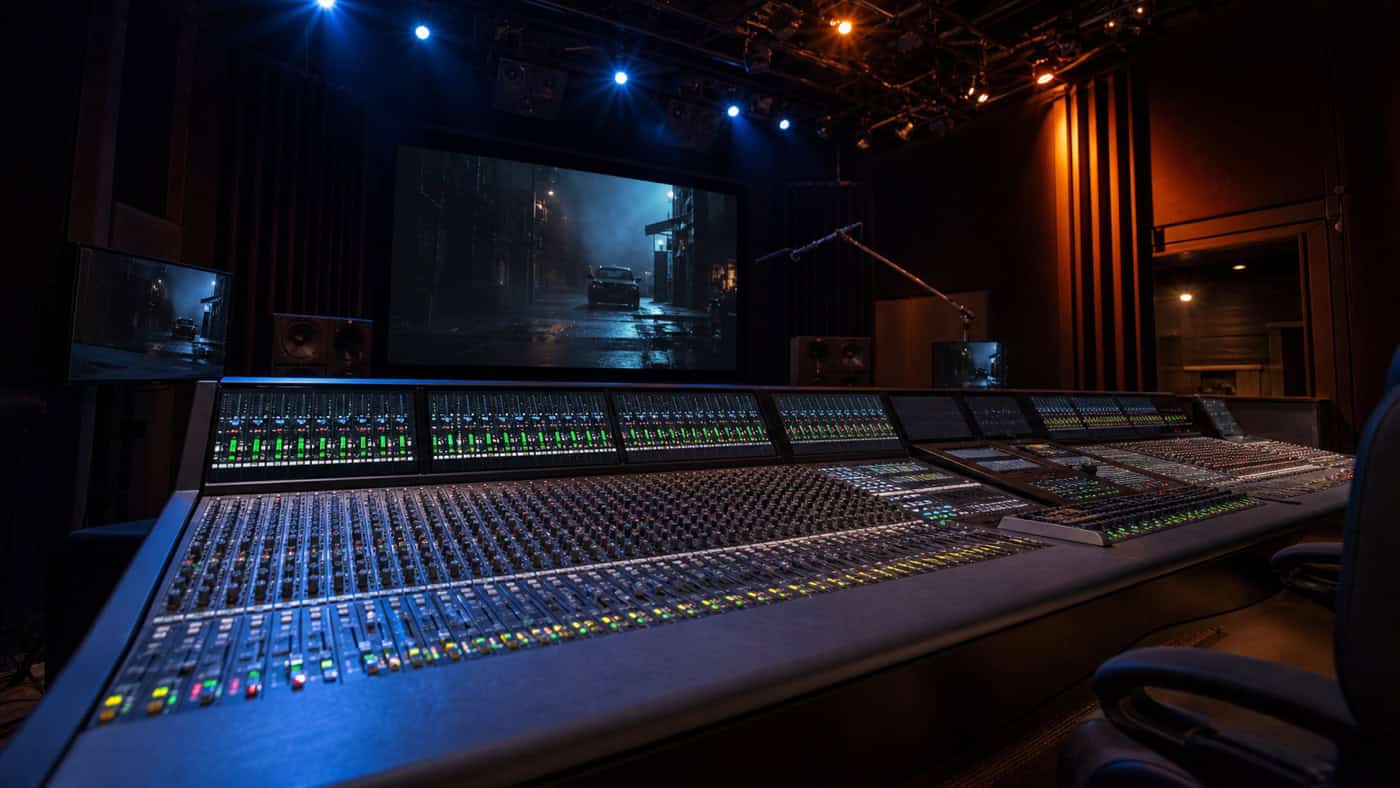
How is the PGM sound played?
The PGM sound is usually exported as a stereo or dual mono file. When exporting to dual mono, pay attention to the labeling between the left and right channels. In Germany and Europe, the PGM sound is also subject to the PGM sound for most broadcasters EBU-128 guideline. This means that there is a loudness of -23 over the entire playing time LUFS and a maximum headroom from -1dBTruePeak is assumed.PGM and M&E: Why two mixtures are needed
In addition to the PGM, the complete broadcast mix, most broadcasters require a second version: the ME (Music & Effects). This is exactly the same mix as the PGM, only without the original language. It therefore contains music, atmosphere, Foley, and sound effects in full quality, but no dialogue. The reason for this is international distribution: If your documentary or film is dubbed into another language, the dubbing studio overlays the foreign voices onto the M&E mix. Without clean M&E, dubbing wouldn't be possible without completely re-recording the audio.
- Fully-filled M&E: Even with the original dialogue removed, ambient sound and Foley are continuously present, so no audio gaps occur.
- Optional D&M (Dialogue & Music) or pure dialogue track: Set up separately in case the sender wants to adjust individual elements.
- Consistency with PGM: Effect and music levels must be identical in the PGM and M&E so that the dubbed version sounds like the original.
Channel layouts: from stereo to 5.1
The PGM (Program Profile) is not always delivered in stereo. Depending on the production and broadcaster, larger layouts are common, especially for cinema and high-quality TV productions. Always clarify the target format before mixing, because surround mixes are structured differently than stereo.
- Stereo (2.0): Standard for web, podcast video and many linear broadcasts.
- 5.1 Surround: L, R, C, LFE, Ls, Rs. The dialogue is typically located in the center channel, which improves speech intelligibility on various playback systems.
- Stereo downmix: A compatible stereo downmix is derived from a 5.1 mix and checked separately because level ratios can shift during folding.
Those who work with the correct number of channels from the start and at mixing By designing the bus structure cleanly, you avoid later modifications.
Language comprehensibility as the primary goal
The most frequent criticism of film and TV sound is poorly intelligible dialogue. In PGM, therefore, speech takes precedence over music and effects. Proven tools for this include moderate... Ducking or side-chain compression, which reduces music and ambient sound as soon as someone speaks. Static EQ corrections in the presence range (approximately 2 to 5 kHz) emphasize consonants without increasing the volume of the speech.
- Dialogue premix first: First, edit the voices cleanly, remove noise and bring them to a constant level, then build music and effects around them.
- Check the relationship: Dialogue should be clear even on small speakers and in mono mode, especially above the bed.
- Focus on dynamics: Too much compression makes the dialogue lifeless, too little causes it to get lost in loud scenes.
Acceptance and typical export errors
Before the PGM is sent out, a brief technical inspection is worthwhile. Many returned transmitters have the same causes, which can be avoided with a checklist.
- Final loudness measurement: Check Integrated Loudness over the entire playing time (according to EBU R128, the objective of the respective institution) and True Peak against the specified maximum, not just the Sample Peak.
- Mono compatibility: Listen to the stereo mix in mono to uncover phase cancellations that weaken the dialogue during mono playback.
- Channel assignment: For Dual Mono, correctly label Left and Right; for 5.1, follow the channel order of the transmitter.
- Silence at the beginning and end: Adhere to defined lead and trail, no truncated word endings or clicks at the interfaces.
- Sample rate and bit depth: Export to the required specification; 48 kHz is common for film and broadcast.
If a consistently high, even sound quality is ultimately required, a separate [device/system] can be used. masteringThis step may be useful for the final version, but should not override the broadcaster-compliant loudness of the PGM.
What is the difference between PGM and M&E?
The PGM (Program Sound) is the finished broadcast mix, including dialogue, music, and effects – exactly what the viewer hears. The M&E (Music & Effects) track contains everything except the dialogue and serves as the basis for dubbing a program into other languages. In international productions, the M&E track is usually a contractually required delivery element.
What loudness standard applies to PGM audio in Europe?
The relevant standard is EBU R128: -23 LUFS integrated loudness (for non-live material with a tolerance of ±0,5 LU) and a true peak of no more than -1 dBTP. Measurements are taken with an R128-compliant loudness meter. This standard ensures that all broadcasts are perceived as having the same volume – without disruptive volume jumps between programs and commercials.
What channel layout does a PGM audio track require?
Depending on the broadcaster, stereo or 5.1 surround sound is required. If exporting in dual mono, the left and right channel assignments must be clearly labeled. For 5.1 surround sound, the correct channel order (L, R, C, LFE, Ls, Rs) must also be followed so that the broadcaster can assign the tracks correctly.
What are the most common errors when exporting PGM files?
Typical issues include reversed channels, incorrect loudness settings (deviation from the -23 LUFS target), and insufficient speech intelligibility compared to music and effects. Such errors can be avoided by checking loudness and true peak with a meter before delivery and by listening to the mix for clear dialogue intelligibility.
Sound mixing by a professional for your documentary or film?