LLM2Fx explained – AI controls EQ & Reverb via voice
A team from Sony AI and KAIST has demonstrated with LLM2Fx that large language models such as GPT-4 EQ- and reverbThe ability to predict parameters solely from text descriptions – without any special training – could revolutionize audio post-production.
What is LLM2Fx?
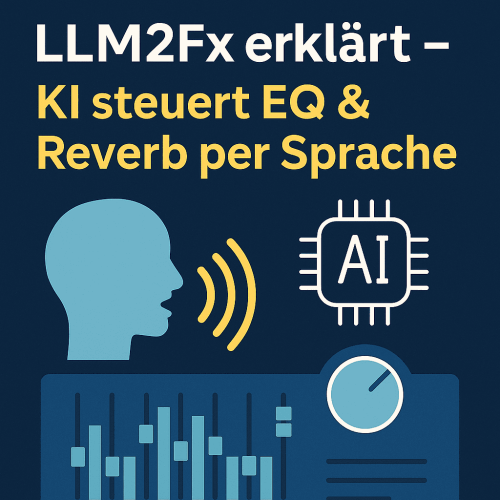
LLM2Fx is a research framework that uses large language models such as GPT-4 or LLaMA to determine audio effect parameters such as Equalizer– or to generate reverb settings directly from text presets. Unlike traditional tools, LLM2Fx requires no specific trainingbut uses the zero-shot capabilities of modern language models.
Example: The text command “Make the guitar sound warmer” is enough – the model automatically suggests suitable EQ parameters.
How Text2Fx works
LLM2Fx combines semantic language understanding with digital signal processing (DSP) expertise. The process is divided into four stages:
System Prompt: The model is framed as a “virtual audio engineer”.
Text command: e.g. “Soft reverb for acoustic guitar”.
In-context examples: Previous text-to-parameter mappings are for reference.
output: Structured JSON parameters plus explanation of how the settings produce the desired sound.
This combination creates a flexible, natural language interface with voice control for sound design.
Performance comparison of models
The researchers tested GPT-4o, LLaMA3 (1B–70B), Mistral-7B, and older optimization methods. Sound quality was assessed using the MMD score. The best results were achieved by:
GPT-4o: EQ: 0.22 | Reverb: 0.70
LLaMA3-70B: EQ: 0.24 | Reverb: 0.52
Mistral-7B: EQ: 0.30 | Reverb: 0.45
Additional context information such as DSP functions, audio features and example queries further improved prediction accuracy.
Possible uses in practice
LLM2Fx is not just a research concept – it shows clear application areas for future tools:
Text-controlled DAW plugins: e.g. “Make the vocals more open”
AI mastering assistants: convert feedback like “more punch” into EQ curves
Voice-Driven Workflows: voice-based control for mixing tasks
This is a game changer for anyone who wants to work more intuitively or needs accessible interfaces.
By the way: For Peak-Studios, You can book mixing & mastering online today – including personal feedback and individual sound advice.
Conclusion: LLM2Fx in everyday mixing
LLM2Fx proves that modern language models are capable of transforming creative audio descriptions into precise parameters. This makes mixing and sound design not only more accessible, but also faster and more intuitive.
The step from classic controllers to voice-based control is not only technically exciting – but also a UX innovation for modern producers.
Try voice-based mixing – with Peak-Studios
Want to know how to make your mix sound better with semantic feedback?
For PEAK-STUDIOS We offer you personal online mixing – transparent, individual and, if desired, including technical advice on AI-supported tools and effective EQ settings.
👉 Book online mixing at Peak-Studios
→ Or send us your mix in advance for evaluation.
FAQ
What is LLM2Fx?
LLM2Fx is a framework that automatically generates EQ and reverb parameters based on text specifications.
Does LLM2Fx work without training?
Yes – the models work in zero-shot mode without additional training data.
What effects does it work for?
The study focuses on equalizers and reverb – two central tools in audio editing.
How accurate are the results?
According to the study, the predictions correspond significantly better with desired sound profiles than classic optimization methods.
Is it already being used in practice?
Not yet commercial, but there is a public LLM2Fx demo.