How to Win Clients as an Audio Engineer: The 5-Gear System
Table of Contents
The 5-Gear Model for a Profitable Recording Studio
3.1 Positioning: From Generalist to Specialist
3.2 Target Audience & Budgets: Choosing the Right Partners
3.3 Visibility: SEO vs. Social Media
3.4 Trust & Social Proof: More Than Just Good Sound
3.5 Service & Client Loyalty: The Growth FrameworkFAQ: Frequently Asked Questions about the Recording Studio Business
1. Introduction: The Dead End of the Talented Technician
You spend countless hours training your ears, buy the most expensive plugins, fine-tune your room acoustics down to the last decibel, and build a setup that would make any tech enthusiast jealous. But at the end of the month, the phone stays quiet. Your direct message inboxes are empty, and the few inquiries that do come in haggle over every euro as if they were at a flea market. It is the classic painful point in the audio industry: the technical excellence is there, but the business reality is sobering.
I'm not speaking in theory here, but from more than 20 years of hard-won practical experience. At Peak-Studios, we've gone through this journey ourselves: from the first uncertain steps to scaling toward a fourth location. Along the way, I learned a truth many technicians prefer to ignore: Good work alone is not a business model. It is only the entry ticket that lets you play the game at all. Many talented engineers treat their studio as an extended hobby and fool themselves when they wonder why they are not moving forward financially.
Anyone serious about starting a recording studio and making a living from it needs a radical mindset shift. We have to stop thinking only like technicians tweaking virtual knobs and start acting like entrepreneurs who build reliable systems. Success in the music business is not a lucky accident, nor is it a matter of "providence." It is built on a logical chain of decisions and processes. If you are ready to let go of the romantic idea of the "discovered genius," I will show you a system that brings in clients more predictably.
This article is part of the series Self-Employed as an Audio Engineer, where I break down the business side of the audio industry in a structured way.
2. The 5 Biggest Misconceptions When Building a Studio
Before we pour the foundation for your business, we need to clear away the rubble. In my mentoring sessions, I see the same five misconceptions again and again. They suffocate success before it has a chance to develop.
Mistake 1: Focusing on reach instead of clarity
The assumption that thousands of views on TikTok or Instagram automatically turn into a full order book is a dangerous misconception. In business terms, reach is only an amplifier. If your offer is vague or unclear, reach simply amplifies that confusion. It does not help if a million people watch your video but no one understands the specific problem you solve for them. Without clarity, reach is just wasted energy.
Mistake 2: The quality illusion
This is the classic artist's illusion: "If I'm good enough, the labels will come knocking on my door." Bullshit. The market does not automatically reward the greatest talent working quietly in a back room. It rewards people who are visible, demonstrate professional processes, and communicate clearly. Quality ensures your survival, but marketing and strategy create growth.
Mistake 3: Platform hopping without a foundation
Whether it's TikTok, YouTube, Google, or LinkedIn, platforms are channels, not strategies. If you jump from one trend to the next without a clear message, you are only changing the stage while the real problem remains unresolved. If you do not understand your craft as a business, no algorithm in the world will save you. Without a channel-independent strategy, you are building your house on sand.
Mistake 4: The low-price trap
"I'll start cheaply just to get my foot in the door." This approach is a boomerang that comes back hard. It attracts extremely price-sensitive clients, creates almost no loyalty, and often produces the highest support workload. You train your market to see you as the discount option. Psychologically and economically, it becomes almost impossible to raise those prices later without losing your entire client base. Those who start cheap usually stay cheap, until they are exhausted.
Mistake 5: Treating marketing as an isolated task
Many people think marketing is something you do "on the side" whenever there is time. In reality, client acquisition is an integrated system. It has to work even when you are not going viral. A true business system is interconnected, with each step building on the next. Anyone who sees marketing as a chore will never create the pull they need.
3. The 5-Gear Model for a Profitable Recording Studio
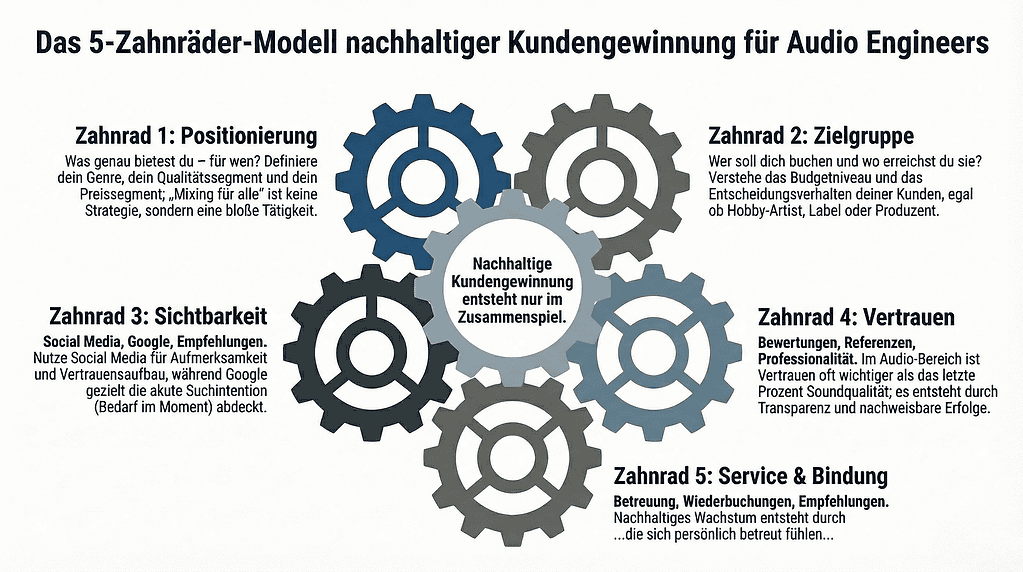
To run a recording studio successfully, I see the business as a system of five mechanical gears. The decisive lesson is that these gears depend on each other. If one gear jams, for example because you are visible (gear 3) but do not create trust (gear 4), the engine may turn, but no power reaches the road. Your marketing budget is wasted.
To make the model easier to scan, here are the five gears in one sentence:
Positioning: What exactly do you offer, and for whom?
Target audience: Who should book you, and how do they think about budget?
Visibility: Where can people find you, through social media, Google, or recommendations?
Trust: Why should someone trust you with their money and their vision?
Service & loyalty: Why do clients return and recommend you to others?
3.1 Positioning: From Generalist to Specialist
The first step toward a stable income is sharp studio positioning. The statement "I offer mixing and mastering for all genres" is not positioning. It is just an inventory list. In a global, saturated market, the specialist wins, not the jack-of-all-trades.
Imagine you are in a metal band investing your entire savings into an album. Do you go to the person who mixes pop in the morning, edits an audiobook at noon, and maybe works on your metal album in the evening? Or do you go to the engineer whose portfolio is full of powerful double-kick drums and aggressive guitars? Specialisation immediately increases your pricing power. An expert in "vocal editing for time-pressed pop producers" can command higher hourly rates than a generalist because they solve a specific pain point faster and better.
Anyone who positions themselves clearly in professional mixing benefits over the long term from stronger pricing power and a much clearer market message.
3.2 Target Audience & Budgets: Choosing the Right Partners
Many engineers complain that their clients have limited budgets, but in reality they have a target-audience problem. A hobby artist who records one song every two years out of pure passion makes buying decisions emotionally and often has a limited budget. A professional label or full-time producer, on the other hand, calculates in business terms. For them, your service is an investment, not just an expense.
If you want to be successfully self-employed in the music business, you need to analyse where your target audience spends time and where their budget threshold really is. If you notice that your clients always stop at EUR 100, that is not because of your skills. It means you are fishing in the wrong pond. A visibility problem is often actually a target-audience and pricing problem. The positioning from gear 1 determines which audience you can address in gear 2.
3.3 Visibility: SEO vs. Social Media
When it comes to visibility, we have to distinguish clearly between two worlds.
- Social media is based on interruption. People scroll for entertainment, and you have to earn their attention. This can be excellent for building long-term brand awareness.
- Google is based on search intent. If someone types in terms like "mastering online", "mixing service", or "recording studio", they have an immediate need and a buying intention at that exact moment.
If you do not appear on page 1 in search engine optimization (SEO), you do not exist for that potential client. If you want to start a recording studio sustainably, covering this search intent is the most efficient way to reach paying clients exactly when they are ready to spend money. SEO captures the leads; social media warms them up.
If someone is specifically looking for online mastering, visibility in Google search often directly determines whether you even make the shortlist.
3.4 Trust & Social Proof: More Than Just Good Sound
In the audio world, trust is the most important currency, often more important than the final fraction of sound optimization. A musician places their heart, their vision, and their money in your hands. They are afraid of being disappointed.
This is where social proof comes into play. At Peak-Studios, we have built up 357 five-star Google reviews over the years. That is not a coincidence. It is a hard-earned asset. Signals like this tell potential clients: "You are safe here. Other people have had a positive experience before you." Professional references, transparent processes, and genuine client testimonials carry more weight than any technical jargon about sample rates or expensive analog equipment. Trust is the oil that reduces friction in the sales process.
In professional recording, too, the combination of visibility and trust often determines whether someone books.
3.5 Service & Client Loyalty: The Growth Framework
The most underestimated gear is service. Real, exponential growth does not come from constantly chasing the next new client. It comes from existing clients and the recommendations they create. Here, we rely on the American service model:
Speed: Do not wait three days before you reply. In the digital world, speed is a form of appreciation.
Clarity: Explain exactly what is possible and what is not. Ask questions instead of guessing what the client might mean.
Transparency: Set clear expectations and keep your deadlines.
Accessibility: Be present as a partner, not just as an anonymous service provider.
A client who feels personally cared for, rather than simply processed on a technical level, will come back. Good service leads to satisfaction, satisfaction leads to strong reviews, and those reviews feed the "trust" gear. This creates a pull effect that makes classic cold outreach unnecessary.
4. Practical Transfer: From Technician to Entrepreneur
The biggest hurdle for talented engineers is the shift in perspective: you have to start working on the business, instead of only working in the studio and turning knobs. Anyone who accepts every job for EUR 50 just to "stay in the game" inevitably ends up in a dead end.
Let's take the example of a mix engineer who charges EUR 50 per track. They need 200 jobs a year just to generate EUR 10,000 in revenue, and that is revenue, not profit. After rent, software, electricity, and taxes, there is barely enough left to live on, let alone time to develop the business strategically. That engineer is trapped in a hamster wheel.
I break down how quickly that revenue shrinks in real life, including operating costs, taxes, and actual net working hours, in my article on hourly rates and pricing logic: https://www.peak-studios.de/preisgestaltung-tonstudio-rechner/
A professional recording studio business plan is not a theoretical document for the bank. It is a conscious decision about which gears you repair first so you can break out of this trap.
Analyse your situation today: Which two gears are jamming the hardest for you?
- Are you invisible? Then SEO is your priority.
- Do clients only come once and never return? Then your service is the problem.
- Do you get many inquiries but few bookings? Then you lack trust or clarity.
Be honest with yourself. Market logic beats hope-based marketing.
How quickly such revenue shrinks in reality (operating costs, taxes, actual net hours) is broken down in detail in my article on recording studio pricing.
5. Conclusion: Your System Determines Your Success
At the end of the day, success in the audio business is not a mystery and does not require secret formulas. It comes down to applying market logic consistently and with discipline. A profitable studio is not a sprint. It is a marathon built on solid, repeatable processes.
If you understand that the combination of sharp positioning, the right target audience, targeted visibility for active searchers, strong social proof, and excellent service makes the difference, you will keep winning clients as an audio engineer over the long term. Stop hoping someone will discover you. Start building the system that makes you impossible to miss.
FAQ: Frequently Asked Questions about the Recording Studio Business
Why am I not getting clients even though my quality is objectively strong?
Because quality is not a unique selling point; it is the baseline. If nobody sees your work (visibility), or if nobody understands why they should book you specifically (positioning), your excellence has no commercial effect. The market rewards the engineer who builds trust and communicates a clear solution.
Is social media or Google more effective?
Both serve different purposes. Google serves search intent: people who are looking for an immediate solution to a specific problem, such as "online mastering". That creates direct revenue. Social media builds long-term trust and brand awareness. If you want to build a client base quickly, SEO is often the more efficient lever.
How important is pricing when starting out?
Price is a signal of your quality. If you sell yourself purely on price, you can also be replaced on price. It is better to justify a fair, professional rate through clear positioning and excellent service than to lock yourself into the low-price segment. Cheap rates attract clients who take up the time you need to build a real system.
How long does it realistically take for an audio engineer to attract clients regularly?
This depends heavily on your positioning, target audience, and visibility. If you think strategically from the start, build clear processes, and target active search intent, you can generate your first stable inquiries within a few months. A sustainable, predictable system, however, usually develops over years, not weeks. Patience is a competitive advantage.
Do I really need my own website to win clients?
In the short term, you can win your first projects through platforms or social media. In the long term, however, your own website is a central asset. It brings references, reviews, processes, and clear offers together in one place. For search engine optimization in particular, it is essential for becoming visible when people are actively searching and for building trust.