
DC offset in music production
If an audio track is not exactly on the zero line, but is permanently shifted slightly up or down, this is called a DC offset. This DC voltage offset is caused by tolerances in analog circuits and affects the headroom-Management during mastering and should be removed before mixing down using a DC filter.
What is the DC offset?
The DC offset is a direct current voltage offset or a direct current voltage displacement.
DC offset is a characteristic value used in operational amplifiers. It describes the differential input voltage that can be measured at an output voltage of zero. Although the output voltage is zero in this case, there is a minimum DC voltage at the inputs. This low voltage occurs due to tolerances caused by the base current or input currents.
How does DC Offset make its presence felt in music production?
In music production, this can be seen by the waveform not being exactly in the middle of the zero line. In the following figure you can see a slight DC voltage offset.
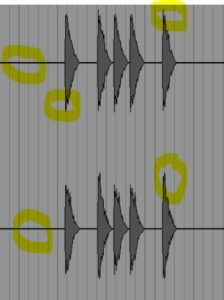
Three things are problematic here:
- The amplitude is not balanced on the zero line, but is predominantly on one side more. This results in us having less headroom and for example a Audio compressor or other signal processors cannot behave correctly because there is an unbalanced signal.
- The zero line indicates a signal that causes the membrane of our listening device (be it a monitor or headphones) to vibrate. This means that the membrane moves even though no sound arrives.
- It can cause “crackles” to occur when cutting the audio tracks.
How do I remove DC offset?
To do this we use 2 techniques.
- Low Cut at 20 Hz on each track This removes the slightly "thicker" waveform of our zero line (as shown in the image above). The voltage level disappears.
- We cut our samples at the points where we detect the DC offset and use the “Remove DC Offset” function in our DAW. Most DAWs have a dedicated function for this.
Frequently Asked Questions about DC Offset
What does DC offset mean?
A DC offset occurs when an audio track does not oscillate symmetrically around the zero line, but is permanently shifted slightly upwards or downwards. This is usually caused by faulty hardware, converters, or certain plugins that add a constant DC voltage to the signal. A DC offset itself is not audible, but it can lead to technical problems.
Why would you want to remove DC offset?
A DC offset shifts the waveform from the center and thus "consumes" valuable headroom The peaks reach the recording limit more quickly, and clipping can occur sooner. Furthermore, audible clicks can occur during editing, and downstream processors may operate less accurately. For a clean result, the offset should therefore be removed.
How can I remove DC offset?
The easiest way to remove a DC offset is with a high-pass or low-cut filter in the sub-bass range (often around 20 Hz), which filters out the inaudible DC component – proceed with caution when working with very bass-heavy material. Many DAWs and mastering tools also offer a dedicated "remove DC offset" function. In professional mastering, the offset is usually checked and corrected if necessary.
What is a good DC offset value?
Ideally, the DC offset should be zero – the waveform should be exactly centered around the zero line. Even small shifts of just a few percent are considered undesirable and are corrected before further processing. A "good" DC offset is therefore simply the absence of any offset.
ONLINE MASTERING FOR YOUR TRACK
Have your music, sound or track mastered at one of Europe's leading mastering studios.