
Album vs. Single Mastering: Which Costs More?
Why album mastering is (usually) more expensive than single-track mastering
The mastering is the finishing touch that gives your songs that final shine – but with an entire album, the complexity multiplies. In this article, we take a detailed look at why this Album mastering is usually more expensive than mastering individual tracks and how consistency in the source material significantly influences workflow and costs.
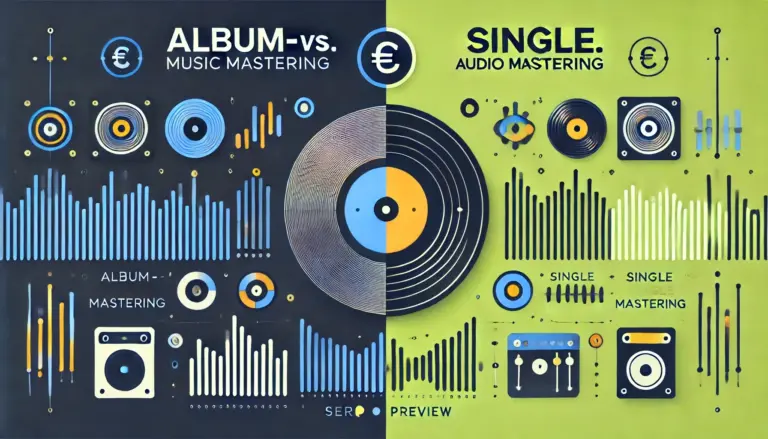
Introduction: An overall picture with many nuances 🎨
Mastering individual songs is a challenging task in itself. But if you want to put together an entire album, not only the technical parameters but also interdependent artistic and psychoacoustic factors be taken into account.
➡️ Question: Why do costs increase exponentially when multiple tracks are involved?
➡️ Answer: Because every detail – from the dynamic balance to frequency coherence – must be coordinated across the album.
Album mastering explained in the video: Common thread, loudness & formats 🎬
In the complete video guide, Chris shows what really matters when mastering albums and EPs – from the tracklist to the correct LUFS range to the target formats streaming, CD and vinyl.
You are currently viewing placeholder content from YouTube. To access the actual content, click the button below. Please note that data will be passed on to third parties.
More informationWhat happens during mastering? – Technology & art in interaction 🎛️✨
Technical details at a glance
Mastering goes far beyond simply adjusting the loudness. The key technical processes include:
- Multi-band compression & EQ matching: Fine-tune the frequency ranges to achieve consistent sound across all tracks.
- stereo image correction: Optimizing spatial representation so that the listener receives a consistent listening experience.
- loudness normalization: Adaptation to different platform standards (e.g. for Spotify, Itunes and co.) ✅
Artistic Aspects & Psychoacoustics
In addition to technology, artistic sensibility a crucial role:
- genre-specific fine-tuning: Different styles of music require different sound characteristics.
- Psychoacoustic fine-tuning: Subtle adjustments that improve the emotional listening experience – for example through targeted Dynamic control.
We'll ensure your album has a consistent sound. Get discounts now!
Album vs. Single: What is the added value – and the effort? 🔍📈
complexity of intertrack coherence
An album is no longer just about the individual track, but about the Total artwork:
Album mastering has different requirements than individual songs — the workflow steps that differ are outlined in the Mastering Guide .
- Interdependent processing: An adjustment to one song can have an immediate impact on neighboring tracks.
- Holistic Dynamic Optimization: The transitions between songs must be smooth and seamless to ensure a consistent listening experience.
➡️ And finally ... A change to a track often requires multiple iterations and fine-tuning in several places. 😊
3.2 Effects of mix consistency
The quality of the source material has a direct influence on the mastering effort:
- High consistency (≤1 dB variance): Allows for a faster and more efficient workflow.
- Medium to low consistency (≥1 dB variance): Leads to additional effort, because Stem mastering oder sogar new mixes may be necessary.
Clear presentation:
| mix consistency | Average mastering time | cost factor |
|---|---|---|
| High (≤1 dB variance) | ~35 minutes per track | 1 × |
| Medium (1–3 dB variance) | ~55 minutes per track | 1.6 × |
| Low (>3 dB variance) | ~85 minutes per track | 2.4 × |
✅ Key: A uniform mix preparation not only saves time, but also reduces total cost significant.
The workflow: time constraints & format variety ⏱️📀
More intensive feedback loops and monitoring
In album mastering, several passes are necessary:
- Macrocyclical monitoring: Listen to the entire album several times in order to evaluate the transitions.
- Microcyclical adjustments: Fine-tuning of fades, crossfades and transitions between tracks.
➡️ Result: More than 4 to 8 complete passes, which must take into account the listening focus and fatigue of the engineer.
More on the topic of album mastering: Read Album Mastering Basics now!
Cross-format output creation
An album is often different formats released:
- Streaming platforms: Standardized LUFS values that require precise adjustment.
- vinyl and physical media: Specific technical adjustments, such as side splitting and additional filters. ➡️More about vinyl mastering
- high-res downloads: 96 kHz/24 bit versions, which take additional time.
✅ Each additional output format requires separate fine-tuning and leads to more effort.
Do you want to know if your tracks have a good consistency and are ready for mastering?
Strategies to reduce costs in album mastering 🛠️✅
Even with a large project, there are ways to optimize costs:
Consistent mixing right from the start:
👉 Make sure that volume levels, frequency balances and stereo settings remain consistent.
👉 Already one 20% higher mix consistency can reduce mastering costs by 35-40% reduce.Early voting & test mastering:
👉 Have a test master created in advance to minimize feedback rounds and optimize the workflow.Targeted format selection:
👉 Check which formats you really need. Fewer variants mean fewer work steps and therefore lower costs.
✅ Tip: Clear communication with your mastering engineer can often result in unexpected savings while improving the end result.
Would you like to have your album mastered at a fixed price?
Conclusion: Quality pays off – invest in consistency! 🎯
Album mastering focuses not only on technical perfection, but also on artistic coherence, A High quality in the source material is the key to justifying the additional effort – and thus the higher costs.
💡 Core message:
An album is a creative Gesamtkunstwerk, where every detail counts. Invest early in consistent mixing and clear coordination processes to not only achieve a harmonious listening experience, but also save time and money.



Cost comparison: The bill speaks for itself 💶📊
Here is an example cost comparison between single-track and album mastering:
900–1640 €
➡️ Note: The higher sum for albums results from the significantly increased workload and the more intensive quality demands.
💡 The binding and current mastering prices per song – for stereo, stem, album and vinyl mastering – you can find transparent pricing on our pricing page.